
I’m a huge fan of Muji.
I’m not a Red Bull person at all.
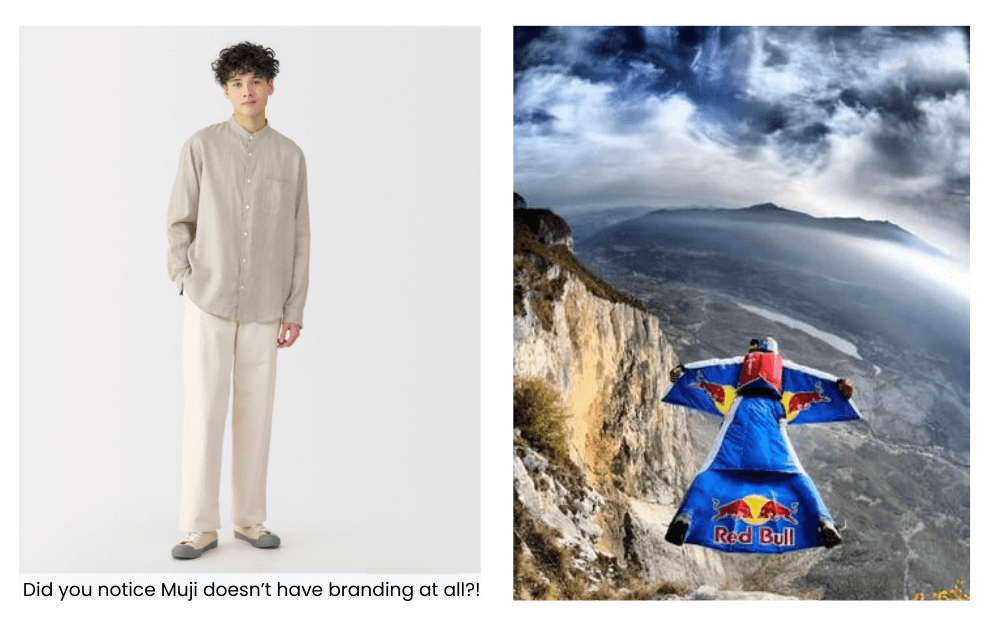
Muji is quiet, minimal, almost invisible.
Red Bull is loud, everywhere, impossible to miss.
They sit at opposite extremes, yet both are wildly successful.
I’ve been obsessing over these two lately because I caught myself wobbling a bit in clarity.
Many founders experience the same thing. When you’re building online — whether you’re a SaaS founder, agency owner, or solopreneur — you have infinite options. Every choice feels right…and wrong, at the same time. That’s when conviction erodes.
Studying them clarified one thing: there is no ‘best’ path — only the need to kill options that dilute you.
The context most founders miss
Muji was founded in 1980 in Japan as Mujirushi Ryōhin — literally “no-brand, quality goods.”
It now operates 1,000+ stores globally, with categories ranging from food and stationery to hotels and houses.
Red Bull was launched in 1987 with a single energy drink.
Today, it sells nearly 14 billion cans a year, runs media companies, owns sports teams, and generates over €12B in annual revenue.
They are opposites in every visible way.
But they both achieved growth and success over 4 decades.
That contrast made me pause — because it challenges one common founder belief: There is one “right” way to build a brand.
There isn’t.
But there is one thing both these companies got right early.
3 insights founders can apply
1. They chose an operating belief before they chose a brand style
Muji didn’t start with minimalism.
It started with a belief: less noise creates better decisions.
Red Bull didn’t start with loud marketing.
It started with a belief: energy creates action.
Once that belief is defined, the high-stakes decisions that usually keep you awake at night become obvious:
- Product: Do you add every requested feature (dilution), or do you perfect the ‘core’ (clarity)?
- People: Do you hire for hustle or structured thinking?
- Growth: Do you chase every outbound lead, or do you build an inbound flywheel that only attracts ideal partners?
- Marketing: Do you shout for attention, or become the quiet authority people seek out?
- The ‘No’: Which opportunities are you willing to walk away from because they don’t fit the belief?
Branding is not about consistency in fonts and color.
It is the result of the decision.
2. They removed internal contradictions early
Most founders try to hold both:
- calm and exciting
- premium and accessible
- simple and powerful
Muji removed excitement.
Red Bull removed calm.
That reduction created strength.
Clarity is about removing the options that pull you in opposite directions.
3. They optimized for one emotional outcome and protected it relentlessly
Muji leaves people feeling unburdened.
Red Bull leaves people feeling activated.
Every decision had to reinforce that feeling — or it was rejected.
This is why their brands feel so different.
And why they never drifted over time.
A question worth pondering
What emotional identity do we want people to feel when they think of our product or service — and what are we willing to sacrifice to protect that feeling?
Muji answered this question.
Red Bull answered it too.
Different answers.
Same clarity.
Here’s the core point
There is a place for loud brands.
There is a place for quiet brands.
What does not work is living in between — where decisions wobble, messaging changes, and founders keep re-explaining themselves.
For a CEO, choosing a side isn’t just about branding; it’s a Growth System.
When you stop trying to be everything to everyone, your customer acquisition cost drops because your signal becomes unmistakable to the right people.
This week’s edition does one thing: give you a lens you can carry into every decision.
If you’re a SaaS founder, agency owner, or solopreneur, take time to verbalize your operating belief. Then align everything to it — product, content, sales, hiring.
That’s where confidence comes from. And growth stops feeling like effort and starts feeling like momentum.
Thank you for reading and thinking with me,
Surabhi
PS: The emotional identity I want my readers to feel is relief. Not the temporary relief of a finished task, but the deep confidence that comes from knowing what to do next and why. That’s the clarity I aim to deliver in CEO Mastery and my 1:1 work.
I would love to know what yours is. Please reply to this email. I read every response.
PPS: As we enter the second month of the year, it’s a good moment to check whether you’re still aligned with the one KPI that should matter most in 2026. I shared my thoughts on that recently — if you haven’t seen it yet, read here.