
Last week, we explored how to choose the right co-founder.
Here’s part 1 if you missed it.
But choosing your co-founder is only half the story.
The real work begins after you start building together.
If something feels even slightly off with your co-founder right now, this edition will show you why… and what to do next.
In the early years, things feel easy.
Urgency hides friction.
You move fast, you’re aligned on big decisions, and small disagreements get brushed aside.
But as the business grows — and as life grows — the partnership gets tested in ways most founders never prepare for. Expectations shift. Priorities change. Communication patterns start to matter. And small unresolved tensions slowly become structural cracks.
It’s rarely the big fight that breaks a partnership.
It’s the slow drift.
The good news is: most of this is preventable.
Strong co-founder relationships don’t rely on chemistry or luck.
They rely on simple, deliberate systems.
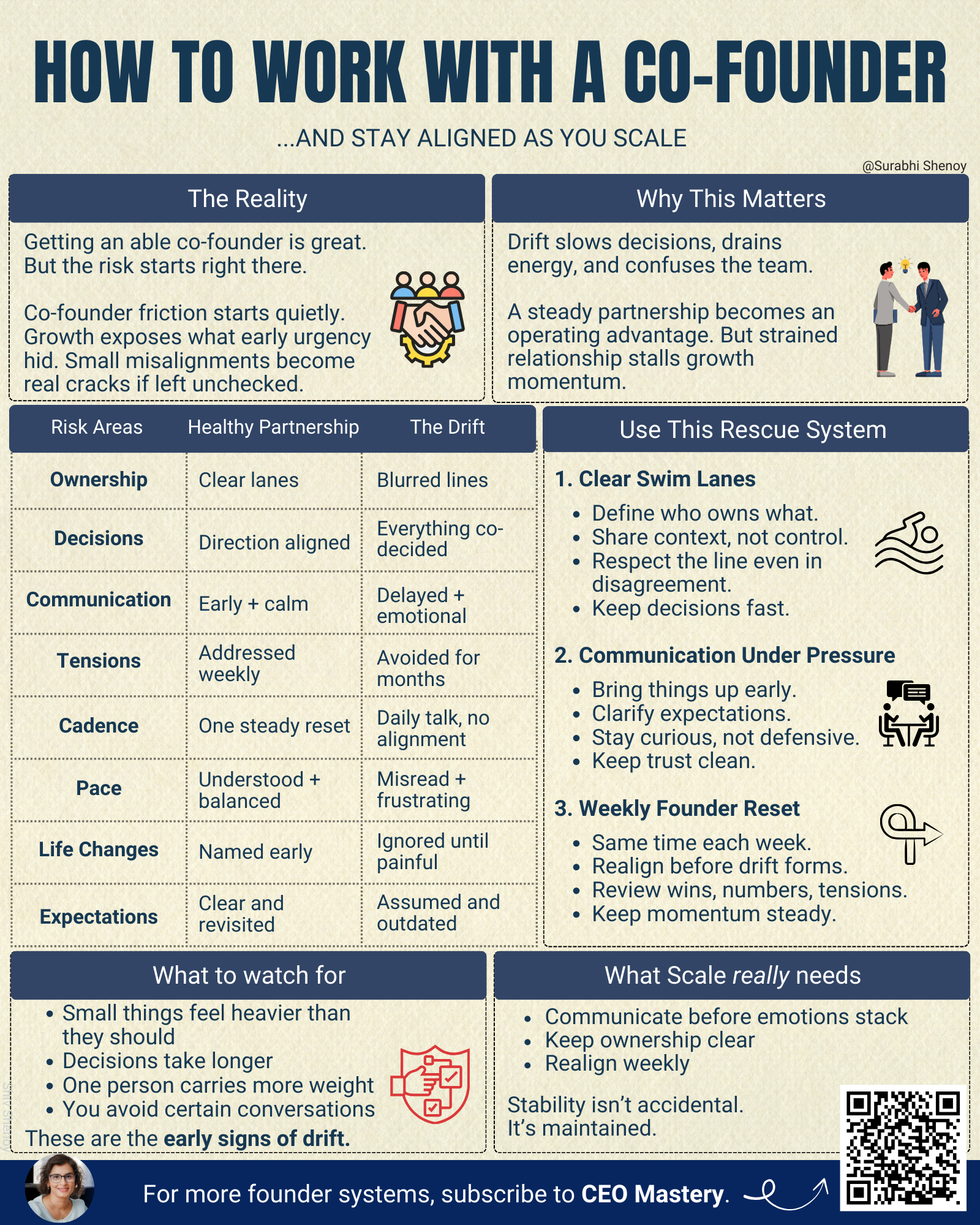
Here are the three systems that make a co-founder partnership work.
1. Clear Decision Ownership (Swim Lanes)
One thing that worked beautifully when my husband and I built companies together was that we had very clear swim lanes.
We exchanged notes, but we didn’t interfere.
We trusted each other’s capability and judgment.
Even when we disagreed, we respected the ownership lines. We didn’t always get it right, but we were ready to win or suffer together as part of the process.
Clarifying ownership early saved us from unnecessary conflicts and kept us focused on growth.
- He took the lead on ideas, relationships, and expansion.
- I took the lead on execution, operations, and delivery.
- We aligned on direction, not on every decision.
Most founder teams confuse collaboration with needing agreement on every decision.
Collaboration is useful.
Co-deciding everything is exhausting.
If you want a stable partnership, define ownership early and respect it.
2. Communication Habits and EQ
I have been coaching a managing partner who kept running into conflict with her co-founder. Every high-stake conversation would end the same way: she went quiet.
At first, she thought she needed more courage.
But as we worked together, I realized she didn’t lack courage at all — she lacked a framework.
– She didn’t know how to express what she wanted without sounding sharp.
– She didn’t know how to set a boundary without feeling guilty.
– She didn’t know how to have difficult conversations without upsetting the partner.
Once we built those tools — how to frame a concern, how to clarify expectations, how to bring something up early — everything changed.
Their meetings became smoother.
Misunderstandings reduced.
Tension dropped.
Most partnerships fail because founders never learn to communicate under pressure.
Communication habits are not “soft skills.”
They are operational infrastructure — as critical as hiring, revenue, or product. It’s worth building this skill deliberately and early. If you want to go deeper, read this.
The strongest co-founders communicate:
- early rather than late,
- clearly rather than emotionally,
- often rather than sporadically (more about this below),
- and with curiosity rather than defensiveness.
This is how trust is maintained — not by avoiding conflict, but by figuring out a healthy way to move through it, again and again.
3. A Weekly Founder Meeting (Cadence & Rituals)
You can talk daily.
You can work side by side.
But if you don’t have one dedicated weekly meeting, the bond between you will eventually break.
Let me share my client’s story.
Two brothers started a business together.
They knew each other’s strengths, weaknesses, and intentions.
For years, everything worked effortlessly.
Then they both got married.
New voices entered in the background.
New expectations formed.
Things that never bothered them before suddenly became sensitive.
Their relationship didn’t strain because of business problems, but because they had no structured rhythm to reset, clarify, and align when life around them changed.
A weekly founder meeting prevents exactly this. In this meeting discuss:
- Wins
- Numbers (revenue, pipeline, team health, burn — whatever actually drives the business)
- Priorities for the week
- Decisions that need agreement
- Concerns or tensions
- Commitments for next week
Thirty minutes. Same time, every week. In person or video. No excuses.
You don’t need more meetings.
You need one deliberate meeting.
This meeting will give you a chance to reset, clear the air, and discuss emotions and issues that are no more than 7 days old. It keeps tiny misalignments from turning into resentment.
Add this to your calendars today. And if you’re already doing it, tighten the agenda and make it non-negotiable.
Be That Partner First
Systems only work when co-founders show up as mature operators.
Clear ownership works when you let go of control.
Healthy communication works when you’re willing to listen.
A weekly meeting works when both people commit and come prepared.
Strong co-founder partnerships are built through discipline, self-awareness, and the willingness to do the uncomfortable work.
If there are cracks forming in your partnership, address them now.
If you’re starting fresh, set these systems up early.
Either way, your future company will thank you.
If you’d like help strengthening your co-founder relationship or setting up these systems, reply to this email — happy to help.
Did you enjoy this edition?
Consider giving me a testimonial here.
My Recent Top Post
A handful of your customers bring most of your revenue — yet most businesses treat every customer the same.
Big mistake.
I wrote a post last week showing how applying 80/20 can transform revenue, ops, and roadmap decisions in under a quarter.
Thank you for being here.
I appreciate all the encouraging emails I receive in response to these letters.
Best,
Surabhi