

How founders balance caring personally with challenging directly.
I still remember sitting across from a team member who had been avoiding my calls.
Her shoulders were tense.
Her eyes stayed on her notebook.
And I knew something was off.
I asked how she was doing. She said she was fine. She was not fine.
I could feel the distance between us. The unspoken things. The careful replies. The way she held herself like she expected bad news.
So I asked a different question.
“What am I doing that makes it hard for you to tell me the truth?”
She looked shocked. Her guard fell. And in the smallest voice, she said, “I don’t feel like I can disappoint you.”
That moment changed how I lead. I realized trust is not built by being nice. And performance is not built by being tough. Both are built by saying the real thing with real care.
This is the tightrope founders walk every day. Care too little and people leave. Care too much and performance drops.
Radical Candor is the balance.
And it is a skill every founder must learn if they want a team that grows instead of breaks.
Why This Book Matters for Founders
Every founder carries the weight of two responsibilities.
Keep the business healthy.
Keep the people healthy.
Most leaders solve this by favoring one side. Either they become overly kind and avoid hard conversations. Or they become overly direct and lose trust.
Radical Candor gives you a practical middle ground:
Care personally.
Challenge directly.
Both at the same time. Not one after the other.
When founders master this balance, communication becomes cleaner, conflict becomes productive, and accountability becomes natural instead of forced.
The Founder-Friendly Radical Candor Framework
At its core, Radical Candor is a grid with two axes: Care personally and Challenge directly.
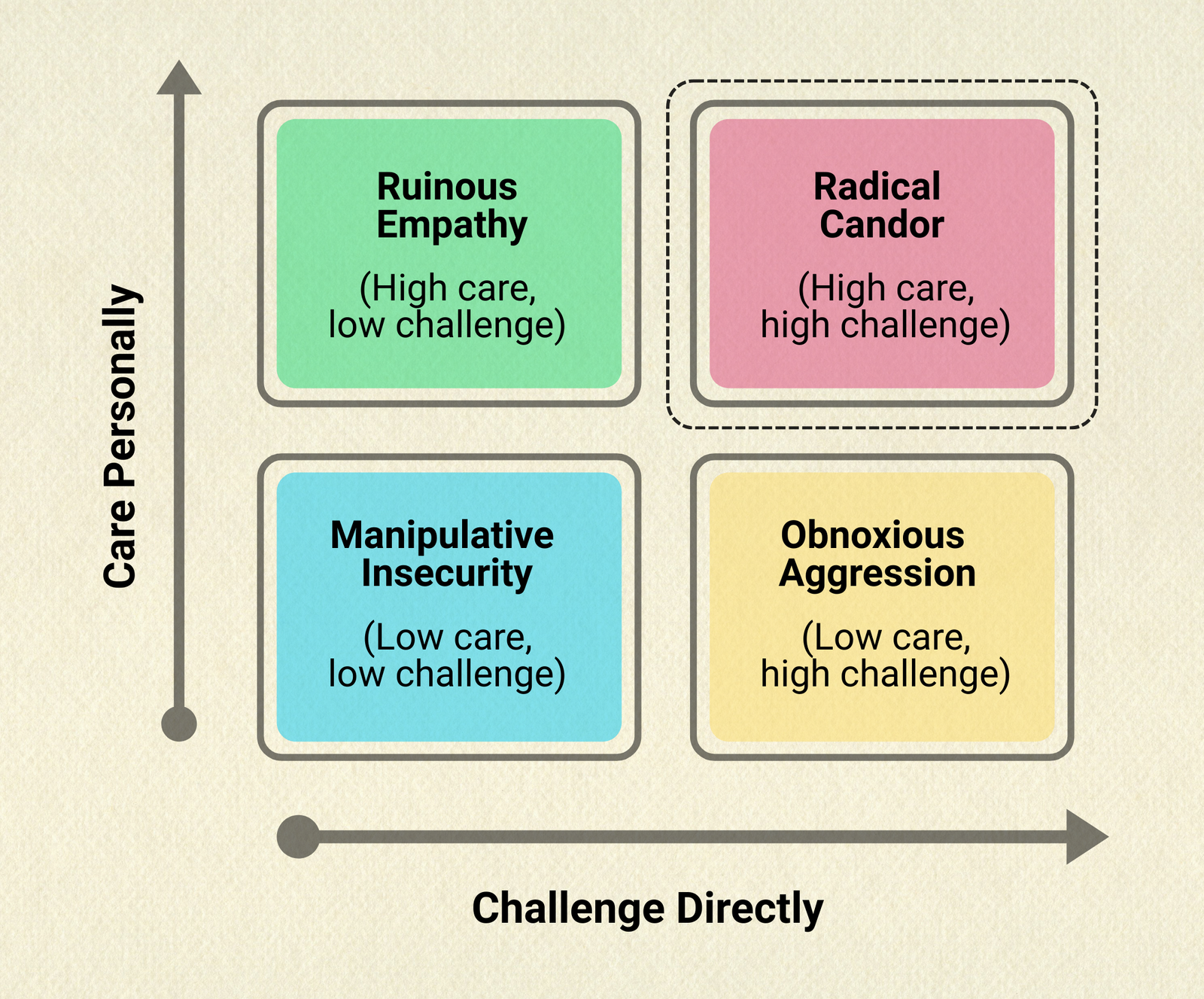
When both are high, you get Radical Candor.
When only one is high, you get one of the other three difficult leadership styles.
1. Ruinous Empathy
This is when you care personally but do not challenge directly. Performance drops. Resentment grows quietly. People feel supported but not strengthened.
2. Obnoxious Aggression
This is when you challenge directly but do not care personally. Short term results. Long term damage. People leave even if the work gets done.
3. Manipulative Insincerity
This is the worst combination. Low care. Low challenge. A place where politics replaces truth.
Founders often swing between Ruinous Empathy and Obnoxious Aggression. Radical Candor is the safe center.
The Founder’s Candor Dilemma
Founders deal with emotional complexity every day.
You see your team struggling. You see the business needing more. You see yourself caught between helping someone grow and protecting morale.
Most founders hesitate because they think hard feedback will break trust. But silence breaks trust faster. Radical Candor teaches you that kindness is telling the truth early. And courage is holding someone capable of better work.
A founder’s job is not to avoid discomfort. It is to guide people through it.
How Founders Can Practically Use Radical Candor
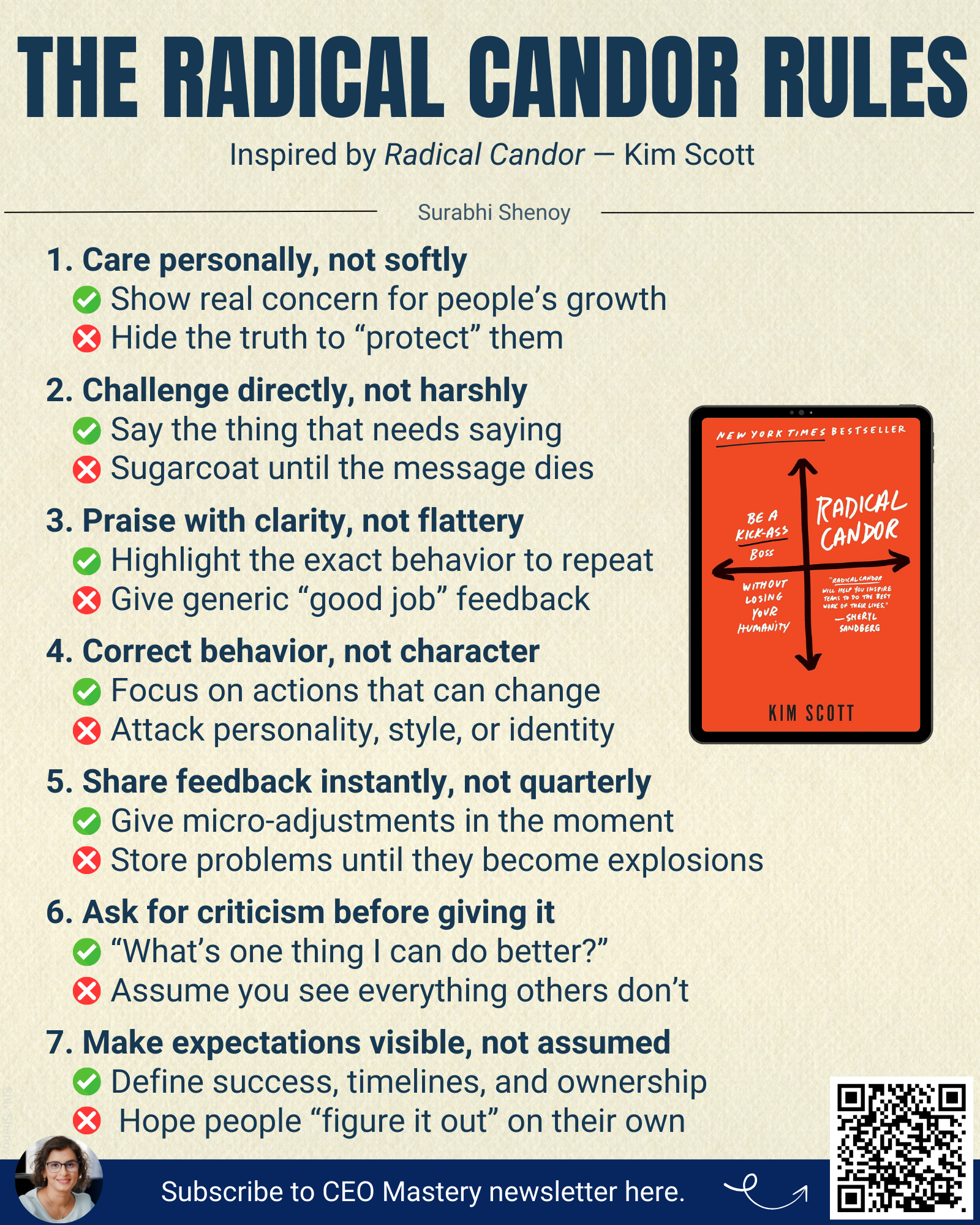
1. Say the thing, early and simply
Founders wait too long.
Feedback loses power when delivered late.
Speak sooner and speak plainly.
2. Care first, then challenge
You cannot challenge well if people do not feel safe.
Show that you see the person, not just the problem.
3. Give feedback that serves the person, not the moment
Make it about their growth, not your annoyance.
Ask yourself: “Will this help them long term?”
4. Do it in private, praise in public
This protects dignity.
It also strengthens trust.
5. Ask for feedback before you give it
A founder who asks, “What should I do better?” reduces fear instantly.
6. Make candor a team ritual
Weekly reflections.
Monthly retros.
Quarterly performance conversations.
Consistency builds culture.
The Founder's Transformation Through Candor
Radical Candor is not about being blunt. It is not about being soft. It is about being human and honest at the same time.
When founders practice Radical Candor:
- Teams communicate faster.
- Decisions become clearer.
- Conflicts resolve sooner.
- Performance rises naturally.
- Retention strengthens without force.
- People stop guessing what you want.
- Everyone moves in the same direction.
Your leadership becomes a force multiplier.
Because people do not grow from comfort.
They grow from clarity wrapped in care.