
You calculate effort and costs before bidding for the project. Resources are allocated. Timelines are set. Margins look healthy.
But once the customer delivery is underway, it feels heavier. You get pulled in — and the more you’re involved, the more you see things drifting beyond the original estimates.
And it’s not just this project. It’s a pattern that repeats across projects.
You’ve tried turning all the usual knobs — more stand-ups, tighter project management, a new tool, parachuting a senior in, pushing harder — yet the gap between estimated and actual persists.
A Founder’s Turning Point
A founder I worked with had it all: Solid pipeline. Strong sales. Smart team.
But nearly every project ran late and over budget.
The margins had reduced from the previous year.
I invited him to audit one of his projects with me.
I asked for specific data, he had none that could help us quantify the cost. No visibility into who worked for how many hours, or at what cost rate.
That clarity hit hard.
“I am shocked that I didn’t think of this before. How have we been running projects without this?” he said.
Then our real work began.
Showing him how to capture and then allocate project costs was a big learning for him. This wasn’t just an operational upgrade, it was a mindset shift.
They started tracking:
- Who worked on what — across roles, seniority, and time spent
- Actual costs incurred — not just assumptions
- Where time was being lost — handovers, rework, underutilized talent
And that changed everything.
- The project manager and delivery head could finally see what needed attention — before things derailed.
- Instead of debating tasks, they could reassign senior engineers to high-value work, tighten handovers where costs spiked, and catch rework early.
- The blame game stopped. Real conversations started.
- Within 60 days, they were tracking delivery costs clearly — and reduced them by ~12% .
No new hires, no layoffs. Just clarity. And a system built on it.
That’s the power of capturing the right data with intent.
It helped them curb emotions flying high, and refocus the team on work that improved delivery efficiency — and, in turn, margins.
More cash meant more room to invest in future growth and expansion.
“Now I can pitch more work to my clients, knowing we can control delivery” he smiled.
What a Customer Delivery Overhaul Looks Like
The lesson I want you to take away from this case study is:
Fixing issues like project delays, defects, or scope creep offers short-term relief. Lasting change comes only when you manage customer delivery through a cost lens.
Those issues are important and will always exist. But when you see their cost impact, you fix where it really matters.
Here’s what that overhaul involves:
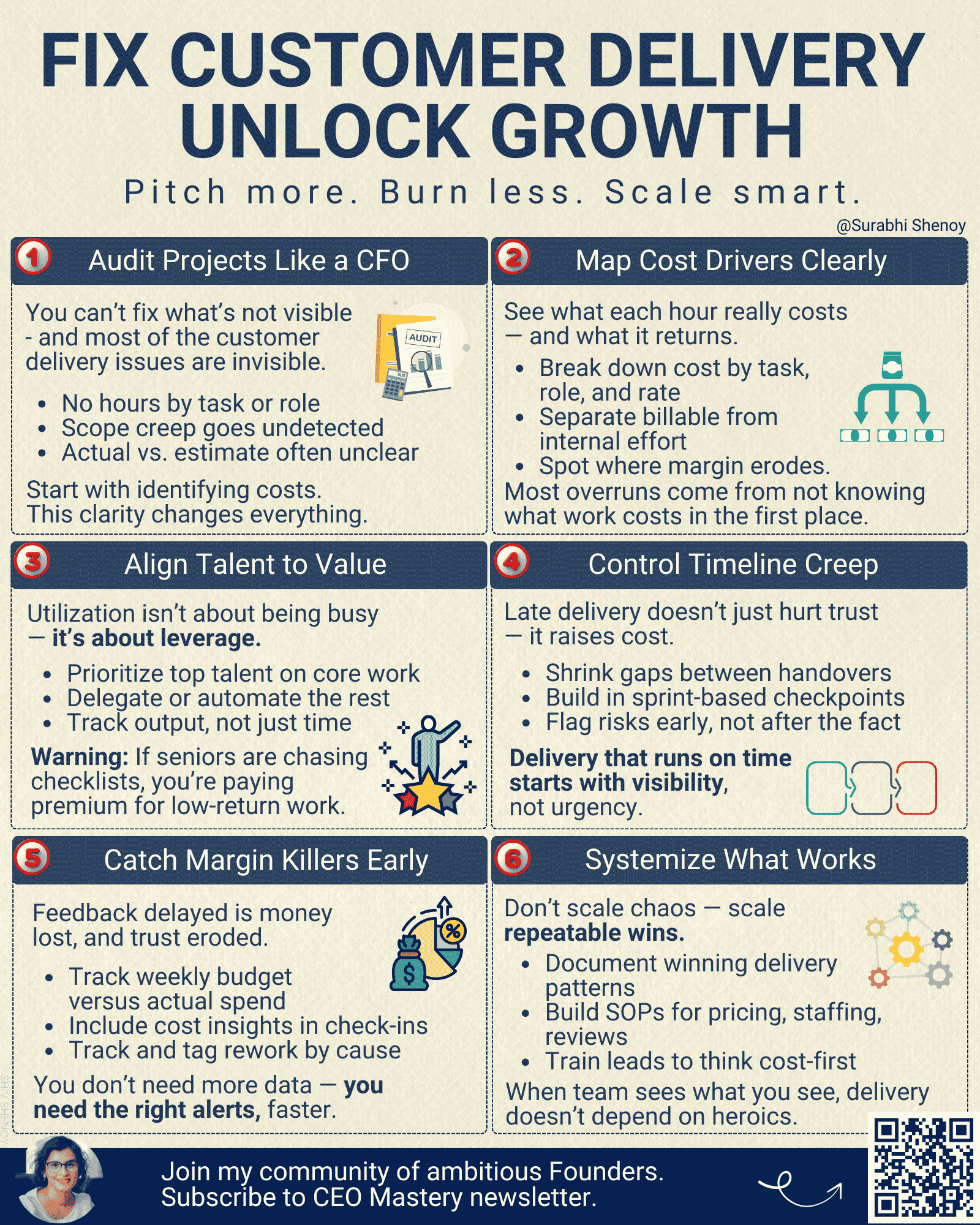
- Audit current and past projects → surface hidden costs, scope creep, and inefficiencies that silently eat margins
- Map cost drivers clearly → track where time and money are going (role, rate, task), not just hours logged
- Improve utilization ROI → align your most expensive people with the highest-value work, or else juniorize
- Control delivery timelines → reduce idle time and handovers that inflate cost without adding client value
- Close cost-feedback loops faster → catch defects, rework, and overruns early — before they sink margins
- Codify profitable delivery systems → standardize what works, so efficiency compounds instead of relying on heroics
This isn’t simple, but this also isn’t about doing more. It’s about building a delivery system that protects margin and helps you scale confidently.
Do You Need a Tool for This?
Founders often ask me: “Do I need a new tool to track all this?”
The truth is, most project management tools already give you the raw data. What’s missing is interpretation and accountability.
At Tejora (my tech company), I built a small PMO — just two trusted people. They had access to project data, salaries, billing rates. Their job was not to manage delivery, but to monitor cost, and report to leadership monthly.
That independent lens made all the difference.
Project managers stayed focused on delivery. The PMO kept us focused on profitability.
So no — you don’t need a new shiny tool.
You need a system (and people) who can see the real cost picture, without being buried in daily project chaos.
Want to Turn Delivery Clarity into Growth Confidence?
Everything I’ve shared with you here took me years to figure out — and even longer to get right.
You can take the same path.
Or we can work together and get there in a matter of months.
Fixing delivery inefficiency is where 70% of my clients unlock margin, gain confidence to pitch for bigger/better projects, and finally find time to work “on” their business.
Book a free Clarity Call with me to discuss how I can help you build your organization ready for expansion.