
I recently did a Decision Audit with a founder who felt stuck.
On paper, his 2-Year startup looked solid.
Everything documented. Systems in place. Margins better than industry benchmarks.
Yet his frustration was boiling over.
“Why are we not growing?”
“Our product is better than what’s out there.”
“The team delivers. So why isn’t the needle moving?”
Then we looked at their sales calls, leads, and demos.
What he considered “enough volume” was well below industry norms.
I showed him the benchmarks.
There was a pause.
Then I asked him to pull up last week’s calendar.
It was packed with internal meetings.
Product reviews.
Process discussions.
Almost no time spent talking to customers or prospects.
That’s when the pattern became obvious.
He was using operations decisions to solve a sales problem.
Every time growth slowed, his instinct was to refine flows, add features, improve quality.
He was building a high-performance engine for a car that rarely left the garage.
The Two DNAs Every Company Has
I’m an engineer turned entrepreneur. I’ve made this exact mistake myself.
The instinct to optimize, prepare, and protect quality is strong. It feels safe and helps avoid market rejection.
Companies tend to have a dominant DNA: sales-led or ops-led.
And the founder’s wiring sets the tone early.
See where you naturally tend to operate:
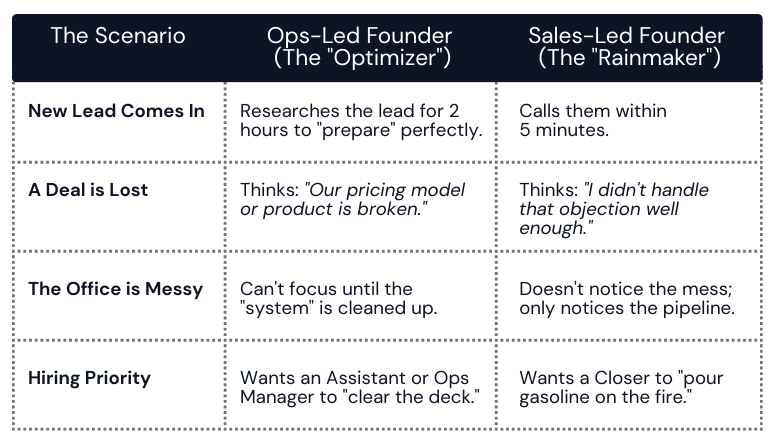
Neither DNA is wrong.
But one of them becomes limiting if applied too early.
If you’re open to it, reply and tell me which one you are. I read every response.
The Survival Shift Most Founders Resist
If you’re an Optimizer, you don’t need to change who you are.
You need to temporarily adjust your priorities to match your stage.
Here’s the progression I’ve seen work repeatedly:
Year 1: Sales Dictatorship
90% Sales. 10% Ops.
Delivery is manual, messy, and slightly embarrassing.
If your backend looks perfect in Year 1, you’re not talking to enough people.
Year 2: Infrastructure Pivot
60% Sales. 40% Ops.
Now that revenue exists, hire an “Ops Lead” to document the chaos you intentionally created.
Year 3: Integration
50/50.
This is where you move to RevOps — a unified system where Sales and Ops finally stop fighting and start fueling each other.
Note: The timeline isn’t literal. Product complexity, business model, and capital change the pace. The principle doesn’t.
How to Make the Shift This Week
If you’ve realized you’re running an Ops org with a Sales problem, start here:
Pause Optimization
Tell your team:
“For the next 30 days, momentum beats perfection.”
Create a Kill List
Delete one internal report or meeting that is polished but not driving revenue.
Use that time for real sales conversations.
Celebrate Inputs, Not Just Wins
Start celebrating rejections, not just closed deals.
It reduces fear of selling and builds volume fast.
Review Incentive Structure (to be rolled out systematically)
If you want behavior to change, rewards have to change first.
- For Sales:
Base + commission is fine.
Add a short clawback window.
If the client churns quickly because they were a poor fit, the commission is reversed.
This preserves speed without sacrificing integrity. - For Ops:
Base + bonus tied to retention, not internal efficiency.
The goal isn’t clean processes.
The goal is revenue that stays.
A Warning for the Other Side
If you’re reading this thinking, “We’re 100% sales” — don’t relax.
Sales-led orgs can die from churn. Growth without retention is just faster leakage.
If deals close easily but clients don’t stay, your next hire isn’t another seller. It’s someone who fixes retention before you pour more into the top of the funnel.
The Bottom Line
You can build the most efficient, high-margin machine in the world. But business needs customers; without them, you don’t have a business.
If you looked at last week’s calendar, would it prove you’re building demand — or preparing for it?
Pause tweaking the engine.
Go find a road.
That’s all for this week.
Surabhi
PS: From the table above, is your founder DNA more sales-led or ops-led?
Reply and let me know. I read and respond to every email.
PPS: If this edition resonated, I’d love to know. A one-line note about what landed; it helps me shape future letters.