
In my tech company, one of our core offerings was building offshore teams.
At one point, we were hiring 2–3 people a week.
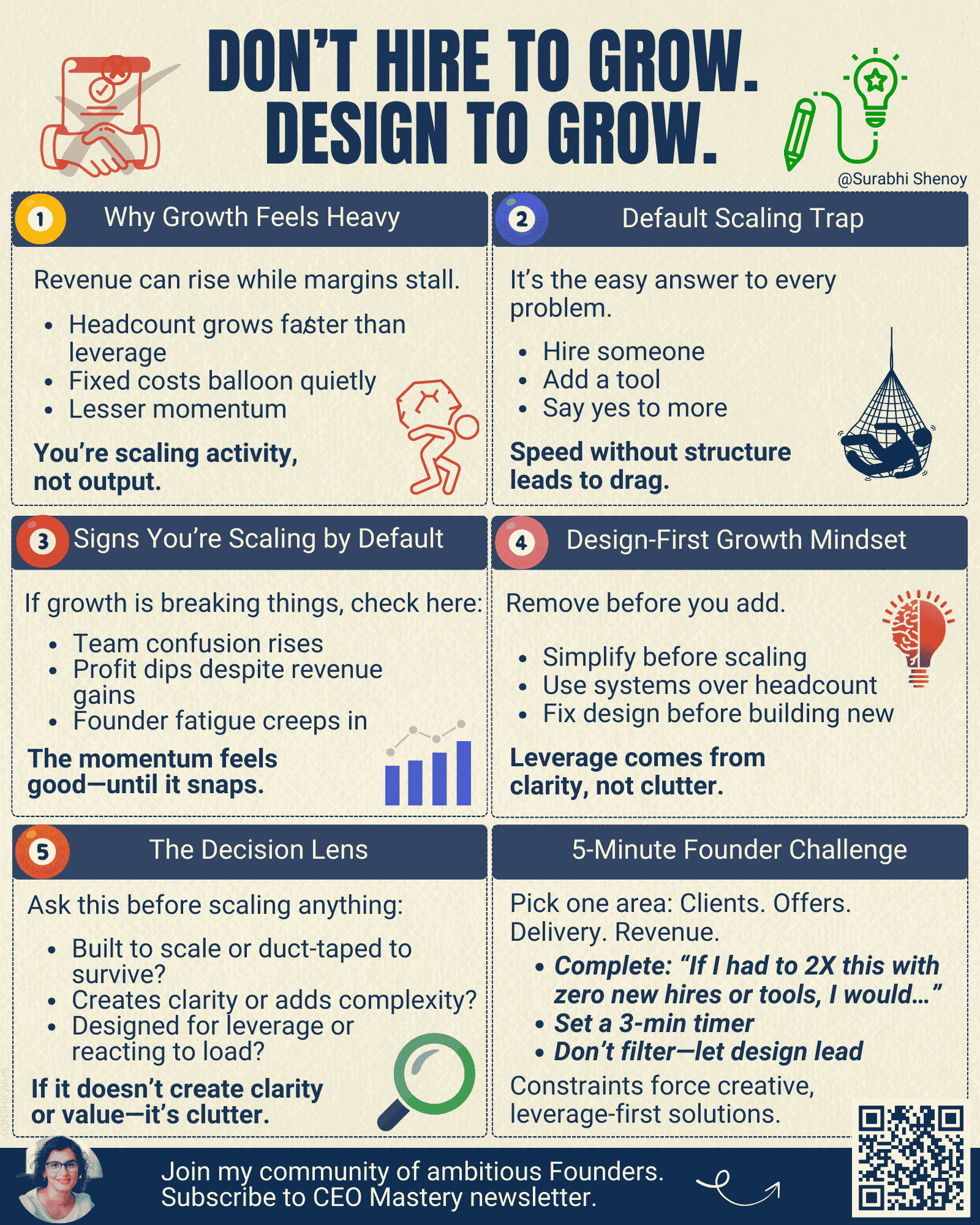
And when you hire that fast, you start thinking that hiring is a solution to all problems.
I stopped asking: Is this person even billable? Necessary? Strategic?
Revenue kept growing, but margins didn’t improve.
Because fixed costs were ballooning alongside.
What felt like growth — was mainly growing load and overheads. And I see founders doing the same today, just with fancier dashboards and expensive hires.
This is what I call scaling by default.
A founder wants to grow.
So they hire.
Layer in tools.
Say yes to more clients.
Add more offers.
But very few stop to ask:
What is this growth built on: leverage or load?
Is this structure scalable — or am I duct-taping my way forward?
And when growth shows up?
So does drag.
Team confusion. Profit dips. Founder fatigue. The momentum feels good… until it breaks something.
All because they scaled by default — not by design.
So what does design-first growth actually look like?
The Shift: Design > Default
A Lean CEO doesn’t default to doing more.
They design for leverage before they grow anything.
Design means building a structure that works harder than you do — without constantly needing more people, meetings, or patches.
Instead of:
“Let’s add someone to handle this,”
They ask: “Can a system or simplification remove this?”
Instead of:
“We need more clients,”
They ask: “How do we sharpen our offer to attract better ones?”
Instead of:
“We need a new product,”
They ask: “Is the current one underperforming due to poor design?”
Leverage isn’t built by adding.
It’s built by removing what’s in the way.
👉 Even if you’re a two-person team, this model applies.
Every offer, tool, or task you add should justify its existence. If it doesn’t create clarity or value, it’s clutter.
Design for future you — not just busy you.
Founder-to-Founder Deal Flow
I’ve been getting messages from both sides — founders ready to sell, and operators looking to buy.
So I’ve quietly started matchmaking buyers and sellers.
If you’re planning to buy a business or sell your business —
📬 Fill this 2-min form to stay on the radar.
I’ll be in touch with you.
Everything stays confidential. Always.
Want to sell your business?
One of my trusted buyers is looking to acquire a strategic service or product company in the BFSI space.
🎯 What they’re looking for:
- $300K–$1M in annual revenue
- Enterprise clients (preferably in BFSI)
- Lean team with structured delivery (recurring or project-based)
- Low founder dependency
✅ High interest in:
- AI, data analytics or automation
- Consulting, SaaS or tech service firms in BFSI problems
- Remote-friendly or India-based teams
💰 Budget: Up to $1M depending on fit
If you’re exploring a sale or partnership and this sounds like a match —
Know someone who’s buying or selling a business? Forward this email to them.
The Decision Lens
Before scaling anything, ask:
- Is this structure built to scale — or just duct-taped to survive?
- Will this create clarity for the team or introduce complexity?
- Am I designing for leverage, or reacting to load?
Default scaling is like sprinting with your shoes untied.
You’ll move fast — until you trip.
Mini Challenge (5 min)
Pick one area you’re about to scale:
Clients. Offers. Delivery. Revenue.
Complete this sentence:
“If I had to 2X this with zero new hires or tools, I would…”
Set a timer. 3 minutes.
Don’t filter. Let your design brain speak.
Your brain will always find the answer, if you ask it the right question.
📚 From My Bookshelf:
Actionable insights from books that transformed me and how I built.
Book: Deep Work

I used to think focus was about managing time. But I still felt scattered — even with a perfect calendar.
Deep Work by Cal Newport flipped something for me.
The problem wasn’t time.
It was depth.
Since then, I’ve redesigned how I write, coach, and think — by protecting space for uninterrupted, meaningful work.
I recently wrote an article sharing 8 specific shifts I made and how they helped me reclaim focus and 10x the quality of my output.
Already love this book? Get it on Amazon.
Here’s a list of all books I have shared on this newsletter.
My top content from last week
Here’s my top performing LinkedIn post – Are you really a firefighter? or an arsonist? – from last week.
A special thank you to Dr Huber Dean for reposting it with his kind recommendation.

In case you missed, this post about “boring businesses” did extremely well and I got several DMs asking for advice.
Until next week,
Build smart | Create wealth
Surabhi
PS: What’s one takeaway from this edition? Reply and tell me. I read every reply.