
This is Part 3 of a 4-part series studying Sam Walton — focusing on how his thinking applies to pricing, distribution, incentives, and growth.
Part 1: How Sam Walton Thinks
Part 2: How Founders Can Use His Thinking
Part 3: How Sam Walton Built a Team That Could Scale (this edition)
Part 4: Where Sam Walton’s Thinking Lives Today
Sam Walton called himself “chintzy.”
His word, not by his critics.
In Walmart’s early years, he paid some of the lowest wages in retail. Employees earned very little. Benefits were thin.
The business was growing fast, but the people running it weren’t sharing in that growth.
This wasn’t cruelty. It was pressure.
Sam was in debt to his eyeballs. Every dollar went into opening the next store, paying down loans, and keeping expansion alive. Higher wages felt like a luxury he couldn’t afford.
In Part 3 of the series, let us dive into how he went from paying the lowest wages in the industry to building one of the strongest ownership cultures in business.
Every founder I talk to is hitting the same wall — hiring, retention, productivity, team alignment — and the structural answers are almost always hiding in the same places Sam eventually found them.
The Shift: From Cheap Labor to Ownership Culture
As Walmart expanded from 32 stores in 1970 to 276 stores by 1980, the people problems compounded.
The company was opening more than 50 stores a year. The industry typically expected store managers to have ten years of experience. Walmart didn’t have that kind of talent — and certainly not people willing to move to small-town Arkansas. .
So they hired people with potential, trained them for six months, and made them assistant managers. If they showed any capability, they were running a store within a year.
Walmart wasn’t just hiring fast. It was building leaders at a pace the industry had never seen. And that only succeeds if the people running your stores have a real stake in the outcome.
Sam’s first move was language.
He stopped calling them “employees” and started calling them “associates.” This sounds cosmetic, but it changed how the relationship was framed — from workers and management to partners in a shared enterprise. This is where Sam Walton’s team building approach moved from hiring to ownership.
Language signaled the shift. The real change came from how the system was designed.
The Architecture of Ownership
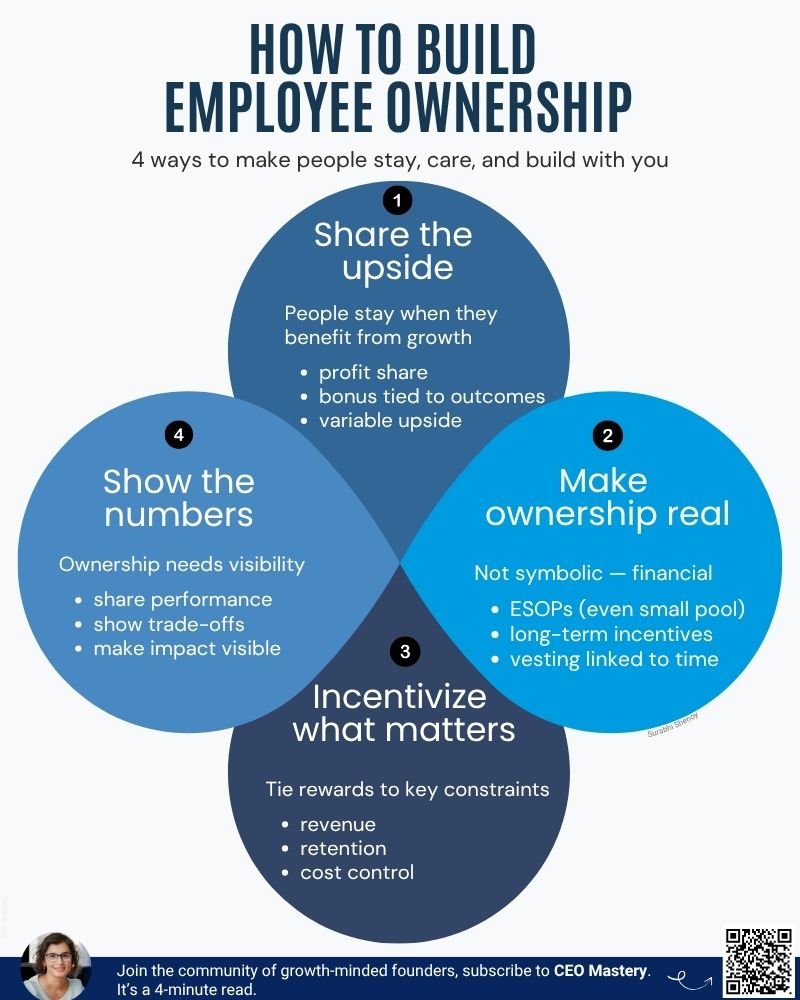
Sam didn’t just improve salaries. He changed how people participated in the economics of the company.
Profit sharing
Associates received a share of company profits based on tenure and performance. This was not a small gesture.
Bob, a truck driver, attended a safety meeting in 1972 where Sam told 20 drivers that if they stayed for 20 years, they would each receive $100,000 in profit-sharing.
He thought it was an empty promise. When he retired, his profit sharing was worth $700,000. He had also bought and sold Walmart stock over the years, building additional wealth through reinvestment.
Employee Stock Purchase Plan
Associates could buy Walmart stock through payroll deductions at a 15% discount. This made ownership automatic and accessible. Nearly 80% of Walmart associates became shareholders — either through profit sharing or through direct purchase.
A woman who started at Walmart in 1968 at $1.65 an hour retired in 1989 at $8.25 an hour. Her hourly wage told one story. Her retirement told another: $200,000 in profit sharing, stock splits over two decades, and enough to buy her mother a house.
These are not fairy tales. They are the result of a system designed so that ordinary people built wealth as the company grew.
The shrinkage incentive plan
This one is my favorite, because it reveals how precisely Sam thought about incentive design.
Shrinkage — inventory lost to theft and error — was one of the biggest profit leaks in retail.
In 1980, instead of adding more security or surveillance on associates, Walmart tried something different. If a store held shrinkage below the company target, every associate in that store received a bonus of up to $200.
The result: Walmart’s shrinkage rate dropped to about half the industry average.
The incentive turned loss prevention from a management problem into a shared responsibility.
Sam connected this to a deeper principle: most people don’t enjoy stealing, even those who do. Given the right structure, people make better choices.
This is what Charlie Munger teaches about incentives as a mental model. People respond to what gets rewarded, not what gets instructed. If you want behavior to change, change the incentive.
This is what employee ownership culture looks like when it’s built into the system.
Transparency Made Ownership Real
Ownership without information is symbolic. Sam understood this.
He shared company numbers openly with associates — revenue, costs, performance, mistakes. He believed that sharing information creates shared responsibility.
His logic was straightforward: if associates understand the business, they act like partners. If they don’t, they act like workers waiting for instructions.
Visibility drives accountability. Invisibility breeds detachment.
It started informally in the early Saturday morning meetings — reviewing results, admitting errors, planning together.
Over time, as performance improved, it became a company-wide practice.
By the time Walmart went public, transparency was already part of the culture. Going public simply extended to the outside world what associates already saw on the inside.
The principle for founders is clean: if you want your team to act like owners, they need to see what owners see. Numbers. Context. Consequences. Not filtered summaries. Not sanitized dashboards. The real picture.
What Founders Should Take From This
Sam Walton’s success story is not a straight line from mistake to mastery. It’s messy.
- He started cheap. He learned.
- He built systems that turned ordinary workers into stakeholders.
- He created transparency that made ownership real.
- He designed incentives around the specific constraints that mattered most.
This is the founder’s people strategy at its core.
Every founder I work with is dealing with some version of this — retaining poorly, incentivizing the wrong things, sharing too little information.
You may not have a public company today. Neither did Sam when he asked a small group of truck drivers to stay and trust that the outcome would be worth it.
What worked for Sam was structural.
Profit sharing, stock ownership, shrinkage incentives, information transparency, Saturday meetings. These were systems designed to align behavior with outcomes. They worked because they changed the economics of the relationship, not just the feelings.
What is your version of that?
What can you design so that staying pays — and leaving costs?
Next week, we will close this 4-part series with what survived Sam Walton, what didn’t, and the question every founder should sit with after studying an operator like him.
Thank you for reading. See you next Thursday.
Surabhi
PS: If this made you rethink your incentive design, we can review it together. One decision. One session. Book a Decision Audit.
PPS: If you’re joining this series mid-way, start with Part 1. The thinking patterns underneath these decisions are what make them coherent.