
This is Part 2 of a 4-part series studying Sam Walton — focusing on how his thinking applies to pricing, distribution, incentives, and growth.
Part 1 : How Sam Walton Thinks
Part 2: How Founders Can Use His Thinking (this edition)
Part 3: How Sam Walton Built a Team That Could Scale
Part 4: Where Sam Walton’s Thinking Lives Today
Last week, I broke down four thinking patterns from Sam Walton: cost as a worldview, learning velocity, thinking small at scale, and competitive identity.
This week is about how that thinking applies to your business today, be it a services or consulting company or a SaaS platform.
Here are four applications.
Application 1: Design Cost Structure Before Pricing
Founders first decide their offer price and then try to make the economics work backward.
Sam Walton did the opposite.
He built the cost machine first. The 1% travel rule. Shared hotel rooms. Walking instead of cabs. A shorter company name to reduce signage costs. Distribution centers built from scratch because suppliers wouldn’t deliver to small towns. We covered this in part-1 here.
The business was designed for low cost. Pricing followed this structure.
This is where many founders go wrong.
They look at a competitor’s pricing and try to match or undercut it.
But they haven’t built the operating model to sustain that price.
Their delivery costs are too high.
Their sales process is too long and heavy.
Their team structure carries too much overhead.
The price looks competitive on paper.
But P&L makes them fearful.
Walmart’s competitors faced this directly.
They had established networks, suppliers, and scale. On paper, they should have crushed Walmart. But they couldn’t succeed in discounting because their cost structures were bloated. They were accustomed to 45% markups. Dropping to 30% margins on a dress they used to sell at full price was a loss-making deal.
Their operating model could not support their pricing intention.
The founder takeaway is precise:
Your pricing is an output of your structure. It is not a decision you make on a spreadsheet.
Before you compete on price, ask whether every layer of your operation — hiring, delivery, sales, overhead — is built to sustain that price profitably. If it isn’t, the strategy will break under pressure.
If you’ve read the SpaceX standardization edition, you will see the same principle at work. SpaceX didn’t lower prices by cutting corners. They redesigned the system so that the cost of delivery was fundamentally different. Sam Walton did this sixty years earlier.
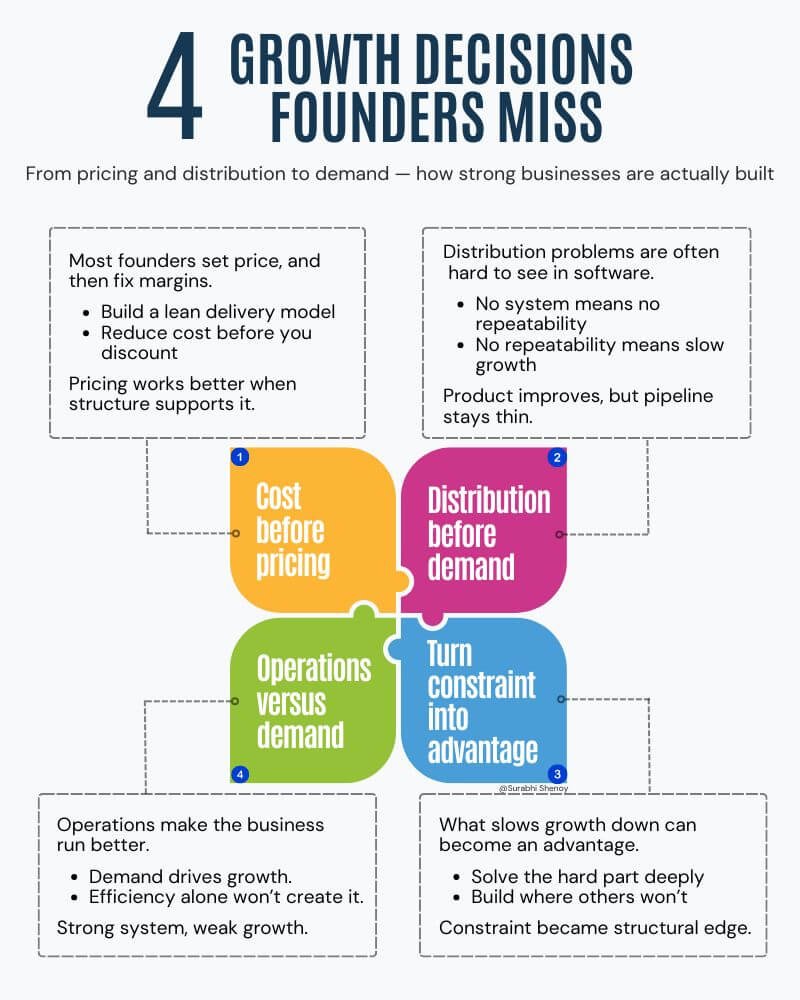
Application 2: Build Distribution Before Demand
This is the one I see missing most often with tech founders.
Sam Walton had no choice but to think about distribution from day one. His stores were in small towns where nobody would deliver or pick up. Inventory sat in warehouses for weeks. Capital was visibly trapped. Cash flow suffered.
That pain forced Walmart to solve distribution early. And because they solved it early, it became their deepest structural advantage (more about this in the next point).
Now compare this with a technology founder.
Software sits on a server.
There is no warehouse filling up.
No trucks waiting to be loaded.
No visible capital trapped in physical stock.
The pain of missing distribution is invisible.
And because it is invisible, founders ignore it.
I see too many founders with excellent products not able to sell because they never designed the distribution. They don’t have a repeatable system for getting the product in front of the right customer, at the right time.
In retail, poor distribution kills you fast.
In tech, it kills you slowly.
You build, you wait, you wonder why growth stalls.
The product keeps improving but the pipeline stays thin.
Sam Walton would find this baffling. For him, distribution wasn’t a department. It was the business.
The question for founder is simple:
How does your product reach customers?
What is the system?
Is it repeatable?
Does it compound?
When will customer acquisition costs get cheaper?
If the answer is unclear, you have a product. You don’t have a business yet.
Application 3: Your Constraint Is Hiding Your Moat
Walmart faced a simple challenge: suppliers wouldn’t deliver to small towns. They solved it with focused, methodical execution.
Every national competitor — Kmart, Gibson’s, Woolworth — focused on cities with populations above 50,000. They wouldn’t open a store in towns below 10,000 population.
Walmart was operating profitably in towns of 5,000.
Walmart built their own distribution system. Warehousing, trucking, logistics — all from scratch. And they built it better, and specific to their needs. What started as a survival response became the structural moat that no competitor could replicate.
Then came Sam’s masterstroke:
Spread outward, then fill in the gaps between existing stores.
This created dense regional clusters, each served by a single distribution center.
Lower logistics cost per store.
Faster learning transfer between nearby locations.
Regional brand presence that compounded with each new opening.
Meanwhile, Kmart was leapfrogging from large city to large city, planting isolated flags across the country. Their stores were spread thin. Their distribution was stretched. They left enormous pockets of underserved demand sitting untouched between their urban outposts.
Sam Walton filled every one of those pockets.
The industry dismissed Walmart as, in Sam’s words, “a bunch of country hicks who stumbled onto something by accident.” Thirty years later, most of those early discounters were gone.
The founder lesson here is not about small towns. It is about constraints.
The lesson for founder here is about constraints:
- A market they serve because no one else wants it.
- A distribution channel they built because the obvious one wasn’t available.
- A pricing model forced by tight cash flow.
The question is whether you recognize that constraint as a potential moat — and whether you’re building deliberately around it, or just hoping it keeps working by accident.
Sam Walton’s advantage was not that he faced constraints. It was that he solved them so deeply that they became capabilities no one else could replicate.
Application 4: Are You Operations-Driven or Sales-Driven?
Sam Walton made an observation about retail that I think applies to every service and technology business I have seen.
He said there are two kinds of companies.
Operations-driven companies focus on efficiency and cost control.
Sales-driven companies focus on increasing sales through promotion and positioning.
The best sales-driven companies continue to improve their operations. But operations-driven companies, he warned, eventually level off and begin to deteriorate.
This showed up in my own experience.
I was an operations-first founder.
My instinct was always to optimize delivery, reduce waste, and keep improving processes. Those instincts served me well in many ways. But when I look back honestly, I under-invested in demand creation.
Sam Walton’s approach was different.
He believed every store had products that could “explode into volume” if promoted correctly.
He would take an ordinary product — toothpaste, detergent, a lawnmower — and promote it aggressively. Stack it floor to ceiling. Make it impossible to miss. Turn it into a local attraction. Customers came for the promoted item. They left with a full cart.
The modern founder parallel is this:
What in your business could “explode into volume” if you promoted it correctly?
– Every services company has one offer that resonates more than others.
– Every SaaS product has a feature that customers love but prospects don’t know about.
– Every consulting firm has a case study that, if told well and distributed widely, would open doors.
These are your sales opportunities. You’re likely ignoring them — because building the system feels more important.
The correction is not to abandon operations. It is to recognize that operations without demand creation is placing a ceiling on your growth.
What Connects These Four Applications
So far, we’ve looked at how Sam Walton thinks — and how that thinking translates into decisions in a modern business.
- Design the cost structure before pricing.
- Build distribution before you need it.
- Turn constraint into advantage.
- Shift from operations-driven to sales-driven.
What connects them is simple: Growth is shaped by the system, not the product.
Product quality gets you in the door.
System design determines how far you go.
Next week, we will look at the hardest part of scaling — people. How Sam Walton went from paying the lowest salaries to building one of the strongest ownership cultures in business.
Thank you for reading. I will see you next Thursday.
Surabhi