
This is Part 1 of a 4-part series studying Sam Walton.
This series shows how Sam Walton made decisions, from running a single store to building a business that now does over $600 billion in revenue.
Part 1 : How Sam Walton Thinks (this edition)
Part 2: How Founders Can Use His Thinking
Part 3: How Sam Walton Built a Team That Could Scale
Part 4: Where Sam Walton’s Thinking Lives Today
Late one night in Rogers, Arkansas, two Walmart employees climbed into an open trash bin behind a competitor’s store.
They weren’t looking for food. They were looking for price tags.
During the day, they had walked the aisles memorizing prices. At night, they dug through discarded labels to fill in the gaps.
This was how the work was done.
Sam Walton had built an organization where understanding competitors wasn’t optional. It was part of the job.
The success of a business is shaped by founder decision making .
That’s why I spent months studying Sam Walton to understand how he thought and made decisions.
Because those decisions compounded into what Walmart became.
The Twenty Years Before the "Overnight Success"
Sam Walton was twenty-seven when he took over his first store — a Ben Franklin franchise in Newport, Arkansas. Small town. Small store. He set himself one goal: make it the best, most profitable variety store in Arkansas in five years.
He hit that goal. Then lost the store over a lease dispute.
He started over. Moved his family to Bentonville — an even smaller town — and kept building. One store became a few. A few became a small chain. For nearly two decades, nobody outside Arkansas paid attention.
He was forty-four when he opened the first Walmart in 1962. It was not impressive. A small, scrappy discount store in a town most retailers ignored. He often drove his pickup truck to fill the store himself — once hauling women’s lingerie in the back because that’s what needed restocking.
That same year, Kmart launched. So did Target.
Within five years,
Kmart had 250 stores making $800 million.
Walmart had 19 stores making $9 million.
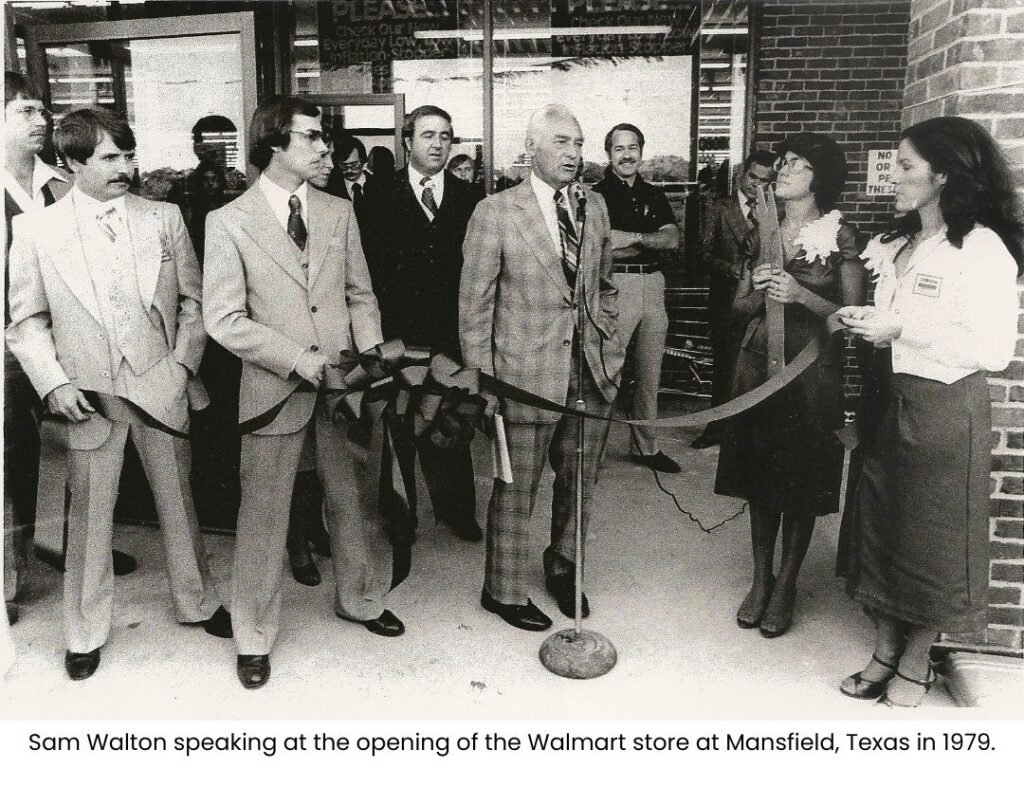
In his autobiography, Made in America, Sam wrote that it would have been absolutely impossible to convince anyone back then that within thirty years, most of those early discounters would be gone — and that Walmart would be among the biggest, best-run retailers in the world.
Sam describes his success from the first Ben Franklin franchise store to the first Walmart store as “an overnight sensation that was about twenty years in the making.”
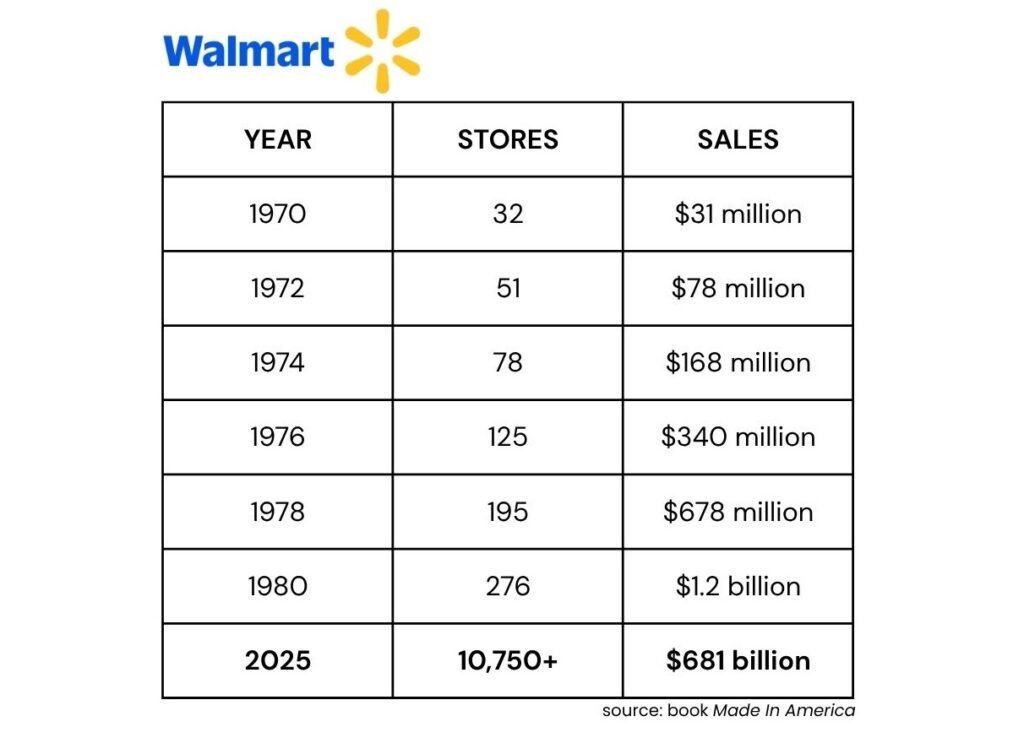
Here is what those twenty years — and the decades that followed — actually produced:
Pattern 1: Cost Is a Worldview, Not a Line Item
From 32 stores to over 10,750.
From $31 million to $681 billion.
Across 19 countries.
Serving 270 million customers every week.
Employing 2.1 million people.
The same person who was hauling lingerie in his pickup truck built this.
The question is how Sam Walton made decisions.
Not what he did — that’s well documented. How he thought. What patterns sat underneath the decisions that compounded into this result.
Four kept showing up.
- How he treated cost.
- How he treated learning.
- How he thought about scale.
- How he treated competition.
Let me show you each one.
Often, founders treat cost control as a finance function. Sam Walton treated it as an operating philosophy.
The name “Walmart” was chosen partly because it had fewer letters. Fewer letters meant cheaper signage, cheaper neon, lower maintenance. Even the brand name was optimized for cost.
On buying trips to New York, he had one rule: travel expenses must never exceed 1% of total purchases. If the team was buying $30,000 worth of stock, they could spend no more than $300 on the trip. They walked instead of taking cabs. They crowded into small hotel rooms. They worked from 6am to past midnight, to shorten the trip.
This scrappiness showed up in everything. How they bought products. How they ran stores.
Walmart’s entire business model — high volume, low price — worked only because the cost structure underneath was strictly maintained low. Built into daily decisions, not assumed.
The insight here is not “be cheap.” It is that your pricing power is downstream of your operating discipline. If your cost structure doesn’t support your pricing strategy, the strategy breaks every time.
Pattern 2: Learn Faster Than You Grow
Sam Walton was not a systems genius. He was not naturally organized. He said this himself.
What he was, relentlessly, was a learner.
He traveled long distances to study self-service stores, then brought those ideas back before competitors even noticed the shift. When visiting other retailers, he gave his team a simple instruction: look only for what they do right.
The bar was low. If you found one good idea, the trip was worth it.
This extended into how he ran the company internally. Every Saturday, managers reviewed what they bought, what they promoted, what worked, and what failed. Mistakes were discussed openly — including Sam’s own. No blame. No lingering guilt. Correct it. Learn from it. Move to the next day.
These meetings started informally when Walmart had a handful of stores. They continued when it had hundreds. What began as necessity became the company’s operating system. A weekly rhythm of collective learning, long before anyone called it a “learning organization.”
Walmart didn’t outgrow competitors. It outlearned them.
Pattern 3: Think Small — Especially as You Scale
This is the one that surprised me the most.
As Walmart became a $50 billion company earning $1 billion in profit, Sam Walton’s concern was that the company would start losing customers.
So he trained his team to think of a single store like a business. Every store matters. What is happening inside that store matters. A company with hundreds of locations cannot afford to think in averages.
He pushed this further with “store within a store”. Each department operated like its own business — responsible for its own profitability, merchandising, display, and customer flow. Where should this product sit? What will a customer reach for next? How easily can they find it?
These are micro-decisions. And Sam insisted they stay micro, even as the company became one of the largest on Earth.
Most founders want to think bigger as they grow. Sam made the opposite move. He scaled the company while insisting people thought small and local. That tension — scaling the business while shrinking the focus — is one of the hardest things to hold as a founder. And one of the most valuable.
This reflects the Walmart founder mindset — scaling the business while keeping the unit of thinking small.
Pattern 4: Compete as Identity
Sam Walton did not treat competition as a market condition, it was his personality.
From childhood, the idea of losing simply did not occur to him. Winning was the default assumption.
This showed up everywhere. When Kmart was doing $5 billion in revenue and Walmart was doing double-digit millions, Sam didn’t flinch. He launched structured programs to sharpen merchandising, tighten team management, and prepare stores near Kmart locations for direct competition. He didn’t position his business around the competition. He positioned against it.
Store managers near Kmart locations were trained to compete head-on. Displays were sharpened. Prices were studied. Promotions were planned specifically to win local customers. The competition wasn’t abstract. It was specific. Local. Intentional.
At that point, the gap between Walmart and Kmart looked permanent.
Thirty years later, most of those early discounters were gone and Kmart’s decline had started – by 2002, they filed for bankruptcy. And Walmart was going from strength to strength.
The lesson is not “be more competitive.” The lesson is that Sam built competition into the culture, not just the strategy. Every store manager knew: we compete to win. That belief showed up in every decision.
What Connects These Four Patterns
Cost discipline. Learning speed. Micro-focus. Competitive identity.
None of these are original ideas. Individually, you have heard versions of each one before.
What made Sam Walton consequential is that all four ran simultaneously.
Cost discipline funded the pricing model.
Learning speed kept the company adapting faster than the market.
Micro-focus prevented scale from becoming a weakness and beat even larger competitors.
Competitive identity ensured nobody in the organization settled.
Great founder decisions require three things working together:
- Systems thinking
- Domain expertise
- Mental models
He had all three — and they reinforced each other in ways that made the whole greater than any single part. This is what founders can learn from Sam Walton — not the tactics, but the thinking behind them.
Understanding how Sam Walton made decisions is interesting. The question is whether any of it transfers to how you build today.
Thank you for reading. I will see you next Thursday.
Surabhi
PS: This is Part 1 of a 4-part series on Sam Walton. Next week: how founders today can apply his thinking to pricing, distribution, incentives, and growth.
If you know a founder who would enjoy these findings, please forward this email. It takes just 9 seconds.