
How founders build high-performance teams decides what the company can become.
It shapes the speed of execution, the quality of decisions, the strength of the culture, and the value a buyer may one day pay for.
Most leadership writing does not help much here. It is written for large corporations with deep benches, unlimited hiring budgets, and decades of brand to fall back on. Startup founders and scaling CEOs have none of that. You work with limited capital, limited time, and a market window that will not wait. A bad hire, a tolerated liability, or a drifting culture can cost the company months it may not have.
This is why high performance is not a preference for scaling founders. It is the operating standard the company needs to survive, scale, and become valuable. And it has to be built by design, not luck.
This article is the contrarian guide to building high-performance teams inside scaling companies. It draws on my 18 years of building and two successful exits to explain how founders actually build high-performance teams and the high-performance companies that hold them.
In This Article
- Why Most Leadership Advice Fails Scaling Founders
- Assets, Neutrals, Liabilities: The Three Categories of People in Every Company
- How Founders Build a Core Team of Assets
- Design Over Dependency: Building a High-Performance Company
- Why High-Performance Companies Need Managers, Not More Leaders
- Performance Culture: What Founders Tolerate Becomes the Standard
- Level 5 Leadership for Founders: What Has Worked for Me
- The Founder’s Real Job in Building a High-Performance Company
- Key Takeaways
Why Most Leadership Advice Fails Scaling Founders
Most leadership advice was written for large companies.
Those companies have advantages you do not have.
They have large hiring budgets, so a slow-to-fit hire is absorbed without pain. They have deep benches, so a weak manager is moved sideways. They have brand, scale, and market share, so underperformance can stay hidden for quarters at a time.
Mediocrity becomes survivable because the system around it is huge.
A scaling company has no such buffer.
You operate with limited capital, limited time, and a limited market window.
Every hire is a meaningful percentage of your payroll. Every non-performing person sets the ceiling for the rest of the team. Every delayed decision costs months you cannot get back. You cannot absorb what a large corporation can. You have to perform.
That reality shapes what “high-performance” means for you. It is not an inspiring slogan. It is the minimum operating standard your resources allow.
This is why three uncomfortable truths, missing from most leadership content, sit at the center of this article.
1. Not All Employees Are Assets
Some employees create compounding value. Some are neutral. Some actively slow the company down. Treating them the same is a luxury large corporations can afford. Scaling founders cannot.
2. Performance Is Designed, Not Merely Inspired
Inspiration is useful. It is not a system. Performance comes from clear standards, honest feedback, and repeated decisions made under real constraints.
3. Management Is Not a Lower Form of Leadership
Management is the discipline that turns strategy into results when resources are tight. Many scaling companies suffer from too little management, not too little leadership.
None of this is an argument against inspiration, safety, or humane leadership. It is a reminder that the leadership that works in this environment is more direct, more standards-driven, and far more execution-focused.
Assets, Neutrals, Liabilities: The Three Categories of People in Every Company
In the early days of Tejora, our operations relied on three people. We gave them three years of growth upfront, CXO and VP titles, and equity unlocked from day one.
They milked it.
They began acting in self-interest even when it hurt the company. They created dependencies that tightened their hold. We lived with the daily fear that losing them meant losing the business.
That experience taught me one of the hardest truths about people in a scaling company: never build a business that only survives if certain people stay. Survival and growth must come from design, not dependency.
If you’re navigating a situation like this right now, where the wrong people have made themselves indispensable, this is exactly the problem I work through with founders in 1:1 CEO Coaching
The question most founders silently wrestle, but do not say out loud, is this: how do you actually tell? How do you know, honestly, which of your people are making the company stronger and which are quietly dragging it down?
The answer starts with a cleaner framework.
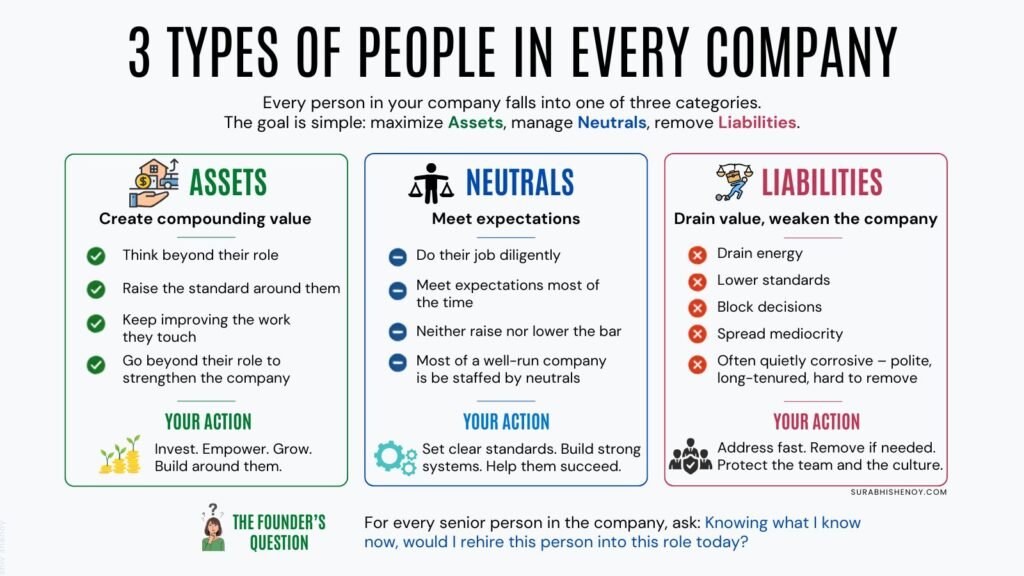
In every company, people fall into one of three categories:
- Assets. They create compounding value. They think beyond their role. They raise the standard around them. You can often spot them because the work they touch keeps improving even after they move on to something else.
- Neutrals. They do their job. They meet expectations. They neither raise nor lower the bar. Most of a well-run company will be staffed by neutrals — and that is fine, as long as the systems around them are strong.
- Liabilities. They drain energy, lower standards, block decisions, or spread mediocrity. Some are openly difficult. More often, quietly corrosive — polite, long-tenured, and impossible to remove without pain.
The slogan “our people are our greatest asset” is incomplete and mostly misunderstood.
People are your greatest asset only if the right people are in the right seats, held to the right standards. That takes active design. Not a placard in reception.
Here is the harder part: churn is bearable. But the real danger is when people stay — slowing decisions, lowering standards, and spreading mediocrity — and you feel trapped into keeping them. No accountability chart fixes that. What you are fighting is not a performance issue. It is organizational fragility.
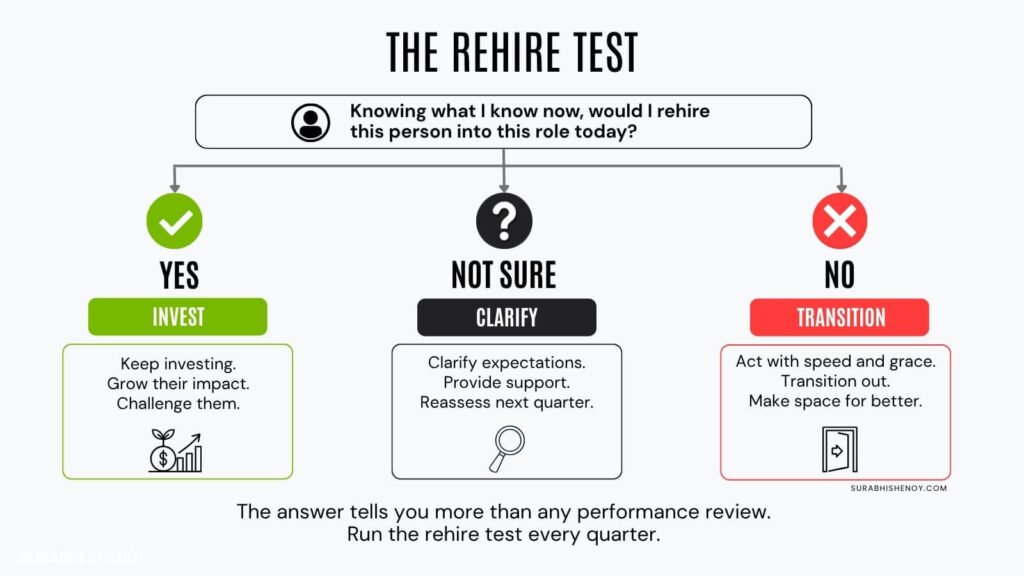
The Rehire Test: Would You Hire This Person Again Today?
If you have wondered when it is time to fire someone, this test gives you a cleaner answer than tenure, seniority, or a performance review ever will.
One question cuts through years of loyalty, hesitation, and wishful thinking.
For every senior person in the company, ask: Knowing what I know now, would I rehire this person into this role today?
- Yes — invest in them, stretch them, pay them to stay.
- Unsure — have a direct conversation. Define what has to change, and by when.
- No — start the transition now. Fairly, respectfully, but without delay.
Run this test on your senior team every quarter. It is one of the fastest ways to see which category each person actually falls into today — and to stop confusing tenure with value.
How Founders Build a Core Team of Assets
The founder of a scaling company has two kinds of team.
There is the broader team, which runs on systems and clear standards. And there is the core team — people who set direction, carry the hardest work, and shape how everyone else performs.
The broader team can be a healthy mix of assets and capable neutrals, because the systems carry them. The core team cannot.
Your core team has to be made entirely of assets.
This is the single highest-leverage hiring decision a scaling founder makes. Get it right, and your company compounds. Get it wrong, and even a strong system will sag under the weight of weak core-team choices.
Scaling founders often ask me: how do I know when someone is core-team material?
Two traits usually separate them from everyone else.
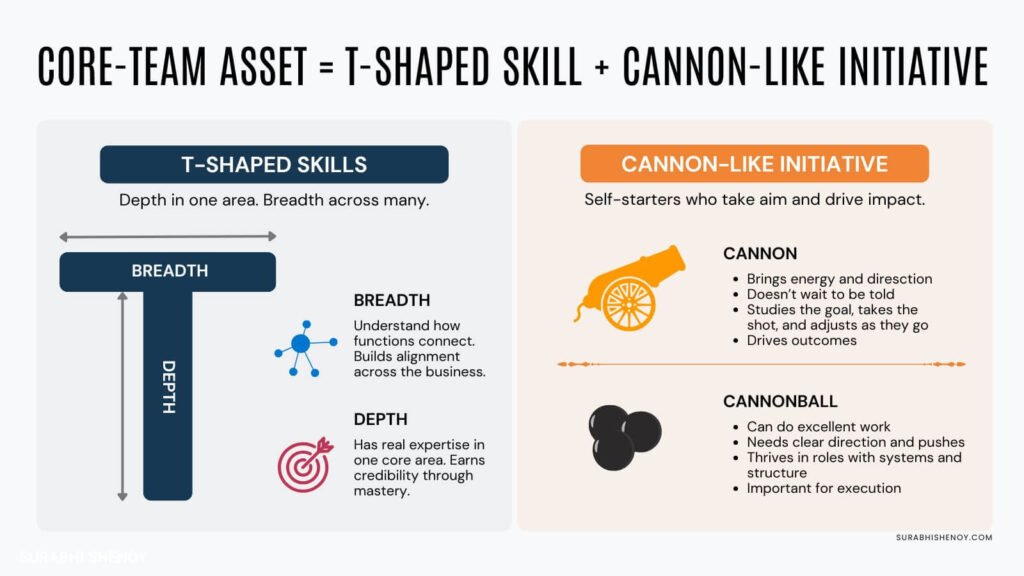
1. T-Shaped Skills: Depth and Breadth Together
Core-team assets have real depth in one function — engineering, product, operations, client delivery, finance — and enough breadth to connect across departments, manage expectations upstream and downstream, and solve problems that sit between roles.
The depth earns them credibility. The breadth lets them think at the level of the company, not only their function. Without the vertical line of the T, they lack authority. Without the horizontal line, they cannot see how their decisions affect the whole.
2. Cannon vs Cannonball: Why Initiative Defines Core Team Assets
Many people in a company are cannonballs. They can do excellent work when someone points them at a target. They need instructions, check-ins, and direction. That is not a weakness. It is a capability match for roles that rely on systems.
Cannons are different. They are the launchers. They bring energy, direction, and initiative. A cannon does not wait to be told what to do. They study the goal, take the shot, and adjust as they go.
T-shape + cannon-like initiative is the DNA of every core-team asset. Depth, breadth, and initiative — compounding together.
When you find such people, do your damnedest to keep them for the long haul. Pay them well, stretch them, protect them from the company’s politics, and make sure their ambition can be fulfilled inside your company. Because the alternative — relying on one or two cannons while the rest of the core is made up of cannonballs — is exactly the fragility that can bring down a company, as I experienced in my early Tejora setup.
Design Over Dependency: Building a High-Performance Company
The founder’s job is not to build a high-performance team.
The founder’s job is to build a high-performance company.
A team is one of the inputs. The outputs are consistent results, compounding value, and a business that someone else would want to own.
This is where the thinking directly connects to the founder’s decision making. Building a high-performance company is “systems thinking” applied to how the organization works.
Every system has three parts:
- Elements
- Interconnections
- Purpose
For a high-performance company, the elements are people, capital, and processes.
The interconnections are how they flow into each other — how a hiring decision changes delivery, how delivery changes cash, how cash changes the hiring decisions you can make next.
The purpose is durable performance that does not depend on any single person.
Scaling founders who fail to see their business as a system end up solving the wrong problem. They try to lead harder, hire better, motivate more. But these are local fixes to a systems-level issue.
The systems-level fix looks different.
Design Systems That Let Average People Perform Above Average
Your systems carry complexity.
Your standards carry quality.
Your people carry judgment.
The combination is what produces performance — not any one of them alone. Average people can perform inside a well-designed system. They cannot rescue a poorly designed one.
Treat Employee Retention as a Byproduct, Not a Goal
Great companies do not bet growth on employee retention.
They build a repeatable engine — clear talent pipelines, structured onboarding, and the ability to bring someone into productivity in weeks instead of months. When the engine works, the departure of one person is a shift, not a crisis.
Build the Company to Run Without You
Not eventually. From the design stage.
Because a company that depends on you cannot be scaled, sold, or stepped away from — and that dependency is the single most expensive form of founder failure I see. If you want a structured, step-by-step path to get there, the Founder Freedom Blueprint is the course I built for exactly this.
Design over dependency is not a tactic. It is how high-performance companies are actually built.
Why High-Performance Companies Need Managers, Not More Leaders
Somewhere in the last two decades, the word “manager” has become embarrassing.
Every job title turned into “Leader” or “Lead.” Every training programme promised to develop inspiring leaders. And the manager — the person who turns strategy into results — was gradually reframed as something lesser. A role to grow out of.
This is one of the most expensive mistakes in modern business thinking.
Leaders set direction. Managers get the company there.
Scaling companies, with their limited resources and no room for execution slippage, need managers far more than another layer of leaders.
Investors or buyers do not pay a premium for vision and mission alone. They invest in proven operations, predictable margins, systems that work, and teams that execute inside clear boundaries. None of that is produced by leaders alone. It is produced by managers.
The good news for founders is that the skills that make a great manager — execution, planning, accountability — are far more teachable and measurable than the qualities that make a great leader. That makes hiring and growing strong managers the fastest path to scale without burnout.
A high-performance company does not need everyone to be a leader. It needs a small number of people who can set direction, and a much larger number of people who can manage the work, the time, and the results within clear boundaries. That is the clarity that actually empowers people.
For a deeper view on this, read: Why Great Management Outperforms Leadership Every Time.
Performance Culture: What Founders Tolerate Becomes the Standard
Culture is not what you write on the wall.
Culture is what you tolerate.
Every time you accept a behavior that falls below the standard you want, you reset the bar for the entire organization. Every missed deadline you ignore, every side conversation you pretend not to hear, every brilliant jerk you protect — each one sends a message louder than any town hall speech.
In a large corporation, there are enough people, enough layers, enough inertia for mediocrity to get absorbed. A startup or a scale-up has no such luxury. Tolerated mediocrity sets the visible ceiling for everyone else — copied by those watching, used as cover by anyone else wanting to underperform.
High standards are the kindest thing you can offer a team.
This is where many founders freeze. They confuse kindness with lowering the bar. They mistake being liked for being respected. They avoid hard conversations to protect short-term harmony — and end up sacrificing long-term trust.
A performance culture does the opposite. It says: we expect your best, we will tell you honestly when you miss, and we will give you the tools and support to grow. We believe you are capable of more, so we will hold you to more.
Done well, this builds a team that feels safer, not anxious. People know where they stand. They know what is expected. They know they will be told the truth. They know mediocrity will not be protected at their expense.
A useful test for any founder this quarter: name the three behaviors you currently tolerate that quietly lower the standard. Then decide which one you will stop tolerating first. That small decision, made consistently, is how high-performance culture is actually built.
If you want a thinking partner who will challenge you and hold you accountable through exactly this kind of decision, see how CEO Coaching works.
Level 5 Leadership for Founders: What Has Worked for Me
Every part of this essay — the people choices, the systems, the management, the standards — sits on top of one fact: how the founder shows up and leads.
I am not going to tell you this is the right way to lead. I’ll share what has worked for me and what I have seen work for scaling founders I work with.
What has worked, for me, is the simplest and hardest combination I know: sheer resolve combined with extreme humility.
This is what Jim Collins called Level 5 leadership in Good to Great. After studying the companies that sustained outsized performance over long periods , Collins found they were not led by the charismatic, inspirational figures business writing usually celebrates. They were led by people who paired fierce professional will — the resolve to do whatever the company needed — with a personal humility so deep that they deflected credit and absorbed blame almost by reflex.
Resolve without humility produces tyrants.
Humility without resolve produces drift.
The combination, practiced consistently, compounds trust into performance.
I have tried my best to show up as a Level 5 leader. When the company was 15 years old, I got tested.
In 2017, I lost my husband — my co-founder and partner in both life and Tejora. Overnight, the responsibility for the company fell entirely on me. And the team was watching closely. They were watching how I carried the grief. They were watching whether the company would hold. They were quietly asking whether their jobs were safe.
I could not hide from the grief. I also could not abandon the company. So I put my head down and worked on the business, on the team, on myself, one day at a time.
What happened next still humbles me.
The team did not just stay. They came together, supported me, and we took the company to heights I would not have reached alone. That was not the result of a vision deck or a rousing speech. It was the product of showing up with resolve to do everything in my capacity to keep building, staying honest about my humanity, and trusting them with both.
That is the version of founder leadership I would bet on every time. If you show resolve and resilience, in small daily ways and even during big crises, you will have a team you can rely on.
This is the kind of founder I work with and for. If you want to develop your own leadership, especially under pressure, let’s talk.
The Founder's Real Job in Building a High-Performance Company
All of these points lead to a simple, unglamorous conclusion.
The founder’s real job is not to inspire everyone. It is to build a high-performance company. The team is the enabler of that. This needs a founder to make a small number of disciplined choices — and to repeat them, deliberately, as the company grows.
Five of them, in order of leverage:
1. Own the leadership hiring bar personally.
Senior hires multiply or cap the company’s growth. A wrong leadership hire does not just underperform; it shapes how decisions get made across the team below them. This is a hire no founder should fully delegate.
2. Set standards, and defend them in public.
Name what excellence looks like. Call it out when it happens. Call it out when it does not. Culture is built in those public moments, not in policy documents.
3. Build management, not just leadership.
Invest in the layer of managers who convert strategy into daily execution. Give them the titles, the authority, and the systems to do the job. Do not dress their roles up as something else.
4. Design systems that let average people perform above average.
Document what works. Train against it. Measure against it. Improve it. This is the single highest-leverage use of your time once the company has product-market fit.
The Founder Freedom Blueprint gives you the exact framework to build these systems, without having to figure it out from scratch.
5. Run the rehire test, and fire fast when the answer is no.
Keeping the wrong person is more damaging than letting them go — to the team, the company, and often to the person themselves. Once you know, move. Delay compounds the damage.
These are the five things no one else in the company can do for you. Everything else can be hired, systemised, or delegated — and most of it should be.
Key Takeaways
- Most leadership advice was written for large corporations, not for you. With limited capital, limited time, and no room for error, high-performance is your minimum operating standard, not a preference.
- Not all employees are assets. Assets, neutrals, and liabilities exist in every company. Acting on the difference with clarity and timeliness is what scaling founders cannot postpone.
- Run the rehire test every quarter. Knowing what I know now, would I rehire this person into this role today? The answer often reveals more than any performance review.
- Your core team must be composed entirely of assets. T-shape plus cannon is the DNA. Hire for it, nurture it, protect it.
- The founder’s real job is to build a high-performance company, not just a team. The team is one input. Systems, standards, and design complete the picture.
- Design beats dependency. Retention is a byproduct. A repeatable onboarding engine and systems that hold without heroes are what actually scale.
- High-performance companies need managers, not more leaders. Management is the discipline that turns strategy into results under constraint.
- Culture is what you tolerate. In a scaling company, tolerated mediocrity sets the ceiling for everyone else.
- The most durable founder leadership combines sheer resolve with extreme humility — Jim Collins’ Level 5. People follow the founder they have seen, not the founder they have been told about.
- The founder owns five things: the leadership hiring bar, the public standard, the management layer, the system design, and the decision to let the wrong people go.