
Founder decision-making shapes everything — how fast you grow, the quality of people you attract, the value you build, and the options you have when it’s time to exit.
When you, as a founder, learn how you make decisions systematically, you can explain that thinking to your team. Your leadership team starts to see problems the same way you do. They make better decisions on their own. Delegation stops breaking. Decision quality no longer depends on one person.
The company’s judgment begins to scale.
This is the foundation of the CEO Mastery Method, the approach I use in my 1:1 CEO coaching and writing.
For startup founders and early-stage leaders, this matters even more. You operate in a high uncertainty environment, with constant change and limited information. The number of decisions increases as you grow, but your time and attention do not.
This article breaks down how great founders think and make decisions. It explains the thinking behind high-quality decisions, and a simple decision making framework you can use to learn how to make better business decisions as a founder.
In This Article
- What Founder Decision Making Really Means
- Systems Thinking: How Founders See the Whole Business
- Domain Expertise: Why What You Know Shapes How You Decide
- Mental Models: The Thinking Tools That Help Founders Make Better Decisions
- Speed of Decision Making: When to Move Fast and When to Slow Down
- Why the Founder Decision Making Process Gets Harder at Scale
- How Great Decision Making Scales Beyond the Founder
- Key Takeaways
What Founder Decision Making Really Means
Founders often focus on working harder, but better decisions are the real multiplier.
The same 40-hour week can produce dramatically different outcomes depending on which decisions are made, how they are made, and what is ignored.
As companies grow, decisions multiply.
Most of what crosses a founder’s desk is noise.
A small number of key decisions shape the next few years — who to hire, where to invest, what to stop doing, and those need the founder’s clearest thinking.
So, what separates founders who consistently make better decisions?
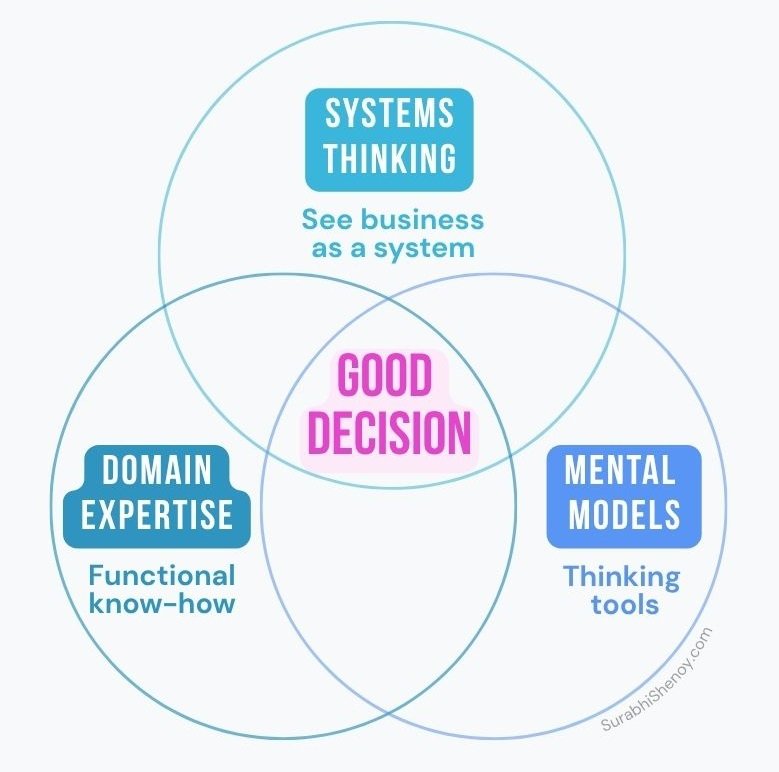
Three capabilities working together:
- Systems thinking — seeing how revenue, profit, people, product, and operations interact and affect each other.
- Domain expertise — knowing your business deeply enough to see patterns, understand constraints, evaluate trade-offs, and assess feasibility.
- Mental models — thinking tools that help you choose well when information is incomplete and the stakes are high.
Together, these form the mental operating system behind great founder decision making.
Systems Thinking: How Founders See the Whole Business
A business is a system. Donella Meadows, in Thinking in Systems, defines a system as a collection of elements, interconnections, and purpose.
Your business has many elements — people, products, customers, cash. But elements alone do not explain how it works. What matters is how they connect and what they serve.
Changing elements rarely changes the system. Replace a person, switch a tool, swap a vendor, and the system behaves much the same.
Change the interconnections — how teams share information, how pricing connects to delivery, how sales commitments affect execution, and behavior shifts.
Change the purpose, and everything changes. Apple under Steve Jobs was organized around one idea: put powerful technology into the hands of ordinary people.
That dictated product design, pricing, and what Apple refused to build. When Sculley took over, the purpose shifted to maximising market share and margins — more product lines, licensed software, competing on specs.
The system drifted. Apple nearly collapsed. Eleven years later, when Jobs returned, he restored the original purpose and cut the product line to four. The system realigned. Everything followed.
When something is not working, founders reach for the elements first. They hire, fire, change offers, or restructure.
The stronger move is to examine the interconnections.
The strongest move is to ask whether the system is organised around the right purpose.
What does Thinking in Systems look like in practice?
Pricing affects margins.
Margins affect who and how you hire.
Hiring affects culture.
Culture affects execution.
Execution affects retention.
Retention affects cash flow.
Cash flow affects what you invest in next.
Everything touches everything.
A founder raises prices by 20%.
On paper, a revenue gain.
In reality: some customers churn. The sales team cannot close at the new price because the value proposition has not changed. Cash collection becomes slow. The leadership team has not yet hired people to deliver at the higher standard because the cash has not arrived.
The pricing decision was sound in isolation.
It failed because it was made without mapping the interconnections.
This is systems thinking in founder decision making — the ability to see the business as one system, where a decision in one area ripples across several others.
Within that system, smaller systems exist.
Your sales process is a system.
Your delivery workflow is a system.
Your hiring is a system.
Each has its own parts and connections — and each affects the others. A bottleneck in your hiring system becomes a capacity problem in your delivery system, which becomes a quality problem in your customer retention system.
In my tech company, my ability to think in systems sharpened specifically when I began examining the business through a buyer’s lens — revenue quality, team dependencies, delivery risks, customer concentration. I stopped seeing individual problems. I started seeing interconnections and purpose. That shift changed every decision that followed.
Domain Expertise: How Deep Knowledge Improves Decisions
Systems thinking shows you how the pieces connect.
Domain expertise lets you evaluate what you see.
In the context of founder decision making, domain expertise means knowing your business well enough to see patterns, understand constraints, evaluate trade-offs, and assess feasibility.
Without this, most decisions remain guesses — even if they feel confident.
When Elon Musk chose stainless steel over carbon fibre for Starship, he understood the metallurgy. A heavier, cheaper metal was actually the faster path. Without that knowledge, the decision is a guess.
The same applies at every scale.
If you do not understand your unit economics, you cannot evaluate a pricing change.
If you do not understand how delivery absorbs complexity, you cannot assess a new service line.
If you do not understand customer behaviour, you cannot make a sound product decision.
Domain expertise turns a guess into a judgment call.
And over time, it reduces the number of “unknowns” in every decision you make.
Mental Models: The Thinking Tools That Help Founders Make Better Decisions
You see the systems. You know the domain. Now comes the hardest part: deciding under uncertainty.
Founders rarely have complete information. Markets are ambiguous. Customer signals conflict. The people around you have opinions shaped by incentives you may not see.
This is where mental models become the separating factor in founder decision making.
The successful founders don’t wait for perfect information. Instead, they build their own processes (or tools) to help them weigh options, assess risk, and act with confidence — even when the outcome is uncertain.
Mental models are thinking tools from economics, psychology, probability, and systems theory. Each gives you a different lens on the same decision. Each reveals something the others miss.
The models I return to most:
Incentives:
What incentives are shaping this situation — for me, for the other party, for my team?
Many behaviours that frustrate founders — sandbagging targets, avoiding hard conversations, resisting change — are rational responses to the incentive structure the founder created. Change the incentives, the behaviour follows.
Second-order consequences:
If this succeeds, what breaks next?
A product launch is a first-order win. The hiring pressure, support load, and cash timing that follow are the second-order consequences that determine whether the win holds.
Opportunity cost:
What am I saying no to by saying yes?
Every commitment closes a door. The large custom project that promises revenue may cost you the strategic work that builds long-term value.
Inversion:
If this fails, what is the most likely reason?
Instead of asking how to succeed, ask how this fails — then work backward to prevent it. Charlie Munger’s favourite tool. Remarkably effective at surfacing risks that optimism hides.
Circle of competence:
Am I inside my circle, or am I guessing?
The most dangerous decisions happen when the founder is confident but unknowingly outside their expertise. Knowing what you do not know — and bringing in people who do — is a mark of mature judgment.
Each model is powerful alone.
The real advantage comes from using them together.
When you examine one decision through multiple lenses, you see what no single model reveals.
In my business, when I considered a large client engagement, I would run it through several lenses at once. What incentives drive this client’s urgency? If it goes well, what pressure does it create on delivery and hiring? What strategic work do we delay? If it fails, what is the likely cause? Do we have the capability to deliver at the level required?
No single question gives the answer. All five together make the decision clear — and the risks visible before you commit. Once you know your shortcomings, you work to minimize them.
Mental models are trainable. Study them. Apply them to real decisions. And learn to separate decision quality from outcome quality. A sound decision can produce a bad outcome — that is uncertainty. A reckless decision can work — that is luck. The founder who applies better thinking consistently will outperform the one who relies on luck.
If you want to apply these mental models in the context of your real decisions, CEO Coaching is where we do exactly that, specifically for your business, your numbers, and your leadership challenges.
Reversible vs Irreversible Decisions: When to Move Fast or Slow
Speed is underestimated in founder decision making.
Most founders default to one mode. Some deliberate too long on everything. Others move fast on everything, including decisions that deserved more thought.
The distinction that helps: reversible decisions vs. irreversible decisions.
Reversible decisions — a new marketing channel, a pricing test with a small group, a new tool — should be made quickly. The cost of being wrong is low. The cost of being slow is high.
Every decision is an experiment, and it’s important to learn from mistakes quickly. Putting mini-experiments into practice before making big decisions allows founders to validate hypotheses and reduce risk.
Irreversible decisions — leadership hires, major capital commitments, market positioning — deserve structured thinking, multiple perspectives, and the mental models discussed earlier.
When founders treat every decision as irreversible, the company slows. Teams wait for approvals. Progress stalls. Decision fatigue erodes the founder’s judgment exactly when it matters most.
Indecision is its own decision — and often the most expensive one.
Move fast on what you can undo.
Move carefully on what you cannot.
And know the difference between these two.
Why the Founder Decision Making Process Gets Harder as you Scale
Three things change as companies grow.
Decisions carry second-order effects.
Entering a new market does not just affect revenue. It affects hiring, delivery capacity, cash timing, brand positioning, and the focus of your leadership team. At scale, one decision triggers a chain across your teams.
The system becomes more interconnected.
Early on, a pricing change affects your revenue and your customers — and you see the result within days.
At scale, that same pricing change moves through sales targets, commission structures, delivery expectations, hiring plans, and cash flow forecasts before you see the real impact.
More parts are connected. The feedback takes longer. And by the time a problem surfaces, the cause is often several decisions back.
Reversibility decreases.
Early decisions are mostly reversible.
Decisions about product positioning, leadership hires, capital allocation, and culture become hard to undo. The cost of being wrong rises with every stage.
This is why systems thinking, domain expertise, and mental models must evolve together.
The founder who relied on gut feeling at $100K needs a structured decision making process to reach $10M. The environment changed. The same tools no longer fit.
This is often the inflection point where CEO Coaching makes the biggest difference, when your instincts alone are no longer enough and you need a structured approach built for where you’re going.
How Decision Making Scales Beyond the Founder
You now have a framework for making better decisions — systems thinking, domain expertise, and mental models working together. You also understand when to move fast and when to slow down.
This will improve your outcomes. But there is a lot bigger benefit.
You now know your own decision making process. You can see it. You can explain it.
That changes everything.
When your leadership team hears how you made a critical decision — the system you mapped, the trade-offs you weighed, the models you applied, the risks you accepted — they do not just receive a decision.
They learn how to think and decide.
Over time, they internalise it. They start asking the same questions before their own decisions. They learn to see systems, weigh trade-offs, and apply mental models under pressure.
This is when delegation actually works.
Most founders struggle with delegation because they hand off decisions without transferring the thinking. The team gets the what but not the how. The next time a new decision comes, they have no framework. They guess. Or they escalate it back.
Teaching your team how to think is the hardest thing you as a founder need to do. But when you do it — when your team can reason through decisions the way you do — delegation stops bouncing back.
Decisions stop bottlenecking at the founder. The company makes good decisions at every level. The reasoning is shared, not locked in one person’s head.
The Founder Freedom Blueprint gives you the system to build this, so your team decides well, and you get your thinking time back.
This is the real compounding effect of great founder decision making.
Better decisions lead to better outcomes.
Explained decisions build a better-deciding company.
And a company that decides well without the founder is a company that scales — and a company that buyers value.
Key Takeaways
- Founder decision making is the highest-leverage activity in any company. A small number of critical decisions shapes direction more than any volume of effort.
- Great decisions need three capabilities: systems thinking, domain expertise, and mental models. Together, these form your mental operating system for deciding.
- Systems thinking means seeing interconnections, not just elements. Changing people rarely changes the system. Changing how the parts connect does.
- Domain expertise turns guesses into judgment calls. You cannot evaluate what you do not understand.
- Mental models are your thinking tools. Incentives, second-order consequences, opportunity cost, inversion, circle of competence. The real power is the latticework — multiple lenses on the same decision.
- Speed matters. Move fast on reversible decisions. Move carefully on irreversible ones. Indecision is its own decision.
- The biggest benefit: decision quality scales beyond you. When your team understands how you decide, they start deciding the same way. Delegation works. The company’s judgment compounds.
- Ready to build the system behind this? The Founder Freedom Blueprint is the structured course for founders who want to scale their thinking and their company without being the bottleneck.