
William Paley built CBS into a television empire.
By the 1970s, he was untouchable. A god in the industry.
But he had one fatal flaw: He didn’t like hearing bad news.
His team learned quickly: bring Paley good news, get a smile. Bring him problems, get a frown and tension.
So they stopped bringing problems.
Not consciously. Not maliciously.
It was Pavlovian.
Pavlovian Association is a psychological concept. Russian scientist Pavlov rang a bell before feeding his dogs. After enough repetitions, the dogs started salivating just from hearing the bell—even without food.
The bell became associated with food. The dogs were trained.
This same training happens inside companies.
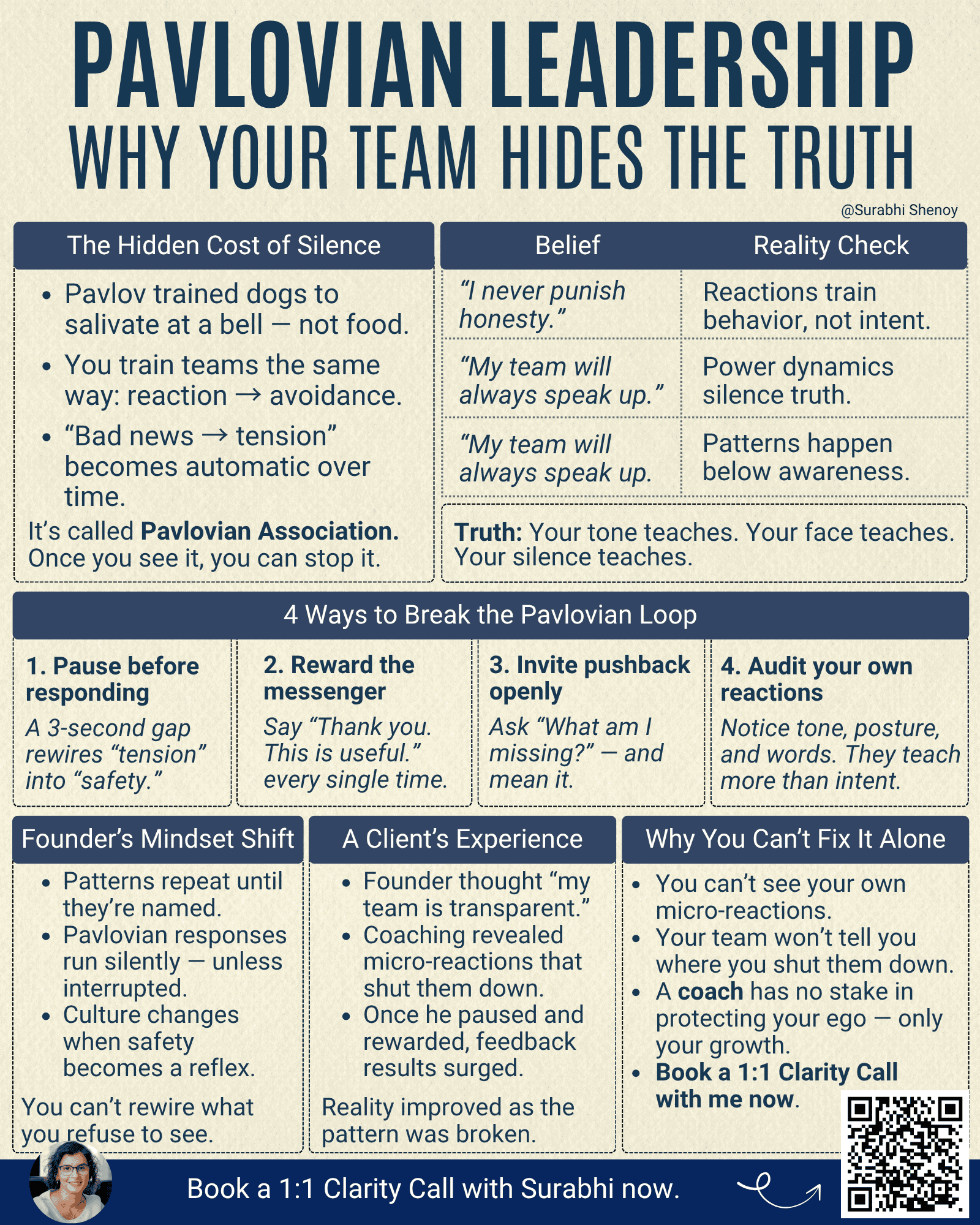
Bad news → your negative reaction → discomfort.
After enough repetitions, your team’s brains learn to avoid bringing you bad news, just like Pavlov’s dogs learned to salivate at a bell.
Within a few years, Paley was living in a “cocoon of unreality.” Everyone told him what he wanted to hear. The business looked great on paper. In reality, it was rotting from the inside.
Every acquisition CBS made under Paley was a disaster. His highly paid advisors, consultants, and investment bankers? All useless. They told him what he wanted to hear, too.
Here’s the uncomfortable truth: You’re doing this right now.
The Pattern You Don’t Notice Until It’s Too Late
You don’t think you punish for bringing bad news. You’re not a tyrant. You’re reasonable.
But watch what actually happens: Someone brings you a problem. You tense up. Your face changes. You ask sharp questions. Your tone shifts.
You think you’re “being strategic” or “digging deeper.”
Your team reads it as: This person is annoyed I brought this up.
They don’t consciously decide to hide things from you. But the next time they have bad news, they hesitate. They wait. They try to solve it first. They sugarcoat it.
You’ve trained them. Pavlovian association.
And because it’s happening below your awareness, you can’t see it until the damage is done.
Why This Gets Worse As You Succeed
At early stage: People argue with you constantly. Challenge your ideas. Push back.
This friction is healthy. It’s why you succeeded.
But as you grow, power dynamics shift. People’s livelihoods depend on you. You can fire them. They can’t fire you.
The very success that validated your judgment becomes the thing that blinds you.
You start making decisions from inside a filtered reality —confident, decisive, and half-informed.
Why This Is Hard to Fix Alone
You can’t see your own reactions in real-time.
This is where working with me helps. As your coach, I create a judgment-free space to name the pattern.
I ask: “How did your team react when you pushed back in that meeting?”
I highlight: “You just got defensive when I challenged that.”
I have no stake in preserving your ego, only in your growth. No equity, no politics, no fear of firing. My only job is to tell you what no one else will.
And I’ve seen this pattern in 70+ other founders. I know what it looks like instantly.
One Thing to Try This Week:
When someone brings you a problem, pause for three seconds before responding.
Then reward the messenger. Say, “Thank you for bringing this up. This is exactly what I need to hear.” Say it even if you’re internally screaming. Train yourself.
That gap—between stimulus and response—is where leadership lives.
By doing this repeatedly, you rewire the association in their brain, from “bad news → tension” to “bad news → safety.”
Small practice. Massive leverage. Soon, you’ll start getting the real information again.
The “cocoon of unreality” cost CBS dearly. Failed acquisitions. Missed opportunities. All because Paley couldn’t hear the truth. Eventually, he had to bring in outside leadership to save the company.
Don’t let that be your story.
📚 From My Bookshelf
Actionable insights from books that transformed me and how I built.
Book: The Art of Thinking Clearly
Some founder mistakes don’t come from bad strategy; they come from invisible thinking traps.
Rolf Dobelli’s The Art of Thinking Clearly is a guide to spotting those traps before they cost you years of progress.
I broke down the seven most dangerous biases founders face, and how to outthink them.
Here’s a list of all the books I have shared in this newsletter so far.
Thank you for being here. I will see you next Thursday.