
I recently started working with a B2B SaaS founder as a growth strategist.
Their AI product is genuinely impressive. I watched the demo recordings. I studied the use cases. There is a real need in the market.
The team is committed. They are sponsoring events, running ads, networking.
And yet, not enough demos are getting booked.
His question on our first call: “What are we doing wrong?“
Where This Usually Goes Wrong
Founders respond to such a frustration by doing more.
More ads. More outreach. More activity.
But more isn’t the fix.
The way you frame the problem determines what you do next. And if that framing is off, the actions that follow will be off too.
His question was about sales. But the real issue wasn’t sales.
It was how he was thinking about the problem.
That’s true for most founder challenges. The quality of the decision depends on the quality of thinking behind it.
What Shapes a Founder's Decisions
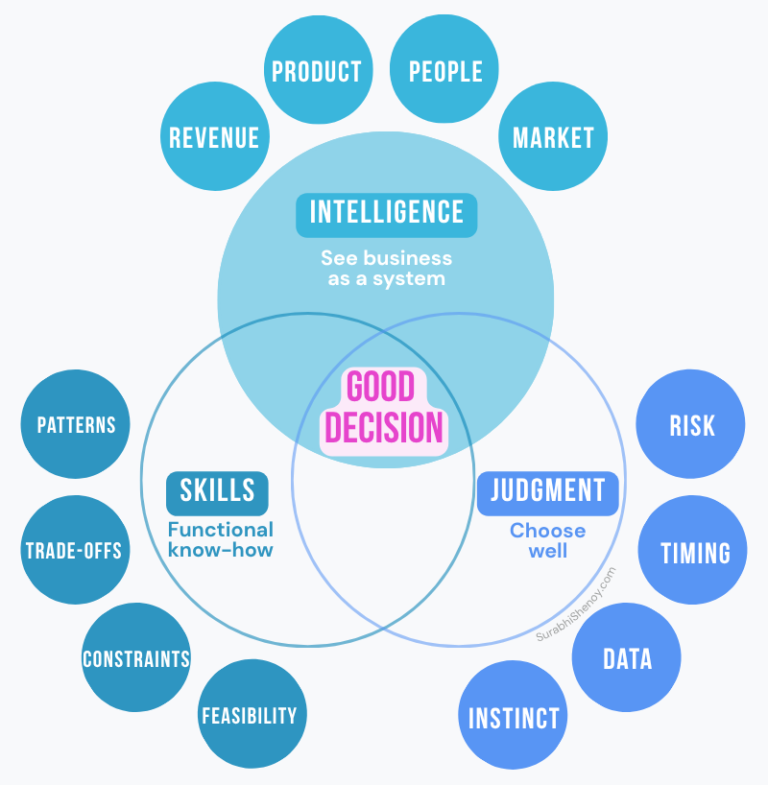
I have been refining how I think about this. Good founder decisions come down to three things:
- Intelligence — the ability to think in systems and see how parts connect. To see how revenue, product, people, and market interact with each other — and within each of them.
- Skills — knowing the domain well enough to understand constraints, trade-offs, and real-world feasibility.
- Judgment — the ability to choose well when information is incomplete, and the stakes are high.
Today, I want to show you Intelligence in action. What does it look like when a founder applies systems thinking to a pain point.
Sales Is a System with Stages
When I sat down with the SaaS founder, I didn’t start with his ads or event strategy. I started with a question.
“Walk me through what happens between a stranger hearing about your product and booking a demo.“
That question reframes everything.
Sales is a system with stages. Each stage feeds the next. If an early stage is weak, everything downstream is affected.
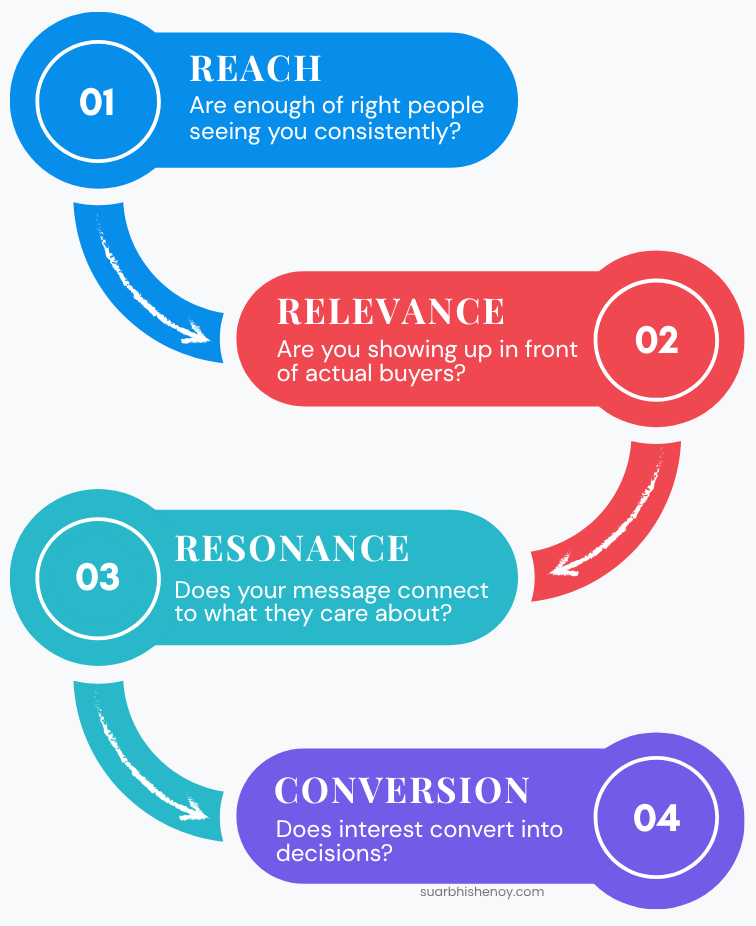
Here are the four stages:
Stage 1: Reach
Do enough people know that you exist?
This is pure visibility. Before anyone evaluates your product, they need to know about it — repeatedly. Demand is a lagging indicator of consistent visibility over time.
When reach is broken, your product may be strong, but almost nobody outside your immediate network has heard of it.
There’s also a volume problem most founders miss. In most B2B markets, you need to reach hundreds — sometimes thousands — to generate a handful of qualified conversations.
If your current volume feels like “enough,” it probably isn’t.
Stage 2: Relevance
Of the people you’re reaching, are they the right people?
You might have visibility — ads running, events, content. But if you’re reaching CTOs when your buyer is the Head of Operations, or speaking to enterprise when your product fits mid-market, more reach just means more wasted exposure.
When relevance is broken, it looks like this: people see you but they don’t engage. They’re not the right audience for what you sell. Positioning clarity is often the fix here.
Stage 3: Resonance
The right people see you. But does your message make them care?
This is where your offer meets the buyer’s world.
Does it speak to a pain they feel right now?
Does it promise a result they urgently want?
Or does it describe features and capabilities, but doesn’t trigger action?
When resonance is broken, people visit your site, maybe even attend your webinar or read your post — but they don’t book a demo. They’re not compelled to take the next step. Your offer needs to make the outcome obvious in the first few seconds.
Stage 4: Conversion
They’re interested. They showed up. Does the process close them?
This is the demo, the follow-up, and the pricing conversation. Most founders spend most of their energy here — refining the deck, polishing the pitch, adjusting pricing.
When conversion is broken, demos happen, but deals stall. Prospects say, “let me think about it,” and disappear.
(Not every demo will convert. That’s exactly why volume at the top matters so much.)
That’s a systems error. Polishing the pitch while barely anyone sees it is wasted precision.
Where the System Was Breaking
When we mapped his situation to the four stages, the picture became clear.
His events and ads were generating visibility — Stage 1 was partially working.
But the events were filled with peers and competitors, not buyers. The ads were broad and had a generic message.
Stage 2 was broken. Reach was there, but relevance wasn’t.
His team was pouring energy into Stage 4 — improving demo scripts, building better pitch decks, refining follow-up sequences.
All good work. But for later.
The system was starving at Stages 1 and 2. Not enough right people were entering the pipeline.
The fix wasn’t more effort. It was redirected effort. We narrowed the target audience, chose channels where those specific buyers gather, and rewrote the message to speak to their pain — not his product’s features.
That’s the difference between working harder and thinking in systems.
Diagnosing Why Your Sales Are Slow
If sales feel slow right now, resist the urge to do more. Instead, walk through the four stages and ask:
Stage 1 — Reach:
How many new, right-fit people are encountering my business every week?
If the answer is “I don’t know” or “not many,” this is likely your bottleneck.
Stage 2 — Relevance:
Of the people I’m reaching, what percentage are potential buyers?
If you’re getting visibility but no engagement, you have a relevance problem.
Stage 3 — Resonance:
When the right people see our message, do they take action?
If engagement is there but demos aren’t booked, your message or offer isn’t landing and creating a sense of need.
Stage 4 — Conversion:
When demos happen, do they close?
If demos are steady but deals aren’t closing, optimize the pitch, pricing, and follow-up.
Start from Stage 1. Fix the earliest broken stage first. Everything downstream improves.
Diagnose your sales system in 15 minutes
This is my R3C Growth Framework.
If you want to go deeper, the full guide walks you through each of the four stages — Reach, Relevance, Resonance, and Conversion — with diagnostic questions, common misdiagnoses, and a worksheet to pinpoint your bottleneck.
Why This Way of Thinking Matters
Founders tend to treat problems in isolation. Sales is one problem. Hiring is another. Delivery is another.
But a business doesn’t work that way. Everything is connected.
Where the pain shows up is rarely where the cause lives.
- A sales problem might originate in positioning.
- A retention problem might start with hiring.
- A delivery issue might trace back to pricing that attracted the wrong clients.
The founder who sees these connections makes one move that unlocks three things. The founder who doesn’t, makes three moves that fix nothing.
That’s what systems thinking changes. Not just how you solve problems — how you see them in the first place.
This is Intelligence at work — one of three foundations I keep coming back to in how founders make decisions. Skills and Judgement each play a different role. I will explore those in future editions.
Thank you for being here. I will see you next Thursday.
Surabhi