
Last week, on a coaching call, a founder confessed.
“I lost my cool in a team meeting. I raised my voice. I was rough with a team member.”
Then he added some context.
His baby had kept him up most of the night. He was exhausted. And in that meeting, it felt like the team didn’t understand the seriousness of the situation, they weren’t stepping up.
So hours of fatigue and frustration came out on one person in that moment.
He regretted it immediately.
A few days later, another founder shared a different situation.
Her team had spent three months pursuing a bank as a client. Strong logo. Valuable learning opportunity. They had jumped through every hoop. Negotiations were done.
When she was expecting a purchase order, procurement sent an email asking for a 15% discount on the first project.
She was furious. “We don’t have that kind of margin. They are taking advantage of us being small.” She really wanted to win this client.
Two very different situations.
In both cases, the challenge wasn’t the situation. It was their decision making while in an emotional state.
The Emotional Fingerprint Behind Your Decisions
The exhausted founder was not really choosing his tone. His state was choosing it for him.
The founder staring at the procurement email was not fully thinking through the decision. She was reacting to a sense of injustice.
This is where founder decision making starts to break down, as emotional intelligence drops.
When you are in an emotionally charged state, it doesn’t feel like you are reacting. It feels like you are deciding.
How I Check My State Before a Decision
In my own journey, I have spent more time working on myself than on the business.
That might sound strange.
But over two decades of building, scaling, and leading through some very difficult times, this is what I have learned: the quality of my decisions was never about how smart I was. It was about how steady I was when making them.
People sometimes say to me, “You are very strong.”
I smile.
I am not unusually strong.
I just have a more defined process.
And I am sharing it with you here.
Years ago, I came across the idea that emotions sit on a scale.
There are 22 of them, arranged from the lowest states — fear, grief, powerlessness — all the way up to clarity, appreciation, and calm confidence.
Here is the full scale:
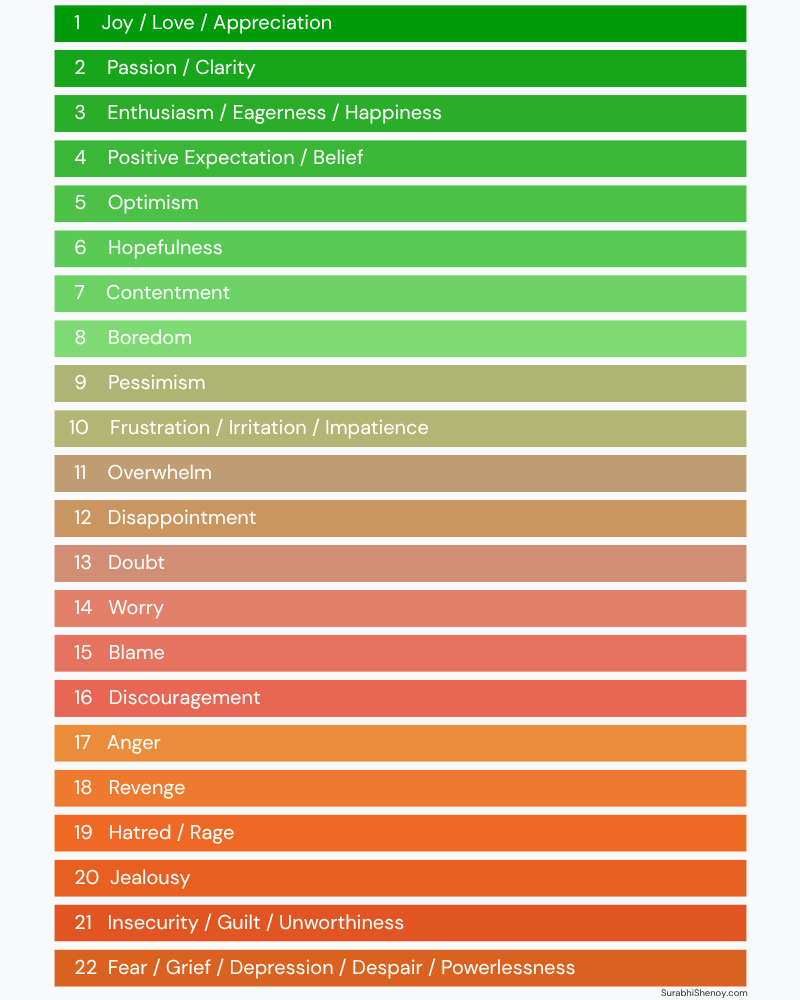
I learned to use this as a private check-in.
Frequently during the day, and espcially before making a decision, I ask myself: Where am I right now on this scale?
Am I optimistic, or irritated?
Am I clear, or in worry, disappointment, or frustration?
That small act of naming the state creates distance between what I feel and what I do next.
Then I made myself one rule.
I will not make decisions from the lower half of that scale.
If I notice I am below contentment, I stop. I sleep on it, go for a walk, or do whatever it takes to move myself up first.
The pressure to decide feels real. Urgent, even — deadlines, expectations, the fear of losing momentum.
But here is what I found: most decisions that feel like they need to happen right now can wait twelve hours. And those twelve hours often change the quality of the decision.
This is a simple way of making decisions under pressure without letting emotion take over.
The Hard Part
The hard part is not understanding this. It is doing it when the pressure to act is high. When a client pushes, a team member disappoints, money is tight, or you are tired.
The real discipline is pausing when everything inside you wants to act immediately.
I have done this through some of the hardest seasons of my life. During periods of deep uncertainty in the business. In moments where the stakes were high and the information was low.
My work on myself — the emotional labelling, pausing, the relentless practice of noticing my state before responding — paid off most during these times. When everything else was shaking, the one thing I could control was the quality of my response.
I did not always get it right. But I got it right far more often because of this practice.
This is what emotional regulation in leadership looks like in practice.
One book that shaped this deeply is Eckhart Tolle’s The Power of Now. It sharpened my awareness of the space between what happens and how I respond. That space changes the decision and the outcome. I wrote about how it changed my leadership here.
Two Decisions, Revisited
This is exactly what I recommended to both founders.
The founder who lost his cool?
If he had labelled his state — “I’m at exhaustion and frustration” — he might have postponed that conversation. The issue with the team member was real and needed addressing. But his state wasn’t the one to address it from.
When you talk to someone about performance from a place of calm, the conversation lands differently. The person hears the message. When you do it from frustration, they hear the emotion. The message gets lost.
That team member will remember the tone long after the founder has forgotten the meeting.
Now the second founder — the procurement discount.
The emotion said: “This is unfair. We jumped through hoops. They should respect that.”
The decision required a different set of questions.
- Is this client worth 15% less margin on the first project?
- What will this logo open in the next two years?
- Can I negotiate a smaller discount that protects both the relationship and the margin?
- What is the real cost of walking away?
These are strategic questions. They deserve answers shaped by calm and deep thinking.
Maybe the answer is still no. But it should be a strategic no, not an emotional one.
The steadiest founders aren’t the ones who feel less.
They are the ones who treat feelings as information, not instructions.
Success of a business is shaped by decisions its founder makes.
Let’s master the skill of Founder Decision Making.
See you next Thursday,
Surabhi
PS: Think about the last decision you made that was shaped more by how you felt than by what the situation required. Would the outcome have been different with twelve more hours? Hit reply and tell me — I read every response.
PPS: If you want to understand how founders evolve as their business grows, read Founder Growth: How to Scale Yourself as Your Company Grows. It maps the four stages every founder moves through and the skills each stage demands.