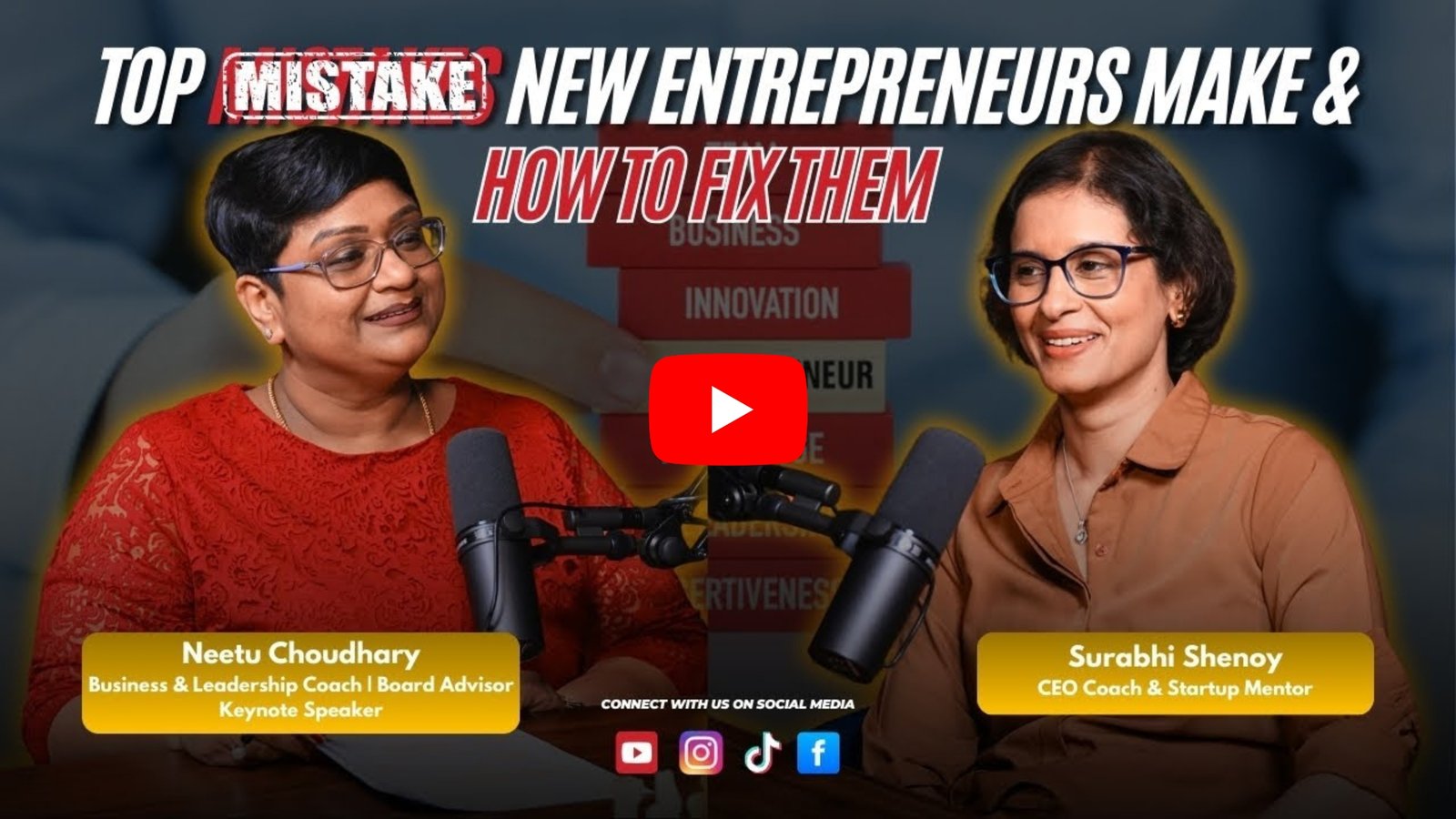
Top Mistakes New Entrepreneurs Make: Idea Validation, Cash Flow, and Scaling

Summary

In this episode of Lead With Neetu, Surabhi Shenoy shares practical lessons from building and exiting two multimillion-dollar businesses. Drawing on her experience in technology and wellness, she explains why founder growth requires constant learning, adaptability, and a clear understanding of who do you serve, whether your business is B2B, B2C, or both.


The conversation covers idea validation, founder visibility, personal branding, cash flow, margins, unit economics, hiring, and team alignment. Surabhi also explains when a business is ready to scale and why founders should build strong systems as customer demand grows.
Key Takeaways

  1. Learn Across Industries – Exposure to different industries helps founders discover ideas, practices, and opportunities that competitors may overlook.
  2. Let the Product Guide the Business Model – The customer problem, product, and founder’s expertise should determine whether the business operates in B2B, B2C, or both.
  3. Entrepreneurship Requires Adaptability – Strong founder decision-making requires leaders to continually learn, unlearn, experiment, and adjust their decisions as customers and markets evolve.
  4. Use Personal Branding to Educate – Sharing knowledge and experiences can build trust, attract strong employees, strengthen employer branding, and generate business opportunities.
  5. Validate Before You Build – Founder enthusiasm should initially be directed toward understanding customer needs, testing assumptions, and identifying objections, not immediately building the product.
  6. Protect Cash Flow and MarginsSustainable revenue and profit depend on healthy margins, clear cost structures, and positive cash flow. Without them, even a growing company can struggle to survive.
  7. Hiring Is a Non-Negotiable Leadership Skill – Founders cannot scale alone. Building a capable core team and aligning people across departments are essential for sustainable growth.
  8. Build Systems When Customer Demand Appears – Once product–market fit is visible and customers begin asking for more, founders need structured meetings, processes, reporting, and decision-making rhythms.
  9. Enjoy the Entrepreneurial Journey – Business goals will continue changing. Founders should celebrate progress, maintain perspective, and avoid allowing the company to consume their personal lives.

Timestamp

  • 00:00 – Why entrepreneurship requires continuous learning and adaptation
  • 01:05 – Introduction to Surabhi Shenoy and her entrepreneurial journey
  • 02:00 – How experience across multiple industries creates better entrepreneurs
  • 05:16 – Understanding the differences between B2B and B2C businesses
  • 08:10 – Why adaptability matters more than choosing B2B or B2C
  • 10:25 – How a founder’s personal brand influences business growth
  • 12:33 – Using content to educate, attract talent, and build customer trust
  • 16:04 – Why entrepreneurs must validate an idea before building a product
  • 17:40 – Testing a new offer and uncovering hidden customer objections
  • 20:39 – The true financial and emotional cost of experimentation
  • 21:36 – Why cash flow, margins, and unit economics determine survival
  • 23:00 – The hidden cost of underpricing and accepting the wrong clients
  • 26:35 – The most important leadership skill for scaling a company
  • 28:05 – How to recognize when a business is ready to scale
  • 29:28 – Responding quickly to unexpected market opportunities
  • 30:44 – Surabhi’s final advice for entrepreneurs and business leaders

Notable Quotes

“Entrepreneurship is about adapting, learning, unlearning, growing, and evolving.”

“Your enthusiasm should be used for validating the idea, not building the product.”

“Growth is expensive. It needs cash. Period. You cannot grow without money.”

“A cheap client is a very expensive client.”

“If you cannot hire, you cannot scale.”

“Once you have product-market fit and customers are asking for more, you are already in the scaling phase.”

“Don’t take it (building business) too seriously. It is supposed to be fun. It is supposed to be a journey.”

Want Surabhi on your podcast?

Share your show details and let's create something valuable for your audience.

Want Surabhi on your podcast?

Share your show details and let's create something valuable for your audience.

Scroll to Top
I will never spam or sell your info. Ever.