

Mindset by Carol Dweck is often spoken about as psychology.
What surprised me is how operational it really is.
Over the years, I’ve seen capable founders slow down because their relationship with learning changed. When things became harder, curiosity gave way to self-protection.
That change is subtle. And expensive.
Growth vs fixed mindset under pressure
The difference between growth vs fixed mindset becomes most visible under pressure.
A fixed mindset pushes founders to prove competence. Decisions become about looking right. Questions shrink. Risks feel personal.
A growth mindset does something else. It allows founders to stay in inquiry longer. To test assumptions without attaching identity to outcomes. To treat early signals as information, not judgment.
I’ve lived both.
There was a phase where our delivery model was clearly straining the team. I could see the friction, but acknowledging it felt like admitting a poor call. The cost didn’t show up immediately. It accumulated—in morale, pace, and trust.
Performance didn’t drop overnight. But learning did.
Learning goals vs performance goals
One of the most useful ideas in Mindset by Carol Dweck is the distinction between learning goals vs performance goals.
Performance goals focus on proving competence.
Learning goals focus on improving competence.
Most founders default to performance goals because they’re visible—revenue, milestones, external validation. They matter. But when they dominate, experimentation narrows.
When I began pairing performance goals with learning goals, conversations changed. Reviews included not just outcomes, but insights. What surprised us. What we’d test earlier next time. Ownership improved because learning felt safe.
The tone shifted. So did responsibility.
Feedback, effort, and how culture really forms
Carol S. Dweck’s research on feedback and effort is often misunderstood as “praise effort.” The deeper point is about what gets reinforced.
When feedback rewards talent, people become cautious.
When feedback rewards thinking and adaptation, people stay engaged even when things don’t work.
This is not about being nice.
It’s about keeping learning alive.
Over time, I’ve seen teams become more resilient when feedback is specific—focused on decisions and patterns, not identity.
Practices I keep returning to
There are a few practices I come back to, especially when things feel tight.
First, I try to make learning visible. Not just results. We track what we tested, what surprised us, and what we’d do differently next time. You’ll also see this in my content, whether in LinkedIn posts, newsletters, or articles like this one.
Second, I pay attention to how effort is discussed. Not as hustle, but as deliberate practice. Clear inputs. Clear reflection.
Third, I separate people from outcomes. Misses become data. Patterns become discussion.
And there is an unexpected one.
I watch my internal language most carefully when something fails.
If my first instinct is to protect identity, I pause. If it’s to understand, I lean in.
This is where growth shifts from urgency to grace. Grace is what makes learning sustainable.
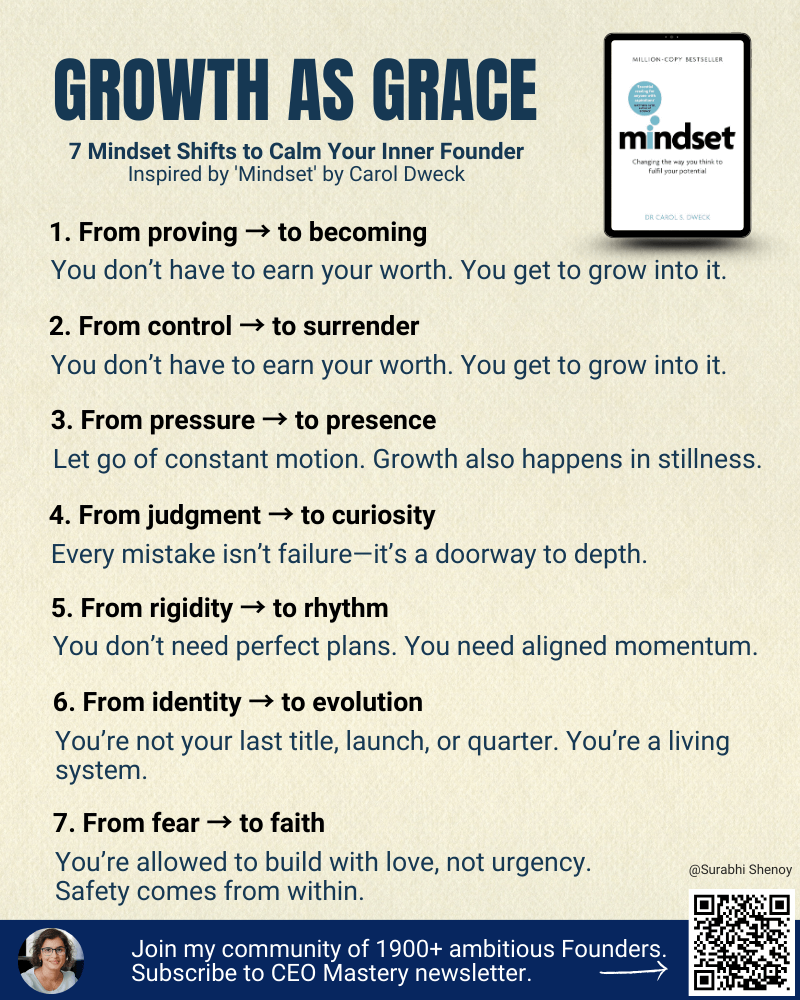
7 Mindset Shifts That Changed How I Lead
These are the shifts I made—and help other founders make—to lead with less pressure and more presence. They are subtle in language. Powerful in practice.
1. From Proving → to Becoming
You don’t have to earn your worth. You get to grow into it.
When I stopped tying my identity to outcomes, experimentation became easier. So did feedback. A missed target no longer felt like a threat to identity. It became information.
That one change made conversations calmer, and more honest.
2. From Control → to Designing Conditions
You don’t need to force growth. You create the environment where it can emerge.
That changed how I build teams. I focus less on pushing people, more on designing clarity, stretch, and safety. Clear goals. Clear reflection. Clear standards.
3. From Pressure → to Presence
Constant motion feels productive. But growth also happens in reflection.
I began protecting thinking time the way I once protected deadlines. I stopped glorifying busyness and started valuing depth. Decisions improved. So did energy.
4. From Judgment → to Curiosity
Mistakes aren’t failures. They’re data.
Curiosity shortened recovery time—for me and for my team. Instead of “Why did this go wrong?” we began asking, “What did this teach us?”
Curiosity keeps learning alive.
5. From Rigidity → to Rhythm
You don’t need perfect plans. You need adaptive momentum.
Rigid identity slows learning. When we stopped defending old strategies, we moved faster. Flexibility became a strength, not instability.
6. From Fixed Identity → to Evolution
You’re not your last title, launch, or quarter. You are a system in motion.
That perspective softened my fear of reinvention. Growth stopped feeling like a risk to credibility and started feeling like alignment.
Evolution is not inconsistency. It is maturity.
7. From Fear → to Internal Safety
Growth requires psychological safety. Not from applause, but from within.
When urgency dropped, clarity improved. When comparison dropped, creativity returned.
Safety created steadiness. From there, decisions improved.
Who This Book Is For
Mindset by Carol Dweck is an essential reading for:
- Founders stuck in the hustle loop
- High performers chasing achievement without peace
- Leaders scaling but feeling disconnected
- Entrepreneurs who want growth without constant self-pressure
This isn’t just a book on growth mindset. It is a reframing of how learning shapes leadership. And that relationship influences everything, from hiring decisions to investor conversations to how you speak to yourself after a difficult quarter.
Implementation Strategy
Reading this book changed my perspective. But applying it required structure.
Start here:
- Pick one shift above and journal how it shows up in your day.
- Reflect weekly on whether you’re leading from learning goals vs performance goals.
- Share the language of growth with your team—build collective identity around learning.
- Revisit the book every 6–12 months. It lands differently each time as you keep growing.
Growth isn’t an achievement. It’s a stance you hold.
And once that posture changes, leadership changes with it.
If this resonates, Mindset by Carol Dweck is worth reading slowly. You can explore it here.