He walked into her store and offered $7 million.
In her thick, broken English, she said, “You too cheap.”
Twenty years later, he returned.
This time he asked. “How much?”
She said, “Sixty million.”
He came back with a check for $55 million and acquired 90% of her company.
No negotiation.
No due diligence.
Her word was enough.
And the man writing the check?
Warren Buffett.
The woman who made him chase her for two decades?
A Russian immigrant who had never seen school, couldn’t speak a word of English, but built an empire starting with selling used furniture in her basement.
Mrs. Rose Blumkin — famously known as Mrs. B. — the most unstoppable founder I’ve ever studied.
Her story is one of the most powerful sets of Warren Buffett founder lessons I’ve ever come across.
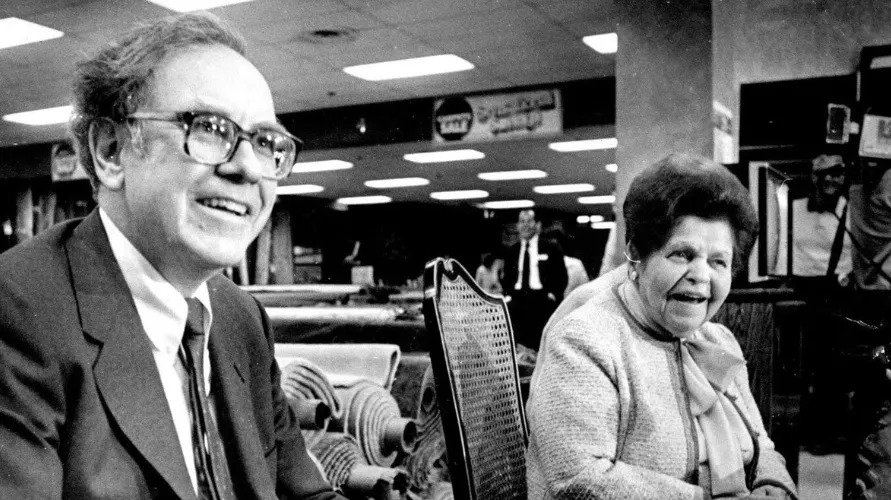
Mrs. B has been my inspiration — my invisible mentor, my course corrector ever since I started building businesses.
What Buffett Saw in 1963
When Warren Buffett first visited Nebraska Furniture Mart (NFM) in the 1960s, he wasn’t looking for inspiration.
He was looking for undervalued assets — businesses with exceptional economics.
And what he found in Mrs. B’s furniture store stunned him. It became the basis for several timeless Warren Buffett founder lessons.
Here’s what Buffett saw and what we can learn from it:
1. A Cost Structure No Competitor Could Touch
Nebraska Furniture Mart had the lowest cost-to-earnings ratio Buffett had ever seen in retail.
She ran the business with:
- microscopic overheads
- fast inventory turnover
- no frills, no waste
- tight control on every dollar
- relentless negotiation discipline
Every dollar saved went straight to the customer — and that price advantage fueled more volume.
Founder’s Insight:
Revenue reveals very little.
Cost structure reveals everything.
If you don’t know what it truly takes to earn each dollar, you’re running blind.
2. “Sell Cheap, Tell the Truth” — A Strategy, Not a Slogan
This was Mrs. B’s entire philosophy — simple, clear, and uncompromising.
Her pricing wasn’t “low.”
It was mathematically unbeatable because her operations were built for speed and scale.
Competitors sued her for “bootlegging.”
She turned those legal cases into free publicity.
Customers drove across states to buy from her, because they trusted her prices and her word.
Clarity → consistency → trust → domination.
A four-step flywheel that hasn’t aged a day.
Founder’s Insight:
Pricing is not confidence.
Pricing is your operating system.
You can’t charge like Mrs. B unless you operate like Mrs. B.
It’s one of those rare Warren Buffett founder lessons that still holds today.
3. Inventory Mastery (Without Software)
Buffett saw her walk the floor and instantly point out:
- how long an item had been on display
- what she paid for it
- how quickly it would sell
- where she could move it to sell faster
This was 1963.
No ERP.
No dashboards.
Just pure operational obsession.
Founder’s Insight:
Most founders know their topline.
Few know their cost structures and delivery cycles with this level of intimacy.
4. A Competition-Obsessed Saleswoman
Mrs. B didn’t run a store — she lived it.
People who knew her often said if you admired a sofa in her home, she’d offer to sell it to you on the spot. She wouldn’t miss an opportunity to sell.
She was notoriously competitive.
She’d spend weekends driving to competitor stores, checking parking lots, observing foot traffic, and studying how fast their items moved.
Her advantage wasn’t analytics.
Her advantage was attention. She watched customers, competitors, and demand shifts in real time.
Founder’s Insight:
Most founders look at reports.
Great founders look at the market.
If you stay closer to the customer and competition than anyone else, you will always know how to win.
5. Speed, Hard Work & Grit — The Founder’s Operating System
Employees moved fast because she moved fast.
Her pace became the company’s pace.
Into her 90s, she was still on the floor — supervising inventory, talking to customers, making decisions. When walking became difficult, she used a motorized cart and still “moved at her speed.”
And then there was her grit.
Undervalued as a woman.
Dismissed as an immigrant.
Mocked for her accent.
Insulted by suppliers.
She didn’t just overcome adversity — she metabolized it.
Hard work was her identity.
Founder’s Insight:
Momentum and resilience are the two most underestimated assets in business.
Slow founders build slow companies.
Disciplined founders build empires.
Buffett doesn’t chase hype.
He was evaluating a machine, and Mrs. B had built one of the finest he’d ever seen.
The cost discipline, the pricing clarity, the inventory speed, the competitive edge, the grit — together, they created irrefutable economics.
That’s what he was buying.

The Twist in the Plot
Mr. Buffet acquired NFM in 1983.
Mrs. B was 89 years old.
But the story doesn’t end with this acquisition; it gets juicier.
Years after the acquisition, conflict grew between Mrs. B and her grandsons, who were involved in the business.
She walked out of the company.
She opened her new store right across the street.
She was 95 years old.
It was called Mrs. B’s Clearance and Factory Outlet.
And customers didn’t hesitate — they crossed the street with her.
Old suppliers quietly returned.
When Buffett acquired 90% of NFM, he made one assumption: At 89, Mrs. B would retire. And he didn’t need a non-compete from her.
He was proven very wrong.
On her 98th birthday, Buffett went with flowers and chocolates and said:
“I’ll buy this one too.”
He paid $5 million to buy her out a second time.
And this time, he made her sign a non-compete. 🙂
Anybody trying to convince investors and acquirers of their valuation must study her ways.
Mrs. B eventually passed away at 104, outliving her competitors, the people who doubted her, and the many who underestimated her because she was poor, foreign, and a woman.
Why She Inspires Me
Whenever I question myself — the pace, the path, the pressure, the point of it all —
I ask myself: “If a poor, illiterate woman could do this again and again…what’s your excuse, Surabhi?”
And instantly, I’m back on track.
Her story forces me to operate from courage and discipline.
She reminds me that building a business is all about relentless forward motion — at any age, under any circumstance. It’s why her story remains one of the great Warren Buffett founder lessons on discipline and grit.
As We Step Into 2026…
Maybe you feel tired.
Behind.
Uncertain.
Pulled in too many directions.
Or wondering if you have what it takes to start, restart, or reinvent.
Let Mrs. B remind you:
You are not too late.
You are not too old.
You are not underqualified.
You are not done.
You have time.
You have resilience.
You have grit.
And you have something worth building.
She built an empire.
Walked away.
Then built another one at 95.
And never stopped being who she was.
If she could do it then, you and I can do it now.
Plan your 2026 to be the year you prove it — to yourself, before anyone else.
I love Mrs. B’s story, and I worked hard to honor it in this edition.
If it offered value, consider giving me a testimonial here.
See you next Thursday,
Surabhi
PS: I’ve studied Mrs. B everywhere — old interviews, newspaper archives, even the few grainy YouTube videos of her speaking.
If you want to go deeper into her story, there’s an excellent chapter on her in Women of Berkshire Hathaway. I’ll leave a link here in case you want to explore it.