
Every month, I receive at least one email like this.
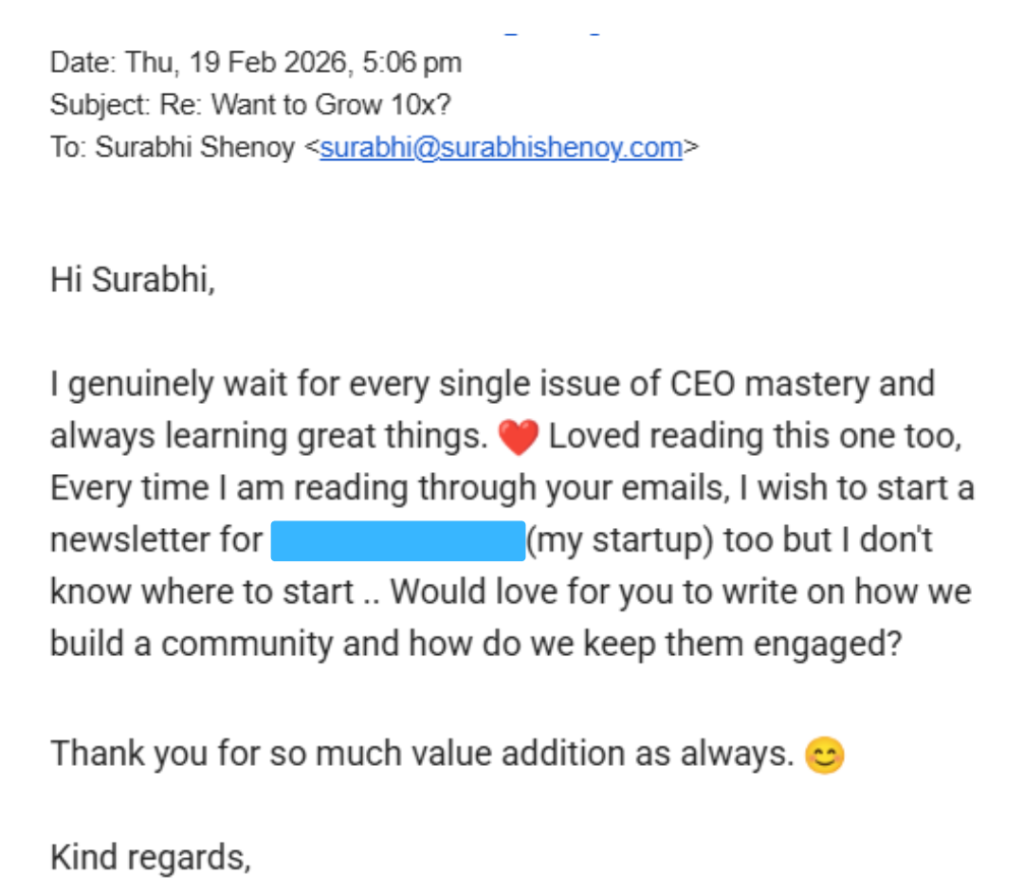
They enjoy reading CEO Mastery.
They want to build something similar for their own business. They want to know how to start.
So today, I’m not writing about revenue or valuation.
I’m sharing why I started CEO Mastery in the first place — and why I believe every serious business should build an email list.
Writing As A Way of Thinking
After my second exit, I made a long list of “what I do not want to do” in my next venture.
I had managed large teams and enterprise clients. I had built scale. Now I wanted something smaller in operation — but deeper in impact.
I returned to something I had always done.
I wrote.
For years, writing has been how I processed decisions. When I was uncertain, I wrote. When I needed clarity, I wrote.
Writing is how I thought.
The difference now was this: I did not want to keep that thinking private. I wanted to write for the founders I was helping.
Learning To Write In Public
Writing for personal clarity is different from writing for an audience. So I joined the Ship 30 for 30 cohort to learn the mechanics of digital writing.
The biggest lesson was simple: do not write in isolation.
Digital writing is iterative. You publish, listen, refine.
That’s how LinkedIn began for me. It became my feedback loop — not just for improving writing, but for choosing direction.
Then came another layer.
If you want to grow on Linkedin, you should study Justin Welsh. 🙂
He spoke constantly about one idea: build distribution before you build a product.
Your audience will tell you their wants and needs and then (and only then), you build.
That got me serious about posting on Linkedin every day.
When Leverage Became Clear
Somewhere along the way, I read that James Clear secured his Atomic Habits book deal because he had a 100,000+ subscriber list.
That was leverage.
An email list is owned attention. It is not rented from an algorithm.
Then I read about Morning Brew. It had grown to about 3 million subscribers and was sold for $75 million — not for the content alone, but for the distribution it had built.
When you walk into a room with consistent, direct access to your audience, conversations change.
Publishers take you seriously.
Investors take you seriously.
The market takes you seriously.
Attention compounds when it is owned.
Around the same time, I heard Ali Abdaal say: Own a small strip of the internet, even if you don’t know what you’ll build on it yet.
So I bought SurabhiShenoy.com.
I remember thinking — who am I to have a website in my own name?
It felt indulgent. But the cost of that was so low that I did it anyway.
Later, it changed how I saw myself.
Where It Came Together
Over time, these ideas converged.
Writing in public.
Building distribution.
Owning attention instead of renting it.
CEO Mastery was born.
It was the start of building an asset.
Why Every Business Needs An Email List
Now let’s make this practical.
In today’s business landscape, content marketing is not optional.
If your company shows up consistently in your potential client’s inbox — with clarity, with insight, with usefulness — something powerful happens.
You build familiarity without pressure.
You build trust before the sale.
And when their problem reaches a point where they can no longer tolerate it…When the frustration needs an urgent fix…When they finally decide to act…
Your name is the first one they think of.
That is the power of being present before the decision.
You don’t chase.
You are remembered.
An email list gives you direct access. No algorithm. No volatility. No rented reach.
That is not marketing.
That is leverage.
Do People Still Read?
I hear this often: “People don’t read. They only watch videos now.”
I don’t see that in serious buying decisions.
There is a limit to noise. A limit to reels, edits, stimulation. After enough scrolling, we crave calm. We crave space to think. You can watch a video and pick up ideas but behavior change happens when you reflect.
When you read, you pause, you sit with an idea long enough for it to influence a decision.
Any meaningful sales require behavior change:
- Booking a call/demo
- Switching vendors
- Upgrade to next tier
- Allocating budget
These decisions involve risk.
Risk is processed slowly.
Email creates space for that processing.
When someone reads your thinking over time, they understand how you approach problems. They see how you make decisions.
That builds conviction.
And conviction drives action.
The Mechanics
The tools are not complicated.
I use Kit as my distribution platform.
LinkedIn drives subscriber growth.
Website SEO is becoming my second channel.
There are many email platforms — Beehiiv, Substack and others. Choose a clean, reliable platform with strong deliverability.
Do not choose based only on price.
Protect your ability to reach your audience.
Even with all this care, sometimes my welcome emails land in spam. That’s part of the game.
The harder part is not the platform and tech. It is quality and consistency.
I chose a weekly rhythm. And so far I have been able to keep my promise. This is Week 86 — 1 year and 8 months. Not bad for a streak 🙂
Start with a rhythm you can sustain. Content quality matters more than volume.
Getting subscribers is one thing. Losing them to the unsubscribe link is another. So make a clear promise — and honor it.
If you promise education, give education.
If you promise product updates, give updates.
Trust, like distribution, compounds.
CEO Mastery Is a Startup
Today, I look at CEO Mastery as a startup.
It has distribution.
It has IP.
It has trust capital.
It has a product ladder.
Everything I build feeds this asset.
Courses.
Coaching.
Speaking engagements
Future books?
It may appear free to the reader but it’s an asset that generates revenue today and continues to compound in value.
And if you have been a long-time reader of CEO Mastery, you know that I repeat one principle: Build a high-value business.
So this is me practicing what I preach.
Play The Long Game
You don’t need to become a writer. But your company should build an email list.
Build distribution before you desperately need it. Start small. Show up consistently with value.
Over time, direct access to your audience becomes one of your most valuable assets.
That’s how this one began.
And that’s how it will grow.
See you next Thursday,
Surabhi
P.S. Around the time my exit was completed in February 2022, Lata Mangeshkar passed away. For those outside India, she was a legendary singer whose voice shaped generations. I remember thinking: will she ever truly be gone? Her voice will still be heard decades from now. That moment inspired me to think of creating something that lives beyond me, and then rest of the research and insights helped me commit.