
Just because you’re busy doesn’t mean you’re building something valuable.
That truth hits hard—for all of us.
It’s possible to grow revenue, hire fast, run hard…
And still build a business that isn’t worth much.
Founders with packed calendars, solid revenue, and proud teams—
But one question makes them pause:
“If someone offered to buy your company tomorrow…
What exactly would they be buying?”
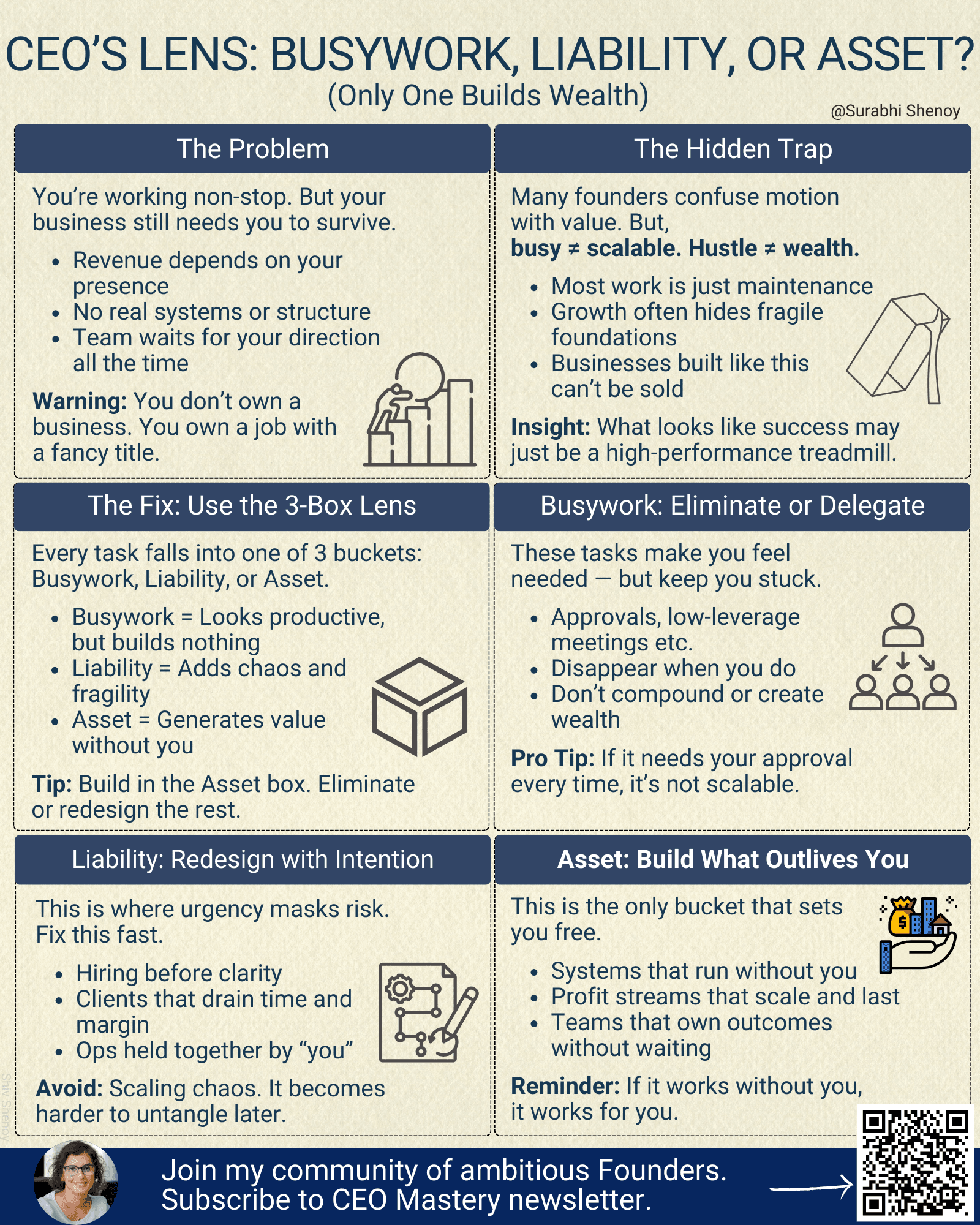
The Hidden Trap
When I ask founders this, here’s what often emerges:
- Systems live in the founder’s head.
- Clients rely on their personal touch.
- The team follows—but only when the founder leads.
- Growth depends on hustle, not structure.
What looks like a thriving company… is actually just a high-performing individual with support staff.
It feels like progress.
But it’s a trap.
Because motion ≠ momentum.
And momentum ≠ value.
You can build a business and still not be building an asset.
What Do I Mean by “Asset”—And Why It Matters Now
Let’s be clear. I’m not talking about what shows up on your balance sheet.
Sure—equipment, IP, or property are assets on paper.
But they don’t automatically make your business an asset.
An asset business is one that creates transferable, compounding value:
- It runs without your daily input.
- It is driven by systems and strong management team.
- It’s the kind of business someone else would want to own.
You can have a product, a team, or physical assets… But if the business falls apart without you, it’s not yet an asset. It’s an income machine powered by one person.
Busywork. Liability. Asset.
Every task, process, and decision in your company falls into one of three buckets:
1. Busywork
Looks productive, but doesn’t build anything lasting. It doesn’t compound.
Your calendar is full. And you are busy with approvals, admin, and meetings that change nothing.
📌 Why it’s not an asset:
It only works when you’re present. It creates motion, not momentum, and no transferable value.
2. Liability
Feels necessary, even urgent. But adds risk and chaos.
This is growth without design —hiring without clarity, unprofitable clients, and operations somehow held together.
📌 Why it’s not an asset:
Because it increases fragility. Liabilities make your company harder to run, harder to scale—and far harder to sell.
3. Asset
Generates value today—and multiplies it tomorrow.
It’s not just something you built—it’s something someone else would buy. It has systems, structure, and team depth. It has Profit streams that are predictable and protected.
📌 Why it is an asset:
Because it generates transferable, compounding wealth.
Even if you get replaced, it will continue to sustain and scale.
Fact is, most founders accidentally build a mix of all three.
But only one sets you free.
What Are You Really Building?
Let’s get brutally honest:
- What part of your business could operate without you—for real?
- If you disappeared for 30 days—would it run, stall, or collapse?
- Can your team create value without your constant input?
- When you open your calendar, how much time is spent building assets… and how much is just spinning wheels?
- What’s one liability you’ve been avoiding fixing?
- Are you building something that pays you well… or something that could one day make you rich and set you free?
You don’t need a business that looks good.
You need one that thrives beyond you.
Your Opportunity (Grab it now):
Want real traction—not just talk?
Reply and tell me: What’s one liability you need to turn into an asset?
This week, I’ve opened 3 Power Hour slots— usually $349, free for the first 3 founders. It’s first come, first served. Reply now if you want to grab one.
See you next Thursday,
Surabhi
P.S. The most common liability I see founders struggling with? Systems that only exist in their heads. What’s yours?