
Selling any new idea — a product, a feature, a service, always hits a wall of objections.
“That’s not how we work today.”
“Your system can’t do what we do manually.”
“The old way is good enough.”
Humans are deeply attached to what already exists.
Even if the old way is painfully inefficient, we defend it.
Founders fight this resistance every day.
And when you try to defend your product against the old way, you lose the comparison before the conversation even begins.
Jeff Bezos faced the same pushback — twice — and what he did next is a masterclass in reframing.
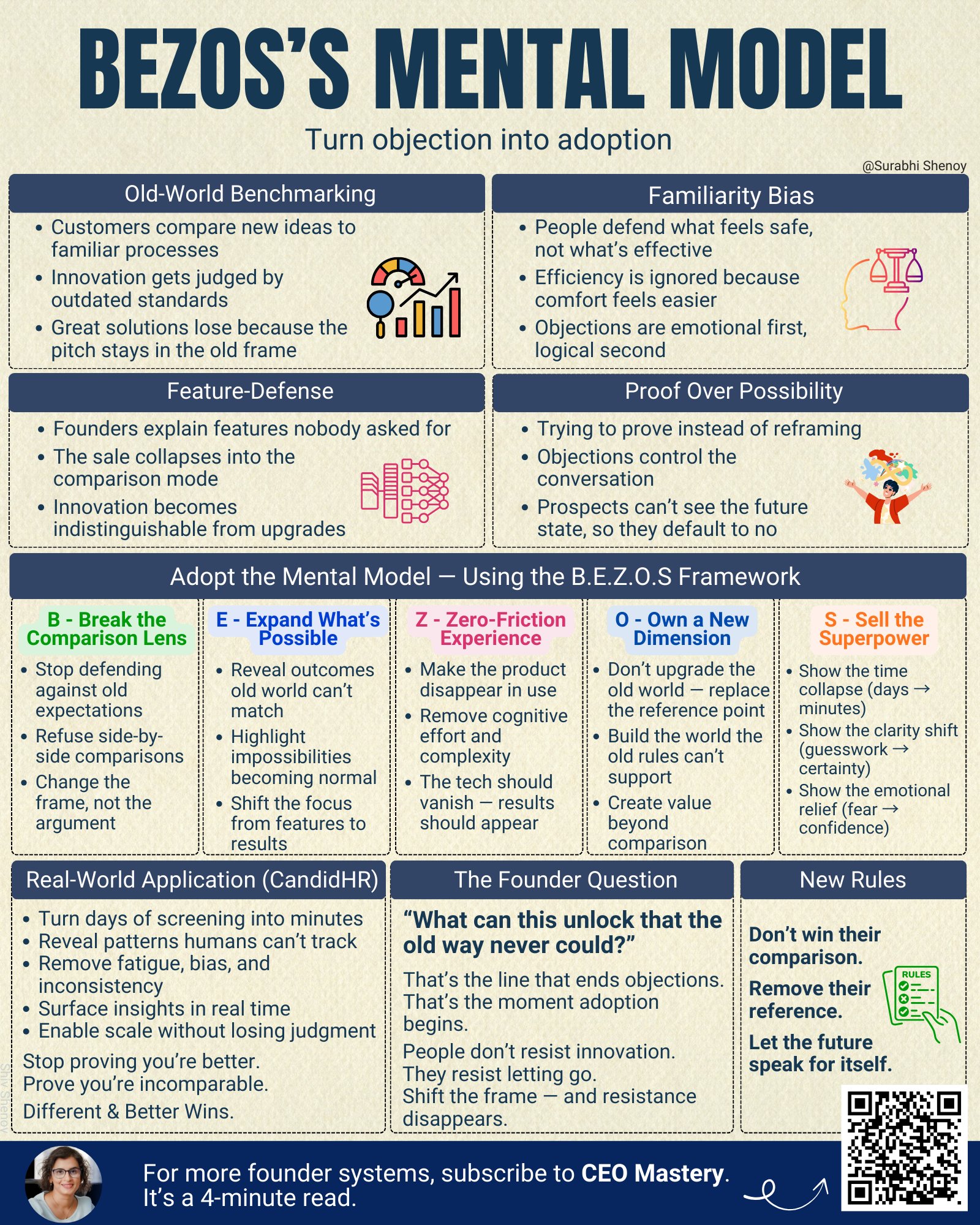
His approach became a blueprint; a mental model founders can use to turn resistance into adoption.
How Bezos Innovation Model Reframed the Game
When Bezos launched Amazon.com, people focused on what it couldn’t do
Everyone compared it to a physical bookstore, and the objections were endless:
- “But you can’t have book signings.”
- “There’s no cozy corner to sit and read.”
- “Where’s the aroma of books? The coffee? The ambiance?”
- “A website will never replace a bookstore.”
Bezos didn’t defend.
He noticed that people were benchmarking a new medium against the limitations of the old one.
So he offered a different paradigm:
“Instead of trying to duplicate physical bookstores, we looked for things we could do in the new medium that could never be done in the old one.”
That single sentence is an important lesson in product differentiation.
Amazon didn’t try to replicate the physical bookstore.
They shifted the game entirely by highlighting what only the new medium could offer:
- Browse millions of titles
- Read customer reviews
- Discover “people who bought this also bought…”
- Buy books without pressure or time limits
- Shop 24/7
It wasn’t a digital copy of a bookstore.
It was a new world — one that the old medium could never offer.
A world that made the comparison irrelevant.
This insight isn’t mine. It comes straight from Jeff Bezos’ 2007 shareholder letter, included in the book Invent & Wander. If you haven’t read it, it’s one of the clearest explanations of how founders should think when building and going to market. Bezos wasn’t just describing Amazon — he was teaching a mental model.
And then he did it again with the Kindle
Years later, while designing the Kindle, Bezos offered a simple insight:
“The book’s most important feature is that it disappears.”
When you read a book, the medium dissolves.
You enter the author’s world.
So the Kindle had to “get out of the way” too — not feel like a device at all.
But Bezos made another crucial point.
“We must not try to out-book the book — a 500-year-old medium perfected over centuries.”
The Kindle didn’t compete with the book.
It expanded what a book could be:
- Get any title in 60 seconds
- Carry thousands of books
- Sync highlights across devices
- Search your notes instantly
- Read in the dark
- Never run out of stock
- Access out-of-print books
It wasn’t an upgrade.
It was a new dimension.
A different game entirely.
And this is the exact mental shift founders need when they’re innovating today.
Where most founders lose the game
Most founders lose the game in the comparison phase.
They build something powerful — but end up defending it against the old way of doing things.
And the moment you let the buyer compare, you’ve already lost.
I’m seeing this shift play out in real time with a business I advise.
Their AI-powered résumé screening platform, CandidHR.ai, kept facing the same objection:
“But it doesn’t work like our manual process.”
A manual process that is slow, inconsistent, biased, and deeply inefficient — yet still defended because it’s familiar.
This is exactly where Bezos’ model becomes transformative.
The real question isn’t:
❌ What can’t this replicate from the past?
The real question is:
✔️ What does this unlock that the old way never could?
Once you shift the frame, everything changes.
For example, a platform like CandidHR unlocks outcomes that manual screening cannot touch:
- Turn days of screening into minutes
- Remove fatigue, bias, and inconsistency
- Reveal patterns no human could possibly track
- Shortlist at scale without losing discernment
- Provide real-time insight instead of backward data
The “old way” might be familiar, but the “new way” offers superpowers the old world can’t match.
Just as Amazon didn’t replicate bookstores, and Kindle didn’t replicate paperbacks, your product shouldn’t replicate the past.
A universal founder pattern
The great builders always do this:
- Bezos — build what physical reality cannot
- Jobs — “The best technology is invisible”
- Disney — the magic happens in what the audience never sees
- Phil Knight — sells the feeling of winning, not shoes
They don’t compare.
They don’t mimic.
They redefine.
They transcend.
They create products that feel impossible in the old world.
The founder question that changes everything
Ask yourself:
“What superpower does my product unlock that the old way never could?”
That’s where your advantage is.
That’s where your differentiation lives.
That’s where customers say, “Oh — we have to have this.”
Let that answer reshape your pitch.
Closing Thought
Bezos writes:
“We humans co-evolve with our tools. First, we change our tools, and then our tools change us.”
Your product will change your customers.
It will change how they work, think, decide, and operate.
So don’t pitch it as an improved version of the old way.
Pitch it as the doorway to a new way.
When you stop defending the past, you help customers see how your new tool will reshape their future.
Did you enjoy this edition?
Consider giving me a testimonial here.
My Recent Top Post
Salary cost was the single biggest pressure point in my tech company.
Mastering it changed our entire bottom line.
Last week, I shared the 12 levers we used to optimize salary spend without hurting talent, quality, or delivery speed.
It struck a chord with a lot of founders navigating the same tension.
Thank you for being here, I will see you next Thursday.
Surabhi
PS: This edition was inspired by the book Invent & Wander. A highly recommended read for every founder. Get Invent & Wander – Jeff Bezos
This is an affiliate link. Your purchase through this link, at no extra cost to you, supports the newsletter.