
65% of startups shut down because of founders conflict.
Not because the idea was weak or the market wasn’t ready — a common myth behind startup failure.
But because the partnership broke.
That number stayed with me ever since.
Earlier this year, I started coaching a managing partner. She was struggling with co-founder issues around alignment and compatibility. Watching it up close reminded me of what I had lived through in my 20 years of building — how quickly small cracks turn into big problems.
It pushed me to study partnerships more deeply. I took notes from “Poor Charlie’s Almanack” and Elon Musk’s biography.
On one side, Charlie Munger and Warren Buffett built a partnership that lasted more than 60 years.
And on the other, Elon has strong views on who cannot be a co-founder.
And then there’s my own story. I co-founded both my businesses with my husband. Trust me, the stakes are even higher when your personal and professional life intertwine. Those years taught me how powerful, and how delicate, co-founder dynamics truly are.
This 2-part series on the founder journey comes from all those lessons.
Part 1: If you’re choosing a co-founder, I hope it helps you choose wisely.
Part 2: If you already have one, I hope it helps you strengthen the partnership.
Let’s dive in.
Choosing a Co-Founder Is a High-Stakes Decision
A co-founder partnership is far closer to marriage than most founders admit.
You’re tying your future, and your reputation to someone else. And together you’re responsible for employees, customers, investors, and every promise you make to the world.
That’s why choosing a co-founder is one of the most high-stakes decisions you’ll ever make.
We often choose co-founders for reasons like:
“We vibe well.”
“She’s strong where I’m weak.”
“Investors prefer multiple founders.”
None of these are wrong. They’re just incomplete.
What you really want to know are the traits of a good co-founder — how someone thinks, behaves, decides, or perseveres, especially under pressure.
Let’s begin with a partnership that truly lasted.
The Partnership That Worked for 60+ years
When Buffett was 29, he was pitching an investment idea over dinner. His host agreed to invest immediately. Surprised, Buffett asked why.
The host replied: “You remind me of someone I know.”
That person was Charlie Munger.
Buffett and Munger had not yet met. A third party spotted a similarity before they even sat together.
When they finally met at dinner, the connection was instant.
They spent hours talking, asking questions, and challenging each other in a way that felt energising, not competitive.
They were different in personality — Munger was blunt and direct; Buffett was gentler and more diplomatic — but they cared about the same things. They both believed in independent thinking, rational decisions, and avoiding unnecessary complexity.
Buffett said: “Charlie and I disagree all the time, but we’ve never had an argument.”
This is a rare kind of compatibility, and it matters more than any résumé.
Five Filters for Choosing the Right Co-Founder
These filters are not quick tests, and they are not a list of interview questions.
You uncover who someone really is through deeper conversations — their backstory, relationships, finances, successes, and setbacks. You understand them by seeing how they’ve actually lived their life.
Just like dating before deciding on marriage.
So here are the filters that matter most.
1. Worldview and Judgment
You don’t need to think the same way.
But your thinking needs to work well together.
You begin to notice this in people — how they talk about their past decisions, how they handled difficult moments, and how they think about trade-offs.
Try to find out:
- When something breaks, what do they pay attention to first?
- How do they choose between two imperfect options?
You’re not looking for agreement.
You’re looking for how their mind works.
If their reasoning pattern sits well beside yours, partnership becomes easier.
If it doesn’t, even small decisions start to feel heavier.
2. EQ and Resilience
People show their real selves under pressure.
What happens when a big client delays payment, a key hire quits, or a launch flops?
Do they:
- Blame, panic, or disappear?
- Or stay steady, think, and move into problem-solving?
Buffett and Munger were calm, deep thinkers and fast movers.
Find out: Can they stay composed? Do they have that self-awareness?
Higher Emotional Intelligence (EQ) is a real advantage here.
You don’t want a co-founder whose emotional swings become another variable to manage. You want someone who brings clarity when things get difficult.
3. Partnership Over Ego
Every long-term partnership has moments of friction.
Friction isn’t the problem.
Ego is.
Ego says:
“I’m more important than the business.”
“My idea is the right idea.”
“I deserve more credit.”
Partnership says:
“We protect the mission first.” That’s real trust in business.
“We win together.”
“Let’s find the right answer, not my answer.”
This difference determines whether you build together for decades or part ways in a few years.
You can often spot this early in small ways: how someone talks about past colleagues, how they share credit, how they react when their idea isn’t chosen, and how they handle being wrong.
Ego doesn’t have to disappear. It just needs to be pointed at the mission you’re building — at feeling proud of the company you’re creating together.
4. Shared Direction and Ambition
Two people can work well together only if they’re moving toward the same destination and they agree on the speed, because speed reflects risk appetite.
My husband and I were complete opposites. He was the risk-taker; I battled analysis-paralysis. He chased ideas and dived head-first; I focused on operations and execution.
But we agreed on where we were going.
That alignment made our differences useful instead of stressful.
Spend time talking about:
- what “good” looks like
- what scale means
- how each of you sees the next three years
- the kind of company you want to run
- what you want to avoid becoming
If you get this part right, the journey feels lighter. You can look back and laugh at the setbacks. You push forward confidently knowing someone is watching your back, and then the hard days don’t feel as heavy.
Shared direction creates that feeling.
5. Skin in the Game
When Elon Musk wanted rocket engineer Tom Mueller to join SpaceX early, Mueller had one request: two years of salary placed in escrow in case the company failed.
Elon agreed. He would have made Mueller his co-founder, but he hired him as an employee.
If someone wants the upside but not the downside, their commitment is conditional.
Skin in the game doesn’t have to be financial.
It can be time, reputation, or opportunity cost.
But it must feel significant enough to anchor long-term alignment.
A founder is defined by what they’re willing to risk — not just what they can contribute.
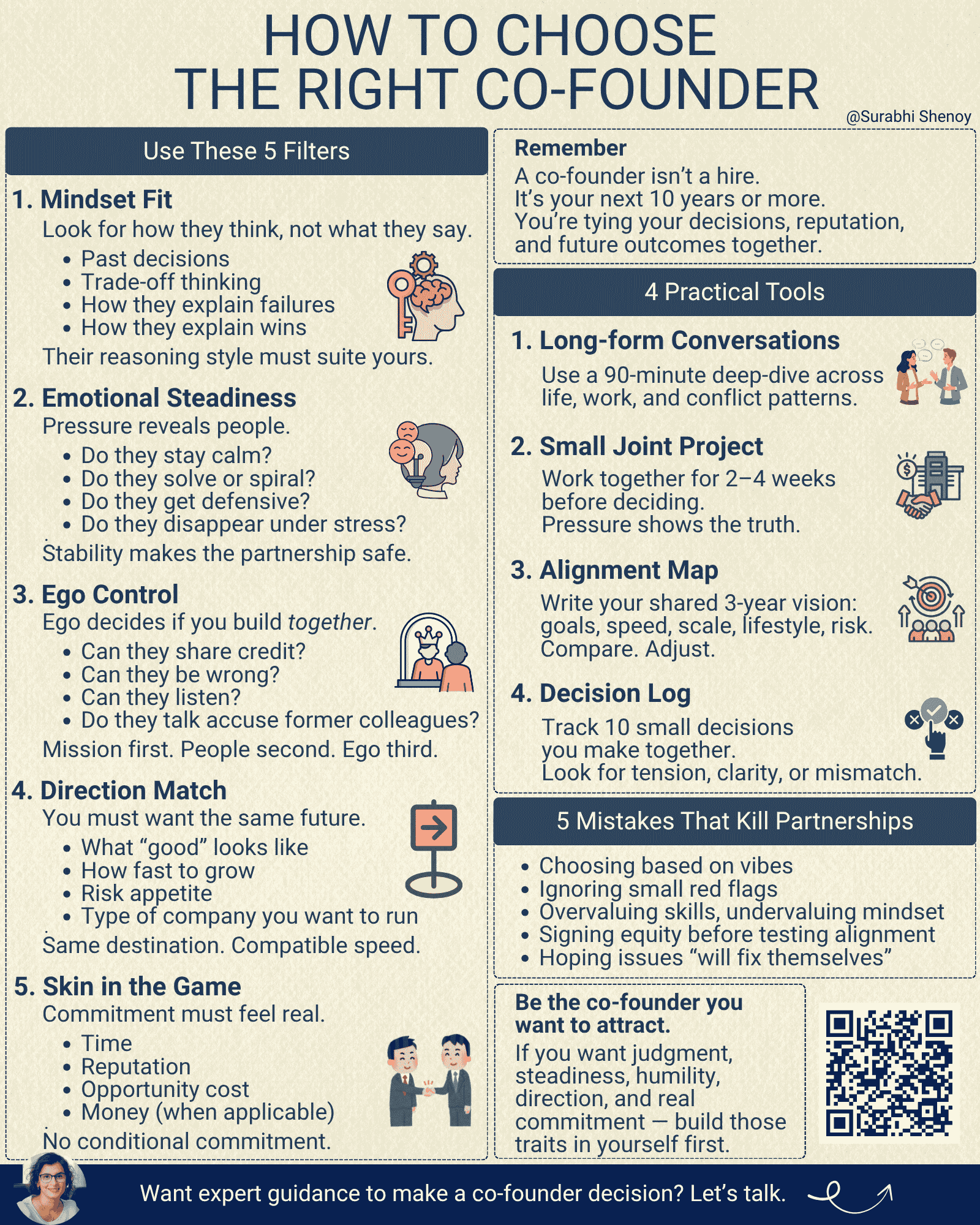
Be that Founder First
Choosing a co-founder is choosing the next decade of your life.
So take the time to see who they truly are beyond their skills, titles, initial enthusiasm.
And don’t force-fit what you want to see because you’re in a hurry to move forward.
Finally, the coach in me has to say this: the partnership you want begins with you. If you want a co-founder with judgment, resilience, humility, shared ambition, and skin in the game, be that founder first.
You attract the kind of partner you already are.
I hope this edition of CEO Mastery helps you choose wisely and build something meaningful.
If you want expert guidance before making a high-stakes co-founder decision, let’s talk.
Next week, in Part 2, we’ll go deeper:
How to work with a co-founder — communication, conflict, decision rights, ownership, and the systems that make partnerships last.
Did you enjoy this edition?
Consider giving me a testimonial here.
I will see you next Thursday,
Surabhi
PS: Black Friday Sale: Get 50% OFF on Founder’s Freedom Blueprint.
65+ founders are already using it to step out of daily operations.
Grab your spot now.
PPS: If you enjoy learning from giants, these two are must-reads:
– Poor Charlie’s Almanack
– Elon Musk by Walter Isaacson
They’ll change how you think about people and partnerships.
Note: These are affiliate links. Your purchase helps support the time and research that goes into each edition — thank you!