
This is the wall you’ll hit:
You want your team to make decisions.
But they keep coming back to you.
You say, “I trust you,” but they hear: “Make decisions, and I’ll judge them later.”
Your team isn’t scared of making decisions.
They’re scared of making decisions that don’t match your thinking pattern.
The Hard Truth About Founder Intuition
Your instincts built this company.
Your quick decision-making got you here.
Your pattern recognition created success.
But now, these same instincts become a bottleneck when scaling. Every time your team waits for your input, your company moves at exactly one speed: your availability.
The Hidden Power of Systems
Consider this: A call center agent can resolve most customer issues without escalation. Not because they’re experts but because they have a clear decision tree.
If this happens -> do that.
If that occurs -> try this.
Like most founders, you’ve never paused to think about creating such systems for your business.
You’ve built your business on instinct, gut feelings, and years of pattern recognition.
But have you ever stopped to ask:
Do I even know how I make decisions?
That’s the real challenge.
You’ve never had to explain or document how you think.
Scaling, though, demands a shift.
You need to turn what’s in your head into something your team can understand and use.
And no, this isn’t about creating SOPs.
SOPs tell people what to do.
Your Company OS teaches them how to think like you.
It’s about capturing your decision principles, not just your processes.
How I Turned My Hiring Intuition Into A System
Like many founders, I used to interview every single candidate. I wanted to ensure culture fit and maintain our standards.
But as we scaled, this became unsustainable. Instead of completely letting go, I systematized. We created a decision tree that became part of our Hiring OS.
Here’s how I did it:
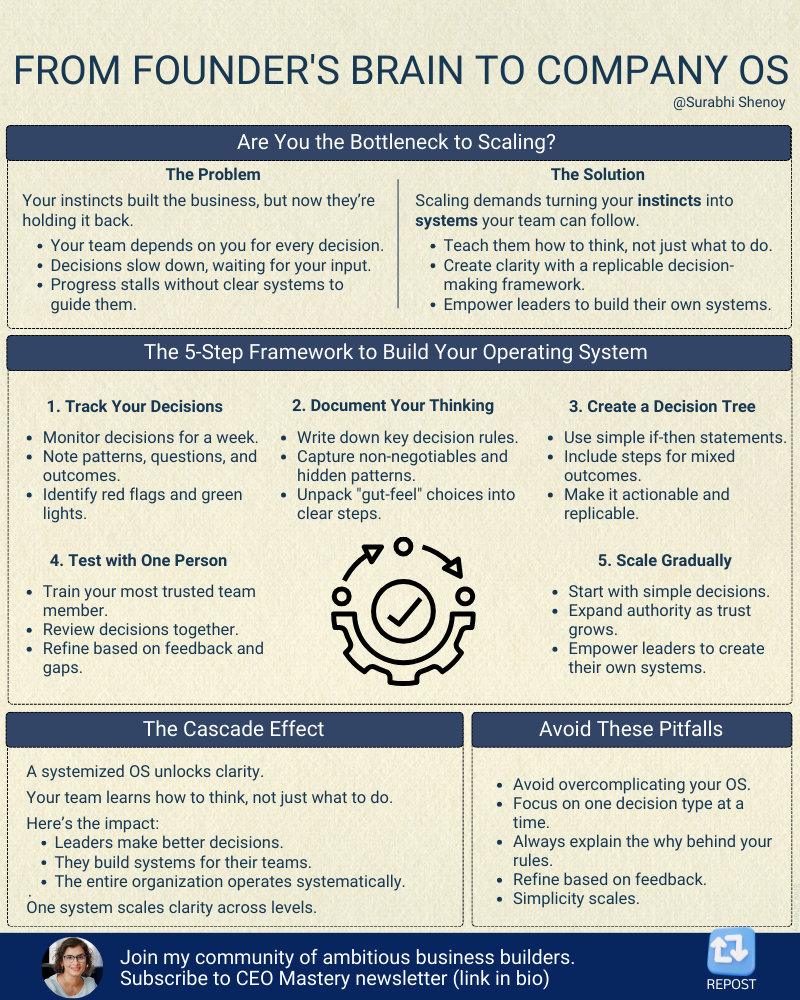
Step 1: Track Your Decisions
Pick any area where you’re the bottleneck.
In my case, it was hiring.
For one week, I tracked every hiring decision I made:
- What questions did I consistently ask?
- Which answers influenced my decisions?
- What patterns emerged?
- What made me say “no” quickly?
The pattern was clear: I wasn’t just evaluating for skills. I was applying unwritten rules about culture, potential, and values.
Step 2: Document Your Decision-Making
Before building any system, understand how you actually think.
I documented:
- Key indicators I looked for
- Clear red flags
- Non-negotiable qualities
- Hidden patterns in my choices
This exercise was eye-opening. Many decisions I thought were “gut feel” actually followed consistent patterns.
Step 3: Create Your Decision Tree
Turn these insights into a clear system. Break down your thinking into if-then statements.
In our hiring system, it became:
If the candidate shows strong ownership in past roles → Proceed
If they blame others for failures → Stop
If technical skills gap but high learning agility → Evaluate the growth potential
Your decision tree becomes the core of your operating system.
Step 4: Test and Refine the system
Start with your most trusted team member.
Let them:
- Apply the system
- Make decisions
- Review with you
In our case, the HR head shadowed my interviews for two weeks, and we discovered nuances like how candidates’ questions revealed their personal traits and growth mindset.
You’ll find gaps. Add nuance. Refine the system.
Step 5: Scale Through Trust Thresholds
Only after the system proves reliable, begin scaling.
Start small. Let the team handle simple decisions independently. Review weekly.
Build trust gradually. As their decisions consistently match your operating system, expand their authority.
The result? In our case, this system reduced my involvement in hiring by 80% while maintaining our standards.
The Cascade Effect
When you systematize your decision-making, something magical happens.
Your team learns not just what decisions to make, but how to create operating systems for their own teams.
One level of systematization creates three levels of empowerment:
- Your leaders make better decisions
- They build operating systems for their teams
- Your entire organization learns to think systematically
Your VP of Sales will systematize account prioritization. Your CTO will create systems for technology choices. Your COO will build systems for resource allocation
This is when it becomes the Company OS.
Framework to Build Your Operating System
Start with one area where you’re stuck:
Step 1: Track for One Week
- Which decisions keep landing on your desk?
- What questions do you repeatedly ask?
- What makes you say yes or no quickly?
- What patterns emerge in your thinking?
Step 2: Document Your Thinking
- List your automatic green flags
- Note your instant red flags
- Capture your non-negotiables
- Write down your hidden rules
Step 3: Build Your Decision Tree
Create simple if-then statements:
- If [good sign appears] → Move forward
- If [red flag shows up] → Stop
- If [mixed signals] → Here’s what to evaluate
Step 4: Test with One Person
Pick your most trusted team member:
- Let them use your decision tree
- Review outcomes together
- Add missing nuances
- Refine the rules
Step 5: Scale Step by Step
Start small:
- Give them simple decisions first
- Review results weekly
- Expand their authority as they show mastery
- Build more trust, give more responsibility
The key? Keep it simple. One decision type at a time.
Common Pitfalls to Avoid
- Overcomplicating the system.
- Failing to test with real scenarios.
- Relying too heavily on automation.
- Not explaining the “why” behind decisions.
- Ignoring the team’s feedback during refinement.
Avoiding these pitfalls helps build systems that are practical and sustainable.
The Bottom Line
Your company’s growth is limited by how well you and your leaders can turn your decision-making into operating systems.
The question isn’t whether you can make good decisions. You already do that.
The question is:
- Can you teach others to think like you?
- Can you empower them to build their own operating systems?
Thank you for being here; I will see you next Thursday.
Keep building,
Surabhi
PS: When I talk about transferring your “brain” into systems, I’m really talking about your values, vision, and principles —everything that makes your company uniquely yours —the very DNA of your leadership.
PPS: In case you missed it, this week’s Linkedin post – Why good ideas fail? I got great engagement. Check it out.
Ready to master your CEO game?
Here are 2 ways I can help
1) Elite CEO Coaching:
Strategic support to scale systematically
→ Book Your Free Clarity Call
2) 1:1 Strategy Session
One focused hour. Clear action plan. Immediate implementation.
→ Get a Power Hour With Me