
Last week, a founder I coach came to me frustrated.
“We’re delivering solid results,” he said. “But no game-changing ideas. Are we stuck?”
His worry was valid. Innovation sits in the dangerous quadrant of “Important but Not Urgent”. Your business runs well. Your team executes. But breakthrough innovation feels out of reach while competitors keep pushing boundaries.
We think innovation is about having bold ideas. It’s not.
Innovation is a skill. And like any skill, it can be learned.
But the problem? Most teams get stuck chasing either small wins or impossible moonshots.
Here’s the good news: The formula to create breakthroughs isn’t magic—it’s a repeatable process.
Let’s unpack it.
(Make sure to grab the cheatsheet at the end of this article!)
Know Your Innovation Target
Most leaders chase innovation like a dog chasing cars. They run after anything that moves.
Smart leaders know better. They start with a clear target.
Three questions cut through the confusion:
1. “What does “innovation” mean in the context of my company?”
(Improving operations? Creating new revenue? Disrupting markets?)
2. “What pain are we solving?”
(Market share bleeding? Growth stalled? Customers leaving?)
3. “Who wins when we succeed?”
(Our customers? Our team? Our investors?)
Your answer isn’t just a strategy. It’s your compass. It tells you which innovations matter and which ones are distractions.
The Two Innovation Mindsets
To innovate effectively, you need to balance two mindsets:
1. Small Wins:
Low risk, fast feedback that compounds over time:
- Optimizing pricing strategy
- Faster customer support
- Better user onboarding
2. Bold Bets:
High-risk, high-reward moves that redefine possibilities:
- New business models
- Untapped market segments
- Game-changing products
The Silent Innovation Killer
Most leaders say they want innovation. Their actions tell a different story:
“Think big, but don’t fail.”
“Take risks, but get approval first.”
“Move fast, but don’t break anything.”
These mixed signals paralyze teams.
Real innovation requires psychological safety.
Your team needs to know that:
- Small experiments are encouraged
- Early failures are expected
- Learning matters more than immediate success
Fix the culture first. The processes can come later.
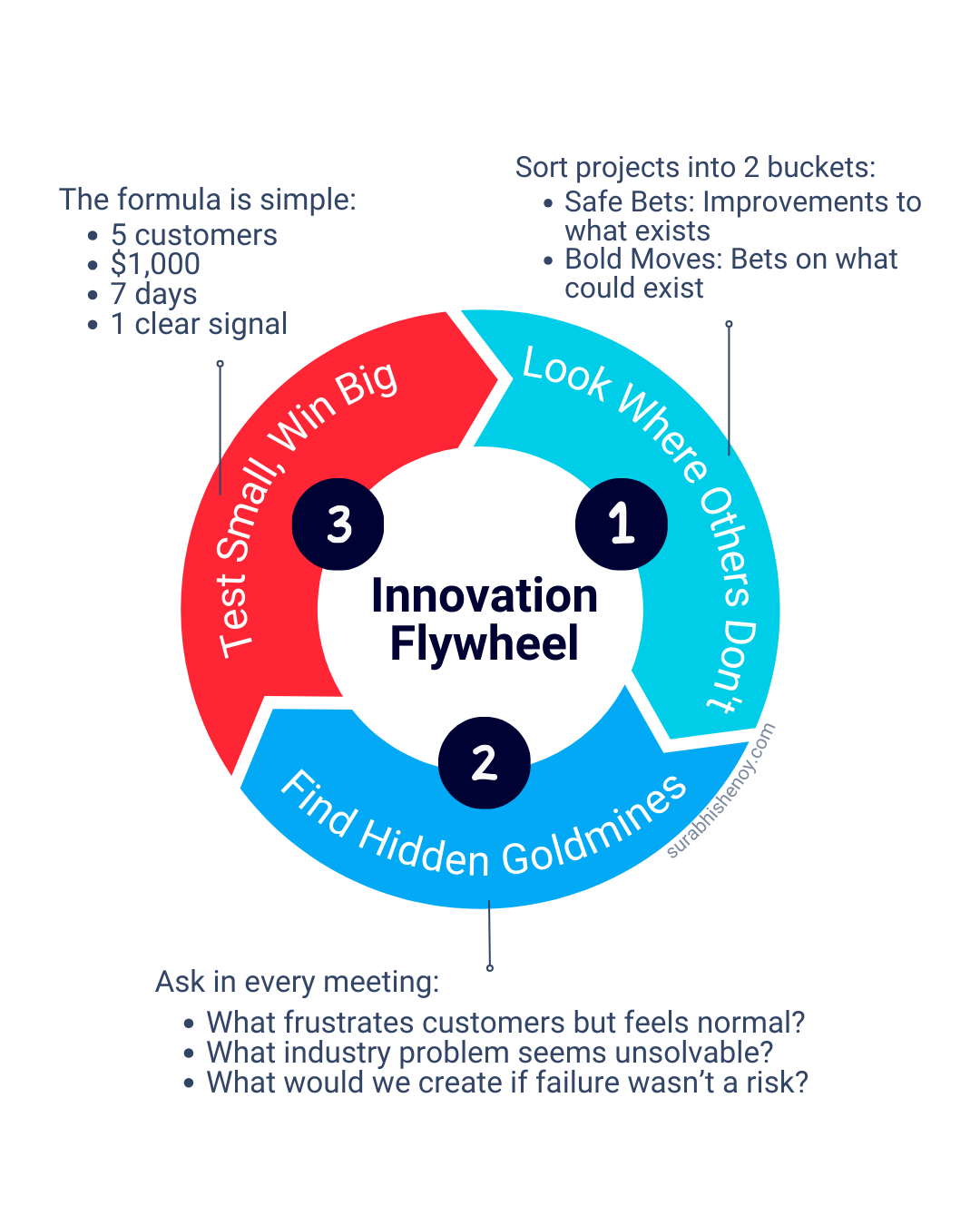
The Innovation Flywheel
Every breakthrough started with a single turn of the wheel.
Here’s how to build yours:
1. Look Where Others Don't
Most teams play it safe. They stay in their comfort zone. They optimize what already works.
But breakthrough innovations happen at the edges of your comfort zone.
Sort your projects into two buckets:
- Safe Bets: Improvements to what exists
- Bold Moves: Bets on what could exist
The rule is simple:
Too many Safe Bets = you’re hiding
Too many Bold Moves = you’re gambling
Find the sweet spot between safety and ambition.
2. Find Hidden Goldmines
The biggest opportunities often hide in plain sight.
Ask these three questions frequently in your team meetings:
- “What frustrates our customers that everyone accepts as normal?”
- “Which industry headache seems impossible to solve?”
- “What would we build if failure wasn’t an option?”
These questions are mining tools. They help you dig where others haven’t looked.
Once you find a goldmine, don’t try to extract all the value at once. Start with a small test…
3. Test Small, Win Big
The formula is simple:
- 5 customers (pick your most engaged users who give honest feedback)
- $1,000 (enough to build a basic prototype or run a small test)
- 7 days (forces quick learning without perfect execution)
- 1 clear signal (specific metric: 4/5 customers want to keep using it, or 40% improvement in speed/satisfaction)
Success isn’t about perfection. It’s about learning:
- Good signal = expand the test
- No signal = try a different approach
- Bad signal = document the learning and move on
That’s it.
Small tests reveal big truths.
How the Flywheel Gains Speed
Each turn gets easier:
- Small tests reveal hidden opportunities
- Hidden opportunities spark better ideas
- Better ideas attract more resources
- More resources enable bigger wins
- Bigger wins fuel the next cycle
💡 Here’s the secret: Document everything. Each spin of the flywheel should teach you something new.
From Books to Empire: Amazon’s Flywheel in Action
Amazon wasn’t born a giant.
Here’s how Amazon’s journey maps to the three parts of the Innovation Flywheel:
1. Look Where Others Don't
Amazon focused on a gap others overlooked: better book delivery.
- Safe Bet: Improve shipping times for books.
- Bold Move: Envision a world where they could ship anything, anywhere.
2. Find Hidden Goldmines
They asked questions that pushed boundaries:
- “What frustrates customers about traditional shopping?” (limited selection, slow shipping)
- “What if we built a seamless experience across all categories?”
From books, they expanded into everything — even groceries.
3. Test Small, Win Big
Amazon’s growth relied on small-scale tests:
- Prime launched in a few cities to test demand.
- AWS began as a tool for internal efficiency before becoming a revenue stream.
Each success gave them a clear signal to expand, turning small wins into massive growth.
Amazon’s empire proves that small, deliberate steps can power a flywheel for limitless innovation.
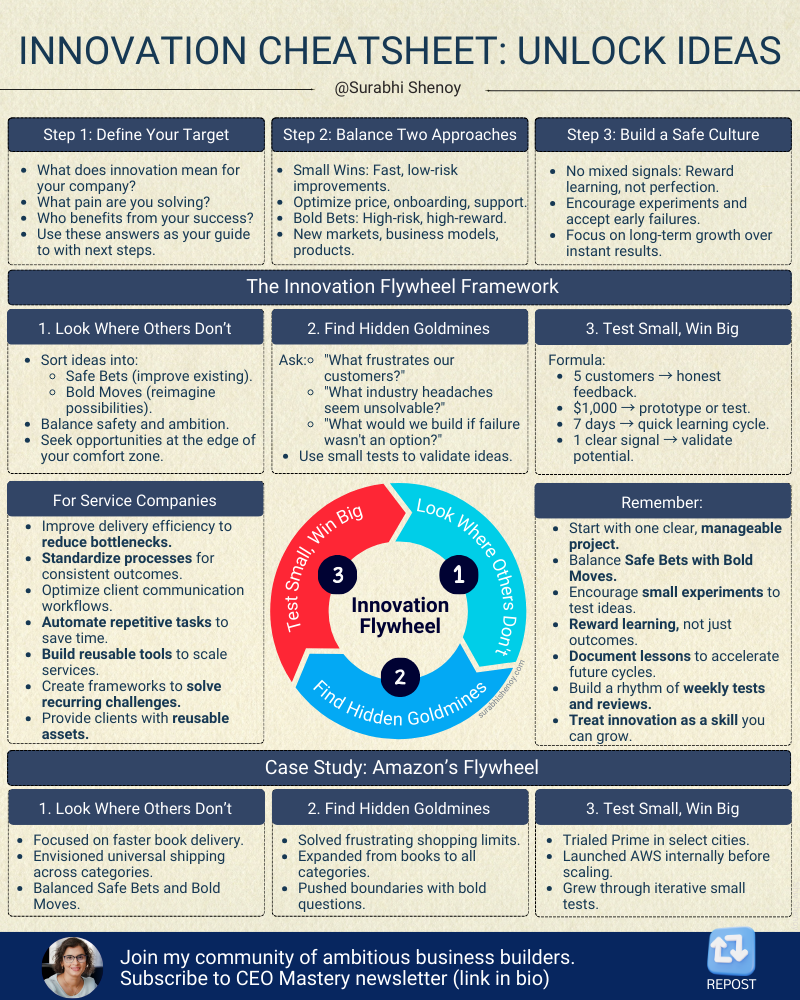
👉 Note for Service Companies: Your innovation needs two tracks:
- Improving delivery (Small Wins): Make your current services better
- Building assets (Bold Bets): Create intellectual property you can reuse — tools, frameworks, or products that solve common client problems without starting from scratch each time.
Fast Forward Six Months
Picture your team bringing new ideas:
- Instead of vague proposals → Data from small experiments
- Instead of asking permission → Showing results
- Instead of fear of failure → Excitement about learning
The possibilities are endless:
- Support team’s small UI tweaks can cut ticket volume considerably
- Sales team can increase deal size by experimenting with solution packaging
- Delivery team can cut project timelines by standardizing common components
This isn’t just innovation — it’s freedom to grow while others play catch-up.
Make It Happen
This Week:
- Pick one project you’re already working on
- Define which type it is:
- Small Win: Improving what exists
- Bold Bet: Creating what could exist
- Run your first micro-test (using the formula above)
Build the Habit:
- Monday: 30-min team meeting to review ongoing experiments
- Till Thursday: Run tests, collect data
- Friday: 30-min to share learnings and pick next week’s experiments
Monthly Check-in:
- Review your Safe Bets vs. Bold Moves ratio
- Update your learning document
- Pick one learning to scale across the company
Remember: The first turn of the flywheel is the hardest. But each turn after gets easier.
Ready to move your company from surviving to thriving? Let’s make innovation a skill — and scale it.
If this letter resonated with you, I’d love to hear about your innovation journey. What’s the one breakthrough your team is itching to create? Hit reply and let me know.
Until next Thursday,
Surabhi
P.S. The founder I mentioned at the start? He texted me last week. His team just launched their first breakthrough project after years of playing it safe. “I wish I had done this years ago,” he said.
Achievements like these that remind me why I do this work — watching teams transform from “I need permission” to “Look what we created!” There’s nothing more powerful. It’s never too late to start your innovation journey. Here’s to your next breakthrough.
Ready to master your CEO game?
Here are 2 ways I can help
1) Elite CEO Coaching:
Strategic support to scale systematically
→ Book Your Free Clarity Call
2) 1:1 Strategy Session
One focused hour. Clear action plan. Immediate implementation.
→ Get a Power Hour With Me