
I’m not sure if I like Elon Musk. But I’ve always been curious about how he operates, and why success seems to follow him despite the chaos.
I’m reading his biography, Elon Musk by Walter Isaacson.
The book is 650 pages long—and he’s still building. But if you work 24/7 for over 25 years and take on missions to change industries and reshape the world, you probably need that many pages.
This CEO Mastery edition isn’t about his controversies. It’s about how Elon Musk works—his business philosophy, mindset, decision-making frameworks, and systems that keep producing extraordinary outcomes — and what we, as founders, can apply in our own businesses.
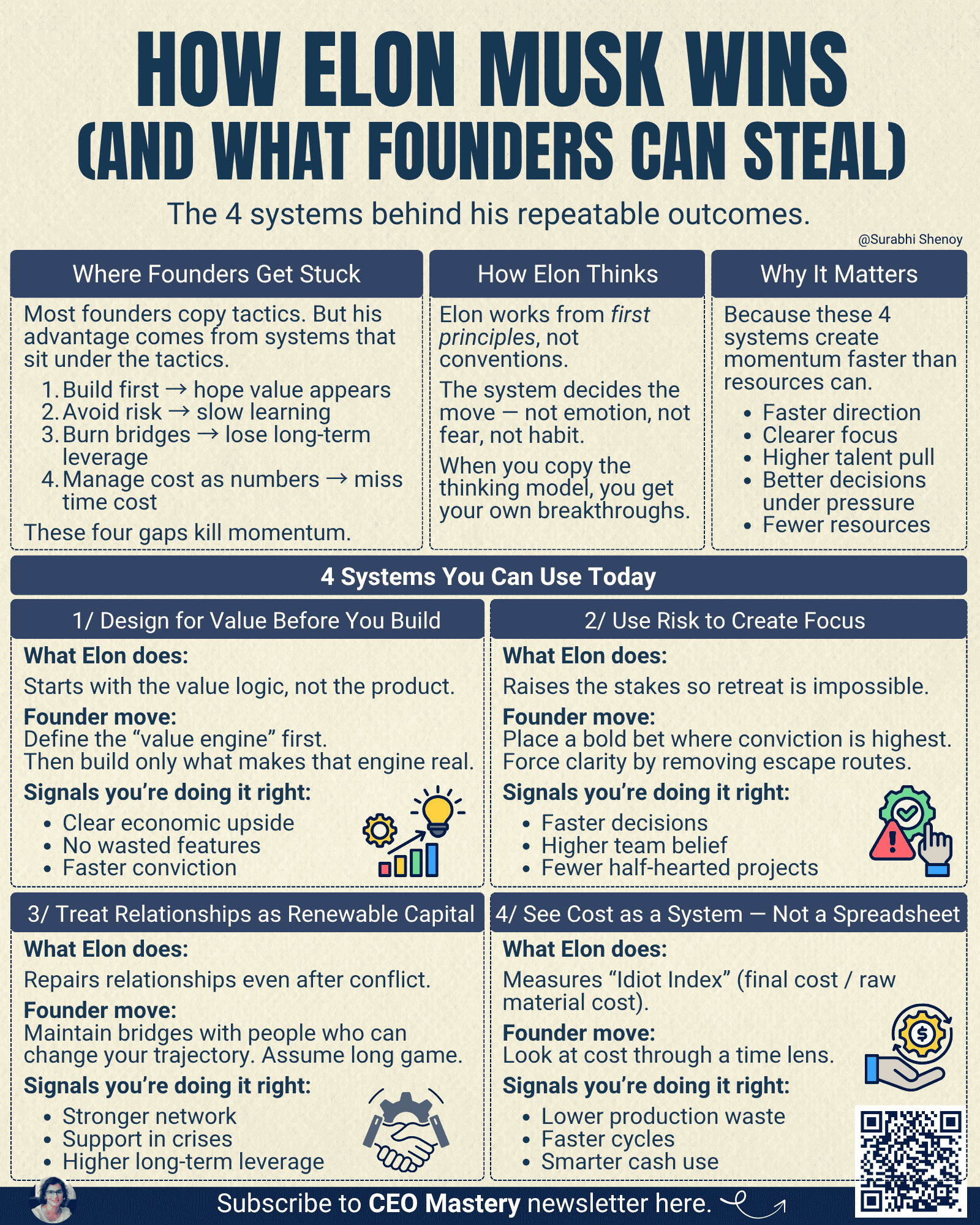
Here’s what I found—four systems and decision-making frameworks that reveal Elon Musk’s business philosophy and show how he achieves big things:
1/ He designs for value before he builds anything
Before it became PayPal, Elon’s startup was X.com. An online financial platform built around a simple insight:
Money is simply an entry into a database. And if you remove all the reasons consumers would take money out of the system, it will become the place where all the money stays—and that would make it a multi-billion-dollar company.
That single insight reflected strong strategic thinking and defined his company’s worth long before a single line of code was written.
When X.com later merged with Peter Thiel’s Confinity (which had its own payments product) and became PayPal, Elon had already architected the valuation logic with a clear long-term vision.
Look around today: wallets, loyalty points, Prime memberships—all built on the same logic. Collect cash early. Keep it in-system. Boost valuation.
Most founders build first and hope it becomes valuable. They ignore core business fundamentals.
Elon reversed it. He designed for value, then built the product that made it real.
2/ He treats risk as an accelerator
His colleagues from Zip2 and X.com say, “Unlike everybody else, Elon doesn’t minimize risk; he amplifies it. This approach to risk leverage raises the stakes so high that retreat isn’t an option.”
After the sale of Zip2, he received about $22 million, and poured almost all of it into X.com, keeping very little for himself.
The pattern repeated in 2008. Tesla and SpaceX were both close to running out of money. He wired in what he had left.
For Elon, long-term progress matters more than short-term safety. This is a cornerstone of Elon Musk’s leadership principles—betting everything on what matters most.
That’s why people follow him. He burns the boats. When leaders remove their own options, followers believe they’ll find a way.
Lesson: Use risk to create focus. Concentrate your effort where conviction is highest, learn fast, and let your commitment signal pull talent and capital.
3/ He treats relationships like renewable capital.
As PayPal’s largest shareholder, Elon became CEO.
Then came a clash of vision. Thiel’s team wanted a payments company. Elon wanted to reinvent banking—payments plus social. He was very demanding and extremely difficult to work with. So they staged a coup. And won.
This was a backstabbing and Elon was furious. He admits he had thoughts of assassination running through his mind.
But he did the opposite.
He worked hard to repair the relationships.
Years later, when SpaceX was on the verge of bankruptcy, Thiel’s venture fund rescued them with a crucial $20 million investment.
Elon repeated this recently after his fall out with the President.
He publicly admitted, “I regret some of my posts about President Trump… they went too far.”
Lesson: We do not have so much drama in our simple lives but if we are letting go a client, refusing a bad offer, we can remember to treat relationships as capital, even when the stakes and emotions are high. This awareness reflects strong founder psychology and is one of the most practical Elon Musk leadership lessons for everyday business.
4/ He sees cost as a system, not a spreadsheet
Elon uses a tool he calls the Idiot Index.
It’s the ratio of cost of the final product to its raw material cost. If a product costs $100 and its raw materials cost $5, the index is 20. The higher the number, the more “idiotic” the design or process.
If the Idiot Index is high, fix the design or the process—those 2 are within your control.
Once, a supplier quoted $120,000 for a part. Elon said, “That’s no more complicated than a garage door opener,” and asked his engineer to build it in-house.
They did for $5,000.
He could be ruthless about cost. He once refused a $2,000 purchase because he wanted the team to make it cheaper.
Yet the same man spent $90,000 chartering a plane to move equipment overnight.
Why? Because every day of delay was, in his words, “a day of missing out on future millions.”
He wasn’t stingy. He was optimizing.
He looked at cost through time, not numbers.
If something slowed progress, it was expensive.
Lesson: Watching your costs and controlling your spend will give you a massive competitive advantage.
We may not want to be Elon Musk. But we can learn from how deliberate he is. Every risk, every cost, every relationship serves one goal: momentum.
“Maniacal sense of urgency is our operating principle”, he says. Steve Jobs also had the same trait, that’s why they were able to ship out beautiful products at such a high speed.
Work expands itself if the timeline is relaxed.
Question for you is: In your business, where can you cut the time in half today and demand the team to become creative to move faster?
A quick note before you go
Last month, I read Poor Charlie’s Almanack and shared my learnings in two editions of CEO Mastery. Read it here in case you missed it.
Now I’m deep into Elon Musk by Walter Isaacson—and couldn’t resist sharing a few insights with you.
It feels like I no longer read just for myself, but for all of you, my CEO Mastery community.
I will see you next Thursday,
Surabhi
PS: Which of Elon’s 4 systems would you steal for your business: design for value, focus through risk, protect relationships, cost as a system?