
When founders think about growth, they usually think about the business — more revenue, more clients, a larger team.
But over time, something more fundamental becomes clear.
A business does not outgrow its market. It outgrows its founder.
In the early stage, effort can carry a business surprisingly far. Determination, hustle, and boldness create momentum. But as the business grows, the nature of the challenge changes.
Complexity grows faster than revenue.
Headcount multiplies consequences.
Decisions begin carrying second-order effects.
At some point, effort stops being the primary driver of growth and adaptation takes its place.
And that is where founder growth becomes the defining factor.
In this article, we will look at:
What Founder Growth Really Means
Founder growth is the evolution of how a founder thinks, decides, and leads as the business becomes more complex.
It is not about working harder or learning more tactics. It is about upgrading your operating model.
In the early phase, growth comes from doing the work yourself.
Then it comes from managing the work.
Later, it comes from enabling others to lead the work.
And eventually, it comes from allocating capital, attention, and direction with judgment.
Each shift requires a different way of thinking.
A different relationship with control.
A different definition of value.
A different use of time.
This is why founder growth always precedes business growth.
The business cannot operate at a level the founder has not yet learned to operate at.
If the founder is still solving problems directly, the business remains dependent.
If the founder is still controlling decisions, the organization cannot scale.
If the founder has not developed judgment around capital and direction, growth becomes inefficient.
What looks like a business problem is often a founder problem in disguise.
And until that changes, growth slows because the founder has not yet evolved to match the opportunity.
Founder growth, therefore, is not motivational.
It is structural.
And it follows a recognizable pattern.
As companies grow, founders move through distinct stages, each requiring a different way of operating, thinking, and leading.
The Four Stages of Founder Growth
In my experience, founder growth follows a recognizable pattern. The four growth stages are not defined by revenue alone. They are defined by the extent to which the business depends on the founder.
Understanding these stages helps founders identify where they are and what must change next.
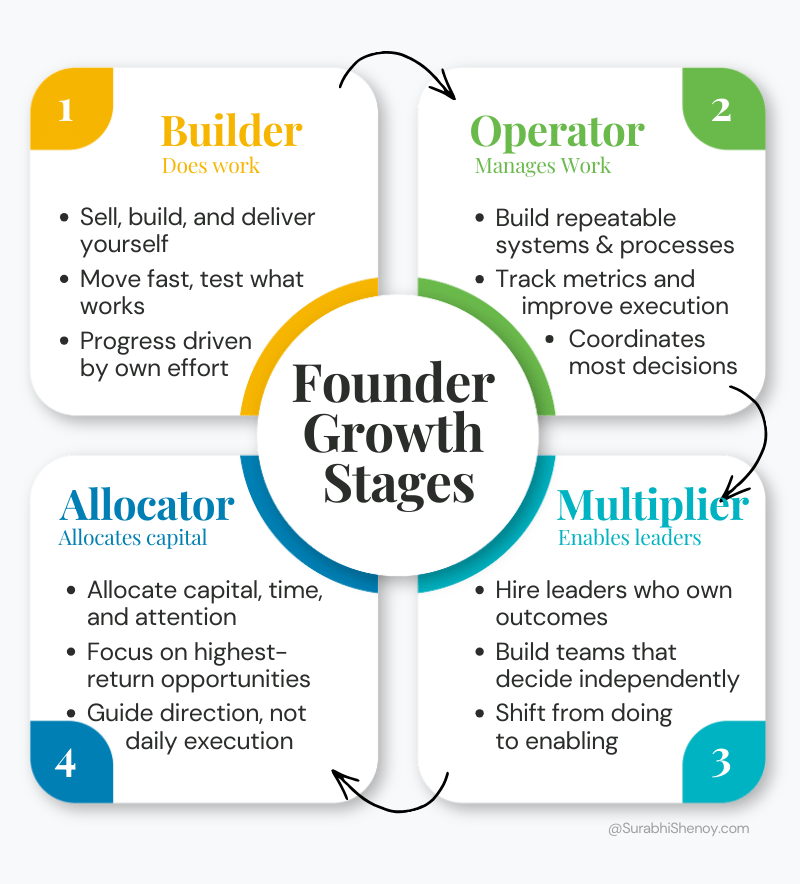
1. The Builder
Primary question: Does this work?
Primary asset: Energy
Primary risk: Founder dependence
In the Builder stage, the founder is the engine of the company.
You sell.
You deliver.
You solve problems.
You improvise constantly.
Speed matters more than structure. Progress comes from personal effort applied repeatedly.
Most companies begin this way.
You know you are still operating as a Builder when revenue rises and falls with your direct involvement, customers ask for you by name, and the team waits for direction before acting.
Nothing is wrong with this stage.
But if the business cannot function without your daily intervention, growth eventually stalls, and costly mistakes multiply.
Founder growth here means replacing effort with repeatability.
The Founder Freedom Blueprint is built around this exact shift, helping founders put the systems in place so the business runs without them at the center.
2. The Operator
Primary question: Can this run consistently?
Primary asset: Process
Primary risk: Over-control
As the company stabilizes, repeatability becomes more important than hustle.
This is where the Operator stage begins.
Processes start getting documented. Metrics begin guiding decisions. Pricing improves. Financial discipline strengthens. The company becomes less accidental and more intentional.
Execution improves.
But a new constraint can slowly appear. The founder becomes the center of coordination.
Meetings increase. Decisions route upward. Standards depend heavily on the founder’s oversight.
The business becomes organized.
But it also becomes slow.
Growing as a founder requires building systems that maintain quality without requiring constant intervention.
3. The Multiplier
Primary question: Can this grow beyond me?
Primary asset: People
Primary risk: Identity friction
The Multiplier stage determines whether a company accelerates or plateaus.
The founder’s value begins to shift from doing the work to expanding the organization’s capabilities.
That means hiring leaders. Clarifying ownership. Building teams that can make strong decisions independently.
This is often where internal tension appears.
In Builder mode, value comes from doing.
In Operator mode, value comes from controlling.
In Multiplier mode, value comes from enabling others.
For many founders, this shift challenges identity. The instinct to remain central can be difficult to release.
But companies rarely scale through personal heroics. They scale through distributed strength.
If you’re navigating this shift right now, CEO Coaching is designed specifically for founders moving from Operator to Multiplier, accelerating the transition without losing what made you effective.
4. The Allocator
Primary question: Where does capital create the highest return?
Primary asset: Judgment
Primary risk: Misallocation
At scale, the founder’s role changes again.
The company now generates resources: money, talent, attention, strategic positioning.
Growth becomes less about activity and more about allocation.
The Allocator thinks in terms of return on capital.
Capital here includes money, but also management attention, hiring capacity, time, and organizational energy.
The key question becomes simple but profound:
Where will our capital produce the greatest long-term return?
Many founders remain trapped between Operator and Multiplier stages — busy and productive but flat in growth.
True founder growth requires reaching the level where judgment about direction matters more than personal execution.
As companies scale, founders must develop a different set of skills to lead the business effectively.
Ask yourself: Which stage am I operating in today — and which stage does my business need me in?
The 5 Skills That Separate Successful Founders from Stuck Ones
As businesses grow, the founder’s role demands a different set of capabilities.
These are not motivational traits. They are structural skills that allow founders to operate effectively.
1. Strategic Thinking: From Doing Everything to Doing What Matters
Strategic thinking is not about having more ideas. It is about recognizing the one idea that matters and building the company around it with discipline.
Charlie Munger said it best: Take one simple idea and take it very seriously.
Great founders rarely win by doing many things slightly better. They win by committing deeply to one governing principle and aligning the entire operation with it.
Sam Walton built Walmart around a structural insight: Spread out, then fill in.
Walmart did not randomly open stores across the country. They expanded outward into small towns and then filled the gaps between stores. This created dense clusters supported by distribution efficiency. Logistics became a strategic advantage, not an operational detail.
Rose Blumkin of Nebraska Furniture Mart operated on an even simpler strategy: Sell cheap. Never lie.
That principle dictated purchasing, pricing, customer trust, and reputation. It was not marketing language. It was an operating doctrine. Many retailers advertised discounts. Few aligned their entire structure around honesty and price integrity.
Jensen Huang at NVIDIA made a long bet before the world validated it: Own the platform shift.
NVIDIA invested heavily in CUDA, developer tooling, and a computing ecosystem around GPUs — for years before the payoff was obvious. When AI accelerated, NVIDIA’s structural position was already secured.
In each case, the strategy was simple — defined in one line — but taken very seriously.
And that is the difference.
Many companies can copy the slogan. Few copy the structure.
You cannot copy “low price” without building supply chain discipline.
You cannot copy “customer obsession” without sacrificing margin.
You cannot copy a platform bet without enduring years of uncertain payoff.
Strategic thinking is not cleverness. It is clarity about what truly drives advantage — and the courage to align everything behind it.
2. Decision Making Under Uncertainty: The Core Founder Skill
Founders rarely operate with perfect information.
As businesses grow, the stakes increase while certainty decreases.
That is why growing as a founder requires improving how you make decisions, not just making more of them.
Strong founders build mental models to reason through uncertainty. They borrow ideas from economics, psychology, probability, and systems thinking to make better decisions by examining problems from multiple angles.
Instead of asking “What feels right?”, they ask structured questions:
- What incentives are shaping this situation?
- What are the second-order consequences?
- What risk am I concentrating?
- What is the opportunity cost of this decision?
Over time, the founder’s role shifts from solving operational problems to making fewer, higher-quality directional decisions. This is the difference between successful founders and the ones who stay buried in operations.
3. Emotional Intelligence for Founders: Staying Steady as Stakes Rise
Scaling companies operate under constant pressure.
Targets stretch. Markets shift. Plans fail. People disappoint.
The founder carries the weight of these shocks while the team looks upward for cues on how to respond.
When leaders react impulsively to every signal, volatility spreads through the company faster than strategy. Emotional steadiness, therefore, becomes part of founder growth as companies scale.
Emotional stability is not automatic. It is developed deliberately.
First, it begins with self-awareness. Founders must learn to notice their internal reactions before those reactions shape decisions.
What situations trigger defensiveness?
Where does urgency distort judgment?
When does fear disguise itself as control?
Second, build space between stimulus and response.
Pause before reacting in meetings.
Sleep on difficult decisions.
Delay replies when emotions are high.
Third, zoom out. Perspective reduces volatility.
Ask a simple question: Will this matter in 3 months, one year, five years?
Most problems shrink quickly when viewed through a longer horizon.
Over time, founder evolution shows up in emotional steadiness. A calm founder strengthens the organization’s ability to solve problems, while reactive leadership destabilizes it.
4. Long-Term Thinking: The Discipline Most Founders Resist
Short-term optimization often weakens long-term strength.
As companies scale, founders frequently face opportunities that promise immediate revenue but quietly erode margin, positioning, or culture. Founder growth often requires resisting those moves.
Jeff Bezos, in his early shareholder letters, repeatedly wrote about long-term orientation — investing today for outcomes that might not show for years.
That philosophy is easier to preach than to practice.
For bootstrapped founders, long-term thinking does not appear as bold predictions about the future. It appears as restraint.
In my own journey, I did not think in ten-year visions or grand narratives about the future.
What I consistently did was refuse growth that would weaken the business in the long term.
I was not anti-growth. I was pro-wealth.
When a large custom project came in, I asked: Is this work aligned with who we are building to become? If I say yes to this, will it be driven by fear of losing a deal?
When a low-margin client promised volume, I asked: Will this strengthen our economic engine, or will it normalize lower standards that are difficult to reverse?
When a “big logo” opportunity appeared, I asked: Is this expanding our future, or narrowing it?
Over time, this discipline compounds. A business built to be predictable, resilient, and optional may grow slower — but it survives shocks better and compounds in value. It makes decisions from strength instead of fear.
Long-term thinking is not always about forecasting the future. Often, it is about refusing to shrink it.
5. Sustained Focus: The Compound Interest of Founder Growth
Sustained focus is the discipline that allows every other capability in founder growth to compound.
In the Builder stage, progress often comes from saying yes to many opportunities. As the business grows from startup to scale-up, opportunities multiply.
That is where the real test begins.
When there is money in the bank, action feels necessary. Expansion appears justified. New initiatives promise momentum.
Charlie Munger once described part of Berkshire Hathaway’s discipline as being willing to “watch the paint dry.”
There were years when Warren Buffett and Munger made several acquisitions, and other years none at all. Opportunities were plenty, but they waited for those that aligned with their principles. They refused to act merely because money was available.
That is sustained focus at the highest level.
For most founders, the temptation is subtler.
- When growth slows, expansion feels like progress.
- When margins tighten, volume feels like relief.
- When energy dips, a new initiative feels like renewal.
But scaling as a founder requires asking harder questions:
- Have we fully penetrated our current market?
- Have we extracted the full value of our positioning?
- Have we strengthened margins before chasing scale?
- Have we built repeatability before adding complexity?
Focus protects depth.
Depth allows dominance.
Over time, founder evolution requires protecting that depth rather than constantly expanding the surface area of the business.
How Founders Actually Grow
Knowing the stages of founder evolution is useful. Understanding the skills required is important. But nothing changes unless the founder makes growth a deliberate practice.
This is where most founders stall — they don’t make space for their own development. The business always feels more urgent than the person running it.
But if the business is a reflection of the founder, improving one without improving the other will always hit a ceiling.
So how do founders actually grow?
Read with intention.
The founders I admire most are serious readers. Not skimmers of summaries and tweet threads — deep readers who let important books reshape how they see their business.
Read biographies. When you study how Sam Walton thought about expansion, or how Jensen Huang held conviction for a decade, you’re not learning retail or semiconductors. You’re learning how successful founders evolve their thinking as the stakes change.
Reading is the cheapest, highest-leverage founder investment that exists.
Write to think.
Journaling is not about gratitude lists. It’s a thinking tool.
When you articulate a decision on paper — the options, the tradeoffs, the reasoning — you often discover that what felt clear in your head was actually unresolved. The best founders I’ve worked with write before they decide.
Block time to think — and protect it.
Founders fill calendars with action. What rarely gets scheduled is uninterrupted thinking time.
An hour a week with no agenda — just space to reflect on where the business is heading and whether you’re the right version of yourself to take it there.
At the Operator and Multiplier stages, this becomes the highest-value hour on your calendar.
Find a mentor who has already walked your path.
Peer groups and networking circles are not enough.
What helps more is a single person who has built, scaled, and exited a business, and who has no agenda other than your success.
The right mentor doesn’t give you answers. They ask the questions you’ve been avoiding. They have lived experience and scars.
If you’re looking for that person, here’s how I work with founders as a CEO Coach.
Get uncomfortable regularly.
Growth happens at the edges — in the negotiation you’ve been avoiding, the conversation you’ve been postponing, the decision you’ve been deferring. Founders who stay in the Builder or Operator stage often do so because those stages feel familiar. The next stage always feels like a stretch. That discomfort is not a warning. It is a signal.
The common thread across all of this is simple: dedicate serious time to growing yourself, not just your business.
Most founders spend 95% of their energy on the business and almost nothing on themselves. The successful founders I know have reversed that ratio more than anyone would expect — and it shows in their clarity, their calm, and the quality of the businesses they build.
If you’re ready to make your own growth as deliberate as your business growth, CEO Coaching gives you a structured path to do exactly that, with someone who has built and exited businesses at each of these stages.
Key Takeaways
- Founder growth determines how far a company can scale. Businesses expand to the limits of the founder’s thinking, judgment, and leadership.
- Founders typically evolve through four stages: Builder, Operator, Multiplier, and Allocator. Each stage demands a different way of thinking and leading the business.
- Scaling as a founder requires developing structural skills: strategic thinking, decision-making under uncertainty, emotional stability, long-term thinking, and sustained focus.
- Growth slows when founders continue operating with the habits that worked in earlier stages. The entrepreneurial mindset must evolve — deliberately upgrading how you think, decide, and allocate money and attention as the company becomes more complex.
- Scaling yourself requires deliberate practice: thinking time, deep reading, writing to clarify decisions, and learning from those who have already built what you are building.
- Ready to accelerate that deliberate practice? The Founder Freedom Blueprint and CEO Coaching are both built around this principle.
Articles to Fast-track Founder Growth
On founder stages and the bottleneck problem:
On long-term thinking and strategic clarity:
On self-awareness, focus, and founder identity:
Best Books for Founder Growth
Grit: Why Successful Founders Outlast the Odds
Talent gets you started. Grit is what keeps you building through the Operator and Multiplier stages when progress feels invisible.
Man’s Search for Meaning: The Leadership Guide Founders Don’t Know They Need
The deepest book on emotional stability I’ve encountered. Frankl’s insight — that meaning sustains you when circumstances don’t — applies directly to the hardest stretches of founder life.
Eat That Frog!: The Productivity Playbook Every Founder Needs
Sustained focus starts with what you do first each day. This book is deceptively simple and genuinely useful.
The Power of Now: How Founders Reclaim Clarity
Emotional stability requires presence. This book changed how I think about the space between stimulus and response.
The Art of Thinking Clearly: Cognitive Biases Every Founder Must Avoid
Decision-making under uncertainty improves when you see the biases working against you. This is the clearest catalogue of those biases I’ve found.
Radical Candor for Founders: How to Care Deeply and Challenge Directly
The Multiplier stage demands a new way of communicating with your team. This book is the manual.