
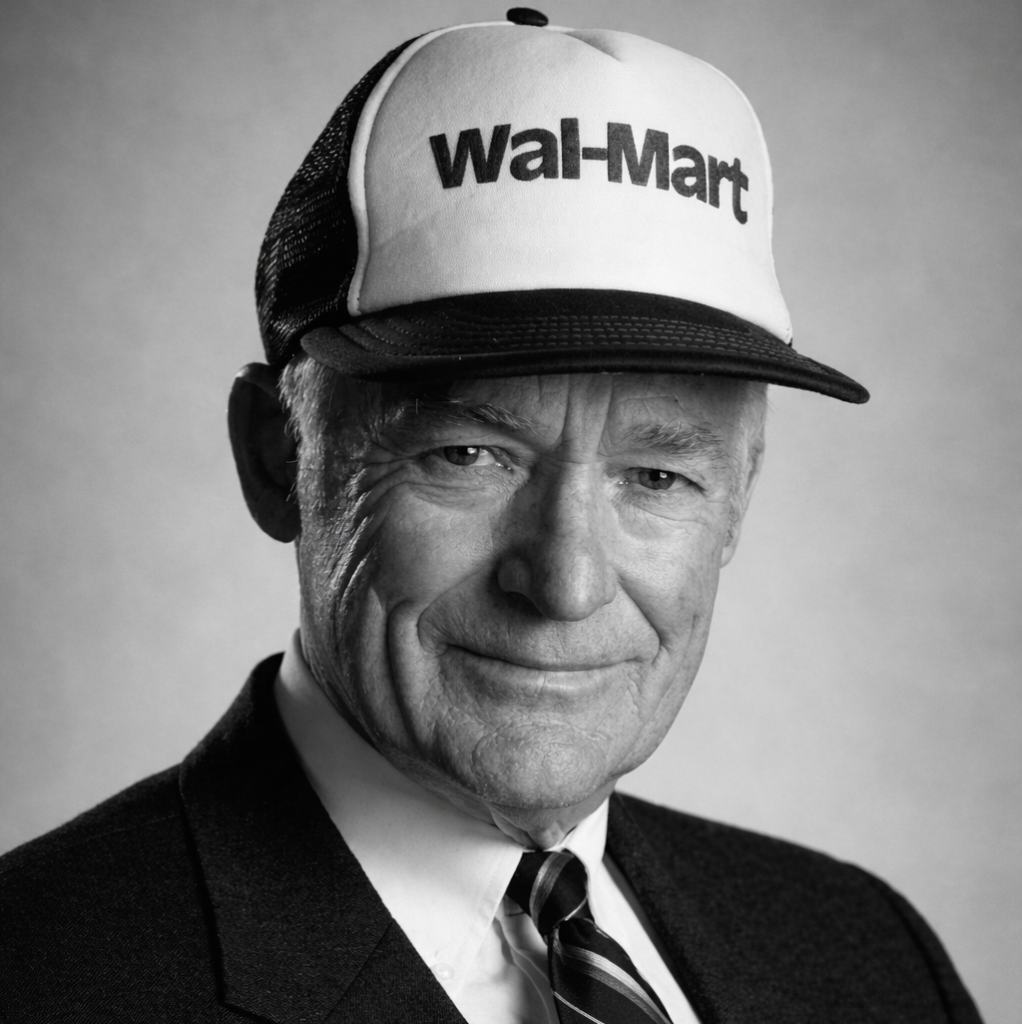
A 4-part founder study by Surabhi Shenoy
Sam Walton was twenty-seven when he took over a small variety store in Newport, Arkansas. He was forty-four when he opened the first Walmart. By the time he died in 1992, Walmart had grown from a single scrappy discount store in a town most retailers ignored into one of the largest companies on Earth.
Today, Walmart operates over 10,750 stores across 19 countries, generates $681 billion in annual revenue, and employs 2.1 million people. Two of its most recent CEOs — Doug McMillon and John Furner — both started as hourly associates, decades after Sam’s death. The system he built is still producing leaders.
Sam once described his success as “an overnight sensation that was about twenty years in the making.”
This series studies those twenty years — and the decades that followed. Not to admire Sam Walton, but to extract the thinking patterns, decision-making principles, and structural choices that made Walmart possible. And to ask: what transfers to founders building today?
The success of a business is shaped by the decisions its founder makes. Sam Walton’s decisions were unusually consistent, unusually deliberate, and unusually compounding. That’s what makes him worth studying.
The Series
Part 1: How Sam Walton Thinks
Four thinking patterns that ran simultaneously throughout Sam Walton’s career — and that together explain how a small-town retailer outcompeted companies many times his size.
What you’ll learn:
- Why cost discipline is an operating principle, not a budget exercise.
- How Walmart learned faster than it grew.
- Why Sam insisted on thinking smaller as the company got bigger.
- And how he turned competition into a cultural identity.
Key themes: Cost discipline, learning velocity, thinking small at scale, competitive identity
Part 2: How Founders Can Apply Sam Walton’s Thinking to Their Business
Sam Walton ran a retail company. You probably don’t.
This edition translates his thinking patterns into decisions modern founders face — in pricing, distribution, competition, and growth.
What you’ll learn:
- Why your product price is an output of your operations, not a spreadsheet decision.
- Why tech founders consistently underinvest in distribution.
- How to recognize your constraint as your potential moat.
- And why operations without demand creation puts a ceiling on your growth.
Key themes: Pricing strategy, distribution, constraint-to-moat conversion, operations vs sales-driven companies
Part 3: How Sam Walton Built a Team That Could Scale
The part of the Sam Walton story that matters to the founders right now.
Every founder I work with is hitting the same wall — hiring, retention, productivity, team alignment. The answers are hiding in the same places Sam eventually found them.
What you’ll learn:
- How Sam went from paying the lowest wages in retail to building one of the strongest ownership cultures in business.
- The specific incentive systems — profit sharing, stock ownership, shrinkage bonuses — that turned ordinary workers into partners.
- Why transparency made ownership real.
- And the question every founder should ask: what can you design so that staying pays and leaving costs?
Key themes: Ownership culture, incentive design, transparency, scaling people
Part 4: Where Sam Walton’s Thinking Lives Today
Sam Walton died in 1992. But the system he built kept producing leaders for decades.
This edition looks at what endured, what didn’t, and what it means for how you build your company right now.
What you’ll learn:
- How a teenager who unloaded trucks in 1984 became CEO thirty years later — and what that says about the system Sam built.
- Which principles transferred across decades and which assumptions became vulnerabilities.
- And the question every founder should contemplate on: What do you believe about how your business should run? And would your team articulate it without you in the room?
Key themes: Developing leaders, embedding principles, adapting to change, scaling what matters
Why I Study Founders
The success of a business is shaped by the decisions its founder makes.
I study consequential builders — not to admire them, but to extract transferable thinking patterns.
Each study examines how a specific builder thought, what patterns drove their decisions, and what modern founders should take — and leave behind.