
18 years of building a tech company taught me many lessons. But this $2M wake-up call stands out – a painful reminder about leadership blind spots.
At the 10-year mark, with 200+ people spread across geographies, I thought we had it all figured out:
Strong client relationships.
Solid delivery team.
Growing revenue.
Then the resignations started coming in.
My heart sank as I watched these mails trickle in one after another. Every other day a new resignation. Nothing unusual on the surface – just some attrition. Or so I thought.
Until one Tuesday afternoon, when a junior team member stepped into my office.
His hands shaking slightly as he closed the door:
“Surabhi, there’s something you need to know…”
The Crisis
What he revealed left me stunned.
It was a carefully orchestrated plan:
- The account manager and project manager had offered our client a sweeter deal.
- Key team members were jumping ship into their newly formed company.
- The client and my team was moving with them.
The situation had been unfolding right under my nose.
And I was oblivious to this, too busy in ‘growing’ the company.
The Big Lesson
This wasn’t just about a potential business loss. It was about a leadership blind spot.
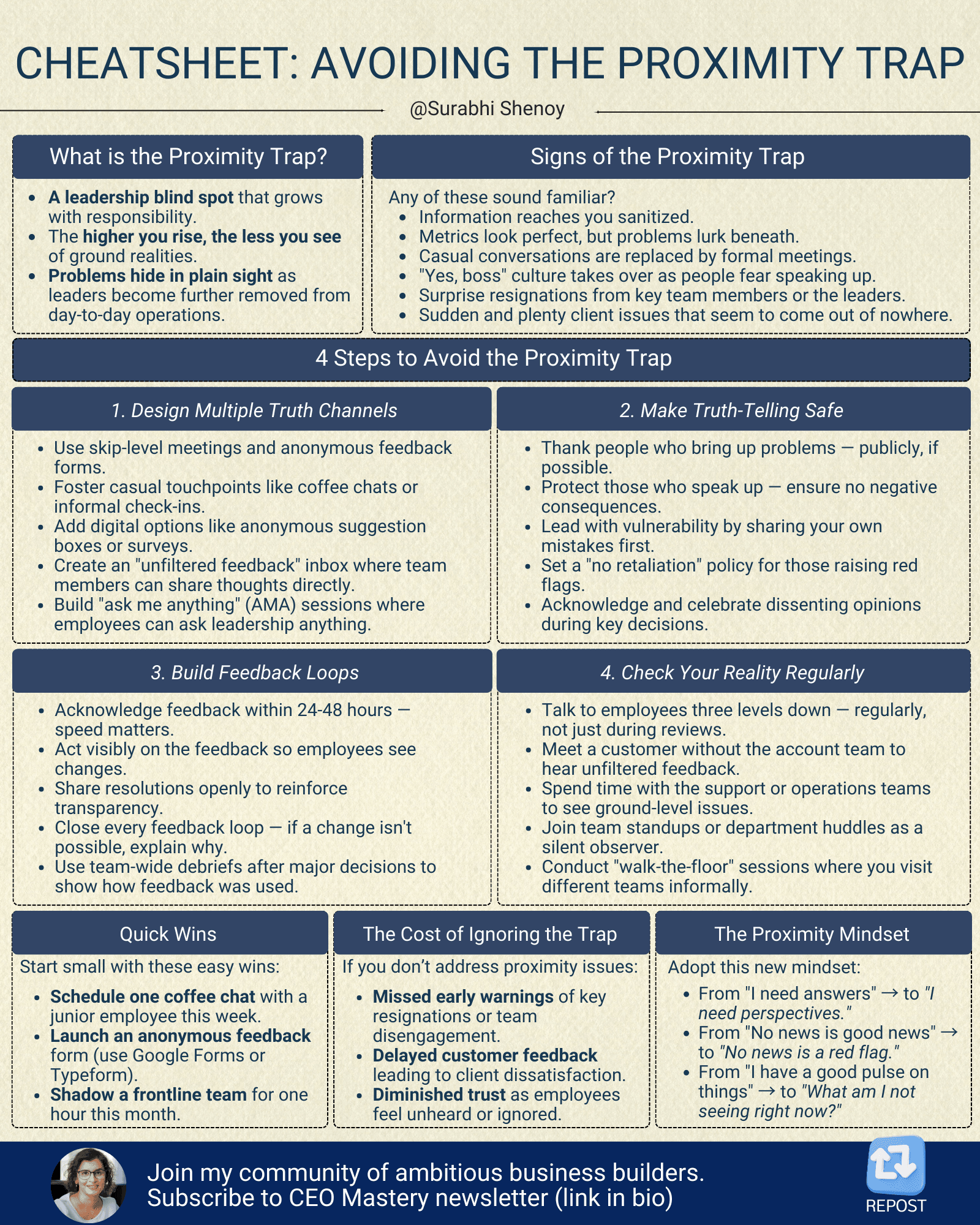
I call it The Proximity Trap: The higher you rise, the less you know what’s really happening.
Like a slow-acting poison, it creeps in silently:
- Information gets sanitized before it reaches you
- Real problems hide behind perfect metrics
- Casual conversations turn into formal meetings
- “Yes, sir/ma’am” becomes the unwritten rule
It was clear something had to change. And fast.
The Turnaround
I shared this incident with my mentor – a sharp, no-nonsense business veteran.
“Do you know how a lion rules?” He asked.
“He pisses on his territory. Every day. Every corner.”
Crude, but unforgettable.
Then he hit me with this:
“When was the last time you had a deep conversation with your customers? Your junior-most team member? You need to mark your territory.”
I needed more than one-off solution. I needed a system to stay connected as we grow.
That’s when I developed the Truth-Flow System.
Before I share this framework, here’s what we discovered during our analysis. See if any of this feels familiar.
The 4 Warning Signs of the Proximity Trap
1/ Information gets sanitized
- Bad news arrives too late
- Good news gets exaggerated
- Reality gets lost in translation
I saw this clearly in our post-crisis analysis:
- Weekly status reports were all green.
- Customer satisfaction scores looked perfect.
Yet we were heading straight into a storm.
2/ Real problems hide behind metrics
- Green dashboards masked red flags
- We tracked data but missed context
- Numbers looked great, reality wasn’t
The wake-up call taught me:
Attrition numbers meant nothing without understanding WHO was leaving and WHY.
3/ Casual conversations disappear
- Everyone gets ‘meeting ready’
- Spontaneous insights get lost
- Real concerns stay buried
Looking back, the signs were there:
Junior team members had tried to hint at issues.
But formal meetings filtered out these signals.
4/ The echo chamber effect
- People repeat what you want to hear
- Innovation gets stifled
- “Yes” becomes the default answer
The hardest truth:
My “open door policy” wasn’t enough.
People needed permission to be honest.
If you’re nodding to any of these, it’s worth paying attention. Spotting the signs early makes all the difference.
After analysis, solution became clear — it was time to create a preventive system to stay connected to ground realities. What emerged was more than a set of fixes – it became a complete system for staying connected.
Truth Flow System
Here’s the framework I wish I had when I started scaling my business.
It’s designed to be simple, powerful, and easy to adapt.
1. Design Multiple Truth Channels
Not just an open door policy, but a mix of:
- Formal channels (skip-level meetings, anonymous feedback)
- Informal touchpoints (coffee chats, walks)
- Digital options (simple anonymous forms)
The key is variety – different people need different ways to speak up.
2. Make Truth-Telling Safe
- Thank people who bring bad news
- Protect those who speak up
- Share your own mistakes first
Safety builds trust, and trust fuels honesty.
3. Build Simple Feedback Loops
For every piece of significant information:
- Acknowledge it quickly
- Act on it visibly
- Share the outcome broadly
This shows people that speaking up leads to action, and encourages them to speak up.
4. Check Your Reality
Monthly reality checks:
- Talk to someone three levels down
- Visit a customer without the account team
- Spend an hour with the support team.
Simple actions that keep you grounded.
Start small – pick one action from each area.
Build gradually. Stay consistent.
A Word Of Caution
Like any system, the Truth-Flow System can be manipulated if not implemented carefully.
Here’s what I learned:
- Share the complete framework with only your most trusted lieutenants.
- Let others experience it as natural leadership practices.
- Keep changing your informal touchpoints – predictability breeds preparation.
- Watch out for “manufactured” problems to get your attention.
- Don’t let formal skip-level meetings replace spontaneous conversations.
Measuring Success
Once implemented, watch for these positive signs:
- People start bringing you problems while they’re still small.
- Disagreements emerge more frequently in meetings.
- You hear about market/customer changes before your competitors.
- Junior team members speak up without being prompted.
- Bad news travels faster, with or without solutions attached.
- You find yourself being pleasantly surprised by ground realities
Changes won’t happen overnight, but when they do, they’re unmistakable.
Your Action Plan
First, assess where you stand:
Quick Self-Assessment: The Proximity Trap Risk Score
Rate yourself (1-5) on these questions:
(Think deeply, bring different incidents to mind)
How frequently do you have unscheduled conversations with junior team members?
(1 = Never, 5 = Very often)
How often do people openly disagree with you in meetings?
(1 = Never, 5 = Very often)
How early do you typically hear about bad news before it escalates into a crisis?
(1 = Never, 5 = Always in advance)
How many layers of management does feedback usually pass through before reaching you?
(1 = 3 or more layers, 5 = Directly with no layers)
How often do you spend time working directly alongside your team?
(1 = Never, 5 = Very frequently)
Score < 15: High risk of proximity trap
Score 15-20: Moderate risk
Score > 20: Good connection, but stay vigilant
What’s your score? Hit reply and let me know.
I’ll share personalized suggestions based on your situation.
Next, plan for this exercise this week:
- Join your most junior team member for coffee in your cafeteria
- Create a simple anonymous feedback form
- Share one of your recent mistakes in your next team meeting
Remember, Truth Flow System is not a one-time task. I suggest starting with quarterly reviews and reducing to twice a year as you progress.
Until next week,
Surabhi
P.S. What happened with that client and team situation?
We chose to end the client relationship – misaligned values weren’t negotiable.. It was a significant financial hit, but it taught us priceless lessons. Some team members left, others stayed, those who stayed helped build a stronger culture of trust and transparency.
PPS: Over the last 28 days, my Linkedin posts have reached 3.3M impressions, sparked 21,000 engagements, and been shared 504 times. Here’s the post that sparked the most conversations—I’d love to hear your thoughts!
Ready to master your CEO game?
Here are 2 ways I can help
1) Elite CEO Coaching:
Strategic support to scale systematically
→ Book Your Free Clarity Call
2) 1:1 Strategy Session
One focused hour. Clear action plan. Immediate implementation.
→ Get a Power Hour With Me