
Ever taken on a client saying, “This is not profitable right now but it will open many doors?”
Then this letter is for you.
I’ve been coaching a bootstrapped founder to grow from ~$1M to $5M. Despite impressive revenue growth, their margins were shrinking. End of the year, there is no money left to invest in growth. The culprit? Too many low-margin projects. Too many clients draining resources.
As a founder, it’s easy to say yes to everything.
We tell ourselves, “Once we get this client, more opportunities will follow.” But many times, that doesn’t happen.
Here’s the exact framework we used to turn things around—and how you can use it too.
The Revenue-Profit Matrix: Your Diagnostic Tool
Your every client/project can be plotted into one of four quadrants based on two simple factors: revenue and profitability.
Here’s what this reveals about your business:
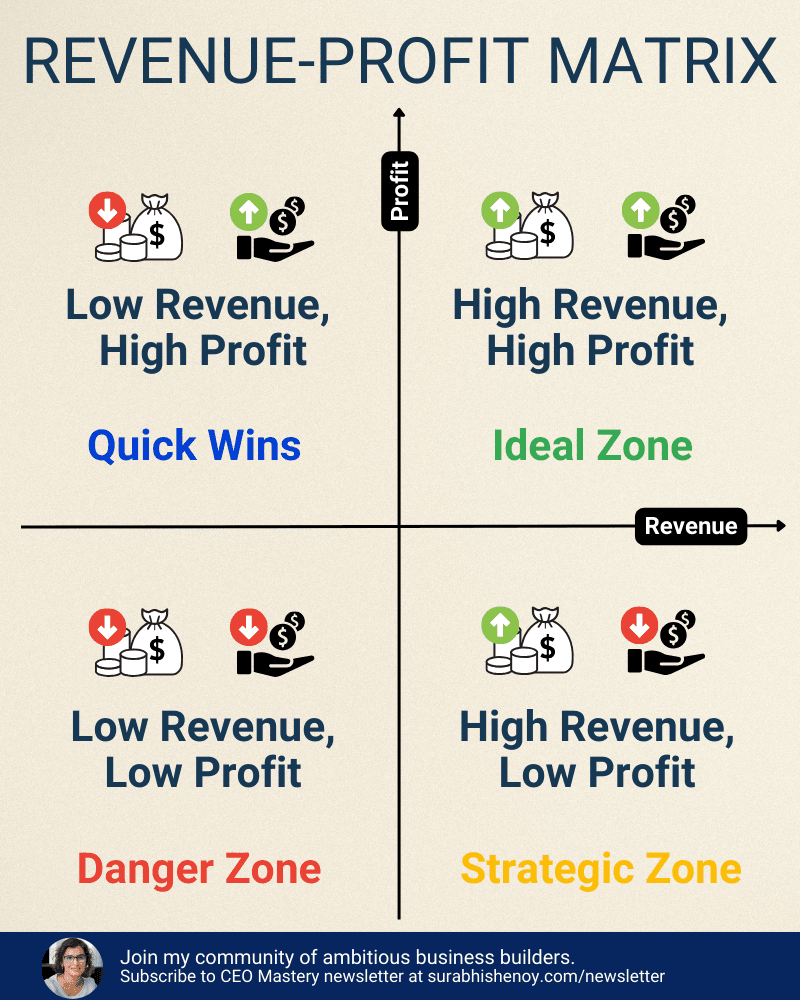
1. High Revenue, High Profit (Ideal Zone)
- These are your dream clients or projects.
- They pay well, respect your work, and give you healthy margins.
- Example: Long-term retainer clients with clear deliverables and great alignment.
2. High Revenue, Low Profit (Strategic Zone)
- These look good on paper
- Often have hidden costs like scope creep, demanding timelines, or inefficiencies.
- Example: Big clients with prestige but razor-thin margins.
3. Low Revenue, High Profit (Quick Wins)
- These are small but efficient clients or projects.
- They take minimal resources but contribute consistently to cash flow.
- Example: Repeatable, standardized services or small projects that are easy to deliver.
4. Low Revenue, Low Profit (Danger Zone)
- These are the clients you need to let go of—quickly.
- They drain your time and resources while delivering almost no value.
- Example: One-off projects with difficult clients who negotiate down to the last penny.
CALLOUT Here’s the key insight: Your success depends not on having more clients but on having the right mix of clients.
Your 3-Step Action Plan
Now let’s put this into practice. Here’s how to start:
Step 1: Audit Your Client Portfolio
- List all your clients or projects from the past year.
- Plot them into the quadrants based on their revenue and profitability.
- Analyze your mix:
- How many fall into the Ideal Zone?
- Are there too many in the Danger Zone?
- Which clients from Strategic Zone can you renegotiate with?
Step 2: Optimize Your Client Portfolio
Most clients don’t start in the Ideal Zone—but that doesn’t mean they can’t get there.
Here’s where strategic intervention can make all the difference:
1. Realign Strategic Clients (High Revenue, Low Profit)
- Renegotiate deliverables and pricing.
- Upsell value-added services to improve margins.
- Streamline your process and workflows to cut costs.
2. Expand Quick Wins (Low Revenue, High Profit)
- Expand the relationship by offering additional services.
- Turn these clients into referral champions for higher-revenue leads.
3. Deepen Ideal Client Relationships (High Revenue, High Profit)
- Strengthen relationships with your best clients through exceptional delivery.
- Explore long-term contracts to lock in consistent revenue.
4. Release or Realign Danger Zone Clients (Low Revenue, Low Profit)
- First, try to move them into a better quadrant by fixing scope or pricing.
- If they stay unprofitable after defined time or efforts, consider letting them go.
Step 3: Future-Proof Your Client Portfolio
Before taking on new clients, ask yourself these critical questions:
- Which quadrant will this client/project fall into?
- If they’re in the Strategic Zone,
- How long will I give them to move into the Ideal Zone?
- Define a timeline (e.g., 6–12 months) to see improvement.
- What effort and resources will this client require?
- Assess whether your team can handle the workload without sacrificing quality for others.
- What metrics will I track to measure their progress?
- Examples: margin improvement, increased scope clarity, or new referrals.
When you took on most of your clients, you had a goal in mind—whether it was profit, prestige, or future opportunities. This exercise is your chance to reconnect with that purpose.
Protect Your Profits
Schedule quarterly portfolio reviews to ensure you stay on track. Mark your calendar now for your first audit.
Here’s a simple 30-minute review process:
- Revisit your Revenue-Profit Matrix.
- Identify which clients have shifted.
- Pick one client from the Danger Zone to improve or exit.
Remember: The most successful businesses aren’t the ones that say yes to everyone—they’re the ones that say yes to the right ones.
Download this cheatsheet and use for your quarterly portfolio reviews.

Thank you for being here, I will see you next Thursday,
Surabhi
P.S. Working with the bootstrapped founder, I noticed they couldn’t answer a simple question: “Which projects are actually profitable?“
So we started with the basics: creating a system to track real project costs against revenue. This revealed shocking gaps between perceived and actual profitability.
Within 90 days of implementing the framework and my guidance, they identified hidden profit leaks and successfully renegotiated two major client contracts.
Today, they have complete clarity: they know exactly what metrics to track, use proven scripts for difficult client conversations, and navigate complex relationships with confidence.
Ready to transform your client portfolio? Book a free clarity call today.
What I’m Reading:
Still deep in “The Storyteller’s Secret” by Carmine Gallo.
Here’s what’s fascinating: The best leaders aren’t just good with numbers. They’re master storytellers.
Whether it’s motivating teams, engaging stakeholders, winning market trust, they transform routine updates into inspiring moments. The book breaks down exactly how they do it.
Numbers inform. Stories transform. That’s why storytelling is a CEO’s hidden superpower.
Ready to master your CEO game?
Here are 2 ways I can help
1) Elite CEO Coaching:
Strategic support to scale systematically
→ Book Your Free Clarity Call
2) 1:1 Strategy Session
One focused hour. Clear action plan. Immediate implementation.
→ Get a Power Hour With Me