
Do you realize that only a handful of customers drive your growth?
Learn strategies to increase your tech sales by focusing on key customers.
Today, we’re diving deep into a principle that can transform your tech business: The 80/20 Rule of Sales.
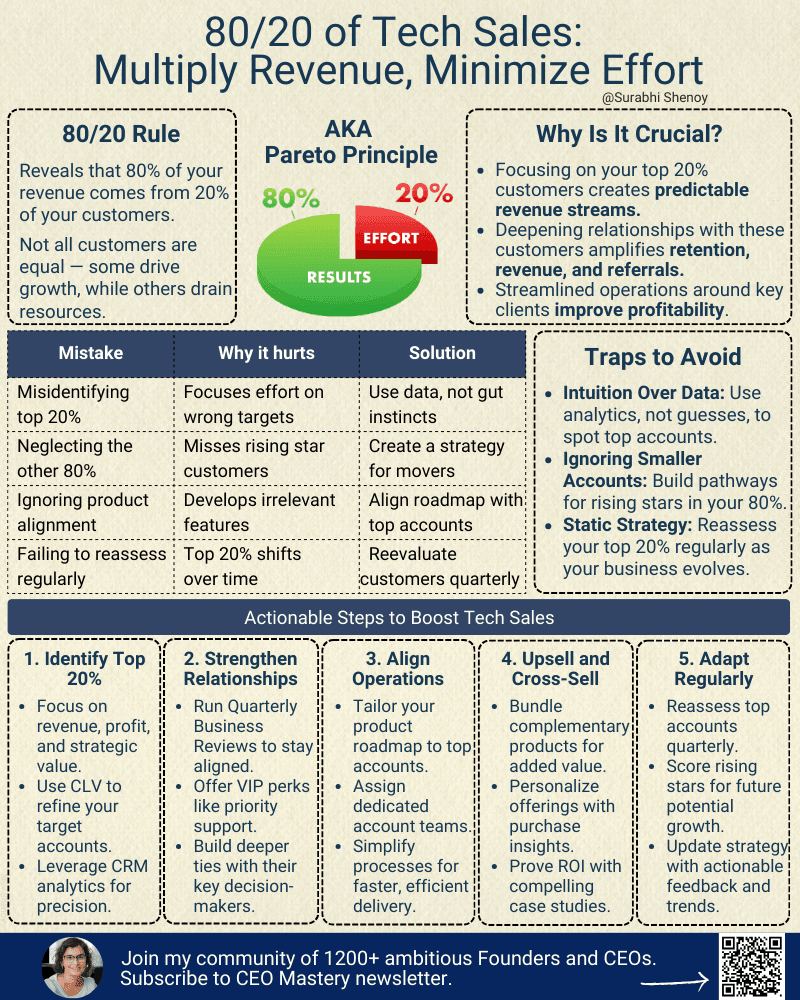
At its core, the 80/20 rule (or Pareto Principle) in sales suggests that 80% of your revenue comes from 20% of your customers.
As a former tech founder who’s built and exited a company, I’ve lived the rollercoaster of sales.
I’ve burned through cash on customer acquisition only to see them churn. But I’ve also landed big accounts that transformed our growth. Not all customers are equal — some drain resources, while others are your lifeblood.
The 80/20 principle isn’t just theory — it’s the key to moving from constant struggle to sustainable success.
Imagine doubling your revenue by focusing on just a fraction of your customer base.
Intrigued?
Read on to discover how the 80/20 rule can transform your sales strategy.
In this edition, we’ll explore:
- How the 80/20 rule transforms tech sales
- 4 critical areas to revolutionize your sales strategy
- Strategies to enhance relationships with top 20% customers
- Pitfalls to avoid when applying the 80/20 rule in your business
The beauty of the 80/20 rule of sales is that it can supercharge multiple business areas simultaneously. So mastering this principle can be the key to sustainable growth and operational excellence.
The 80/20 Advantage
In 2012, we aimed to expand our business in India’s BFSI segment.
Being self-funded, our resources were limited. So, we zeroed in on a select group of top customers — those with the potential to give us more work and whom we could fully satisfy. By focusing our limited resources on this top 20%, we doubled our revenue in 18 months.
Here are the 4 critical areas to revolutionize your sales strategy:
1. Revenue Growth
- Identify your top 20% of customers and focus on deepening these relationships
- Develop targeted upselling and cross-selling strategies for this group
- Create premium offerings tailored to their specific needs
Result: Exponential revenue growth without the cost of acquiring new customers.
Tesla leveraged data analysis to pinpoint its most promising repeat buyers, representing about 20% of its customer base. The company then crafted targeted incentives for this group, resulting in increased revenue from existing customers. This strategy, inspired by the Pareto principle, allowed Tesla to increase revenue without additional marketing costs to acquire first-time customers.
2. Customer Satisfaction
- Allocate more resources to serving your top 20%
- Provide personalized, high-touch experiences for these valuable clients
- Gather and act on feedback from this group to continually improve your offerings
Result: Higher retention rates and more word-of-mouth referrals.
3. Operational Efficiency
- Streamline your processes to cater to the needs of your top 20%
- Optimize your product dev roadmap based on their feedback
- Align your team structure to better serve these accounts
Result: Improved profit margins and more predictable operations.
4. Team Productivity
- Focus your team’s efforts on activities that directly impact your top 20%
- Develop specialized roles dedicated to managing and growing these accounts
- Create clear KPIs aligned with serving and expanding your best customer relationships
Result: Increased output and improved team morale through clear, high-impact focus.
Strategies to Enhance Relationships with Top 20% Customers
- Conduct quarterly business reviews. Analyze their usage patterns and ROI from your products, so that you can align your services with their evolving needs.
- Develop a 12-month strategic plan for each key account. Align your product development with their long-term goals. Give them a frictionless value ladder.
- Provide priority support with faster response times. We discovered that we could offer priority support with just 25% of the turnaround time of our competitors. This became our trump card for customer satisfaction, leading to repeat business.
- Implement a structured feedback program for top customers. Act swiftly on their suggestions and communicate the changes.
- Finally, the most important and effective of all, meet them personally. Visit them on-site to understand their operations better. Give them your time and ear. You will learn a lot.
Key Takeaway: These strategies go beyond basic account management. They’re about deeply integrating your top 20% into your business ecosystem.
By implementing these, you’re not just retaining customers – you’re creating strategic partners invested in your mutual success.
Common Pitfalls to Avoid
While the 80/20 rule is powerful, implementation can be tricky.
Here are key areas where tech founders often stumble:
1. Misidentifying the 20%
Don’t rely on gut feeling or surface-level data.
Dig deep into your analytics, considering factors like:
- Total revenue per customer
- Profit margin per customer
- Rates and payments
- Growth potential
- Strategic value (e.g., marquee clients that attract others)
2. Neglecting the 80%
While focusing on your top 20% is crucial, completely ignoring the rest can be a mistake. Some of these customers may have the potential to become top performers.
Develop a strategy to:
- Identify potential risers in the 80%
- Create pathways for customers to move into your top 20%
3. Failing to Adapt Your Product Strategy
Your top 20% should heavily influence your product roadmap (offerings).
Avoid:
- Building features that don’t serve your best customers
- Ignoring feedback from your most valuable clients
4. Forgetting to Reassess Regularly
Your top 20% isn’t static.
Set up systems to:
- Regularly analyze your customer base
- Identify emerging high-value customers
- Adjust your strategy as your business evolves
Implementing the 80/20 rule in tech sales isn’t just about knowing the principle — it’s about expertly applying it to your unique business context. It requires careful analysis, strategic thinking, and, often, a significant shift in how you operate.
As CEO coach, I guide tech founders through this process, helping them overcome obstacles and achieve exponential growth.
If you’re ready to harness the power of the 80/20 rule in your tech sales strategy, let’s talk. Book a strategy call here.
Here’s to your success,
Surabhi
PPS: If you found this useful, help a friend by sharing this newsletter.
Ready to master your CEO game?
Here are 2 ways I can help
1) Elite CEO Coaching:
Strategic support to scale systematically
→ Book Your Free Clarity Call
2) 1:1 Strategy Session
One focused hour. Clear action plan. Immediate implementation.
→ Get a Power Hour With Me