
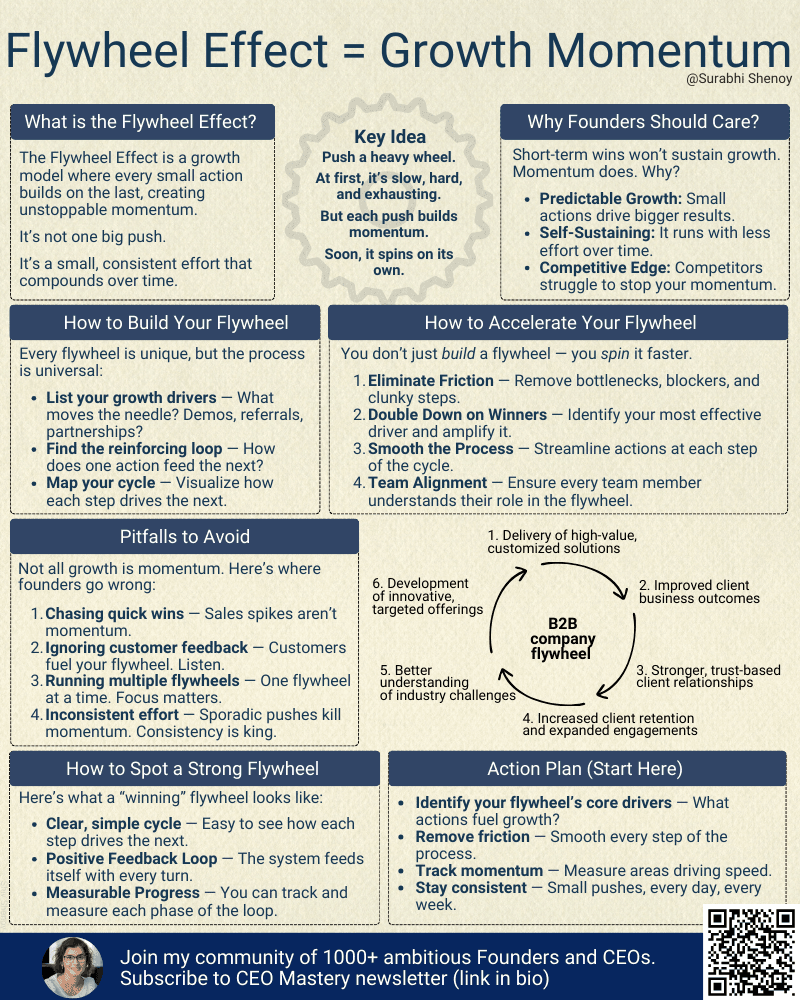
This week, we’re diving into a powerful mental model that’s transformed countless businesses: the flywheel effect.
But first, what’s a mental model? It’s a thinking tool that helps us understand how things work in the real world. Mental models simplify complex ideas and help us make better decisions.
A common mental model is the Pareto Principle, or the 80/20 rule, which states that 80% of outcomes come from 20% of efforts. Understanding such models can drastically improve decision-making and strategy.
The flywheel effect is one such model that can revolutionize how you approach business growth.
If you want to create momentum that leads to sustainable growth in your business, this is one concept you can’t ignore.
The Flywheel Effect: What It Is and Why It Matters
Picture a massive, heavy wheel. At first, it takes tremendous effort to move and complete one round. But as you keep pushing rotation after rotation, it starts to gain momentum. Eventually, it becomes easier to spin, and the wheel’s own weight propels it forward with increasing speed.
That’s the flywheel effect in a nutshell.
In business terms, it’s about creating a self-reinforcing loop where each action and success builds upon the last, generating unstoppable momentum.
For tech entrepreneurs, understanding and implementing this model can be the difference between short-lived success and long-term growth which is powered by momentum and comes with ease.
So, how do you create a flywheel for your tech business?
Start by identifying your core drivers. These are the key activities that, when executed well, feed into each other to accelerate growth.
Let’s look at Amazon’s flywheel as an example:
- Lower prices lead to…
- More customer visits, which lead to…
- More sellers joining the platform, which leads to…
- More products, which lead to…
- A better customer experience, which leads back to… 1. Lower prices (due to economies of scale)
Each element reinforces the others, creating a powerful growth engine.
For a B2B company (such as a business consultancy or a specialized supplier), the flywheel might look like this:
- Delivery of high-value, customized solutions leads to…
- Improved client business outcomes, which leads to…
- Stronger, trust-based client relationships, which leads to…
- Increased client retention and expanded engagements, which leads to…
- More comprehensive understanding of industry challenges, which leads to…
- Development of innovative, targeted offerings, which leads back to…1. Delivery of even higher-value, customized solutions.

As you can see, while the specific elements differ, the principle remains the same across various tech businesses. Now, let’s focus on how you can identify and build your own flywheel.
Identifying Your Flywheel
The first crucial step is identifying your business’s unique flywheel.
Here’s a process to help you do that:
- List your key business activities and value drivers.
- Analyze how these activities impact each other and your overall business growth.
- Identify which activities create a reinforcing loop – where one action leads to another, ultimately cycling back to strengthen the first.
- Arrange these in a circular diagram to visualize your flywheel.
Each business’s flywheel will be unique, reflecting its specific value proposition and growth drivers.
Building your flywheel is a great start. But you also need to strategically build momentum.
Strategies for Building Momentum
Once you’ve identified your flywheel, focus on optimizing each component:
- Measure relentlessly: Track the key metrics for each part of your flywheel. What gets measured gets improved.
- Reduce friction: Look for bottlenecks or pain points slowing your flywheel. Streamline processes, improve user experience, and eliminate unnecessary steps.
- Amplify strengths: Identify which parts of your flywheel have the biggest impact and double down on them.
- Align your team: Ensure everyone understands the flywheel model and their role in pushing it forward.
- Be patient: Remember, the flywheel takes time to gain momentum. Don’t get discouraged if the results aren’t immediate.
To give you an example, you might find that your product demo is the biggest driver of customer conversions. By investing in a seamless demo experience and training sales teams to deliver it effectively, you can accelerate your flywheel’s momentum.
Now you have everything to build and operate your own Business Flywheel. Let me give you a few pointers to increase your odds of success.
Common Pitfalls to Avoid
As you implement the flywheel model, watch out for these common mistakes:
- Mistaking short-term gains for true momentum: Flash sales or aggressive marketing can spike growth temporarily, but they don’t necessarily contribute to your flywheel.
- Neglecting customer feedback: Your customers are a crucial part of the flywheel. Ignore their input at your peril.
- Trying to push too many flywheels: Focus on your core flywheel before branching out.
- Inconsistency: The flywheel requires consistent effort in one direction. Sporadic pushes won’t create the momentum you need. They also reduce your overall RoI.
Remember, your flywheel should be unique to your business. Don’t just copy others – think deeply about what drives your specific growth and customer value.
Resource of the Week
For a deeper dive into the flywheel concept, I highly recommend “Good to Great” by Jim Collins.
Collins introduces the flywheel idea and provides excellent examples of how top companies have used it to achieve sustained success.
Closing Thoughts
The flywheel effect isn’t a quick fix or a growth hack.
It’s a fundamental shift in how you think about and operate your business. It requires patience, consistency, and a long-term mindset.
But for those who get it right, the results can be transformative. A well-executed flywheel can create a virtuous cycle of growth that becomes increasingly difficult for competitors to match.
So, start pushing your flywheel today. It will be hard at first, but keep at it. Before you know it, you’ll have built an unstoppable growth engine for your tech business.
Thanks for being here, I’ll see you next Thursday,
Surabhi
CEO Coach
PPS: If you found this useful, help a friend by sharing this newsletter.
Ready to master your CEO game?
Here are 2 ways I can help
1) Elite CEO Coaching:
Strategic support to scale systematically
→ Book Your Free Clarity Call
2) 1:1 Strategy Session
One focused hour. Clear action plan. Immediate implementation.
→ Get a Power Hour With Me