
In this edition, I will show you how to become a well-rounded tech entrepreneur.
In my early days of entrepreneurship, I felt like an idiot —lost, confused, and stressed out. As I shared in my journey from engineer to CEO, this feeling is common among new entrepreneurs.
It took me years to realize a crucial fact: I wasn’t an idiot, I just lacked skills.
Many tech professionals-turned-entrepreneurs focus on technical expertise, overlooking critical business skills.
You need a layered skill set at different stages of your business journey:
- Skills to get your business off the ground.
- Skills to direct and drive your business forward.
- Skills to accelerate, scale, and manage rapid growth.
- And skills that tie everything together for long-term success.
A well-rounded skill set trumps deep technical expertise alone.
There are no shortcuts here. Just practical strategies to help you become an effective entrepreneur. We’ll cover:
- Why “T-shaped” skill set is your secret weapon
- 7 critical skills tech founders need and how to build them
- 2 mental blocks sabotaging your growth and how to overcome them
Let’s dive in.
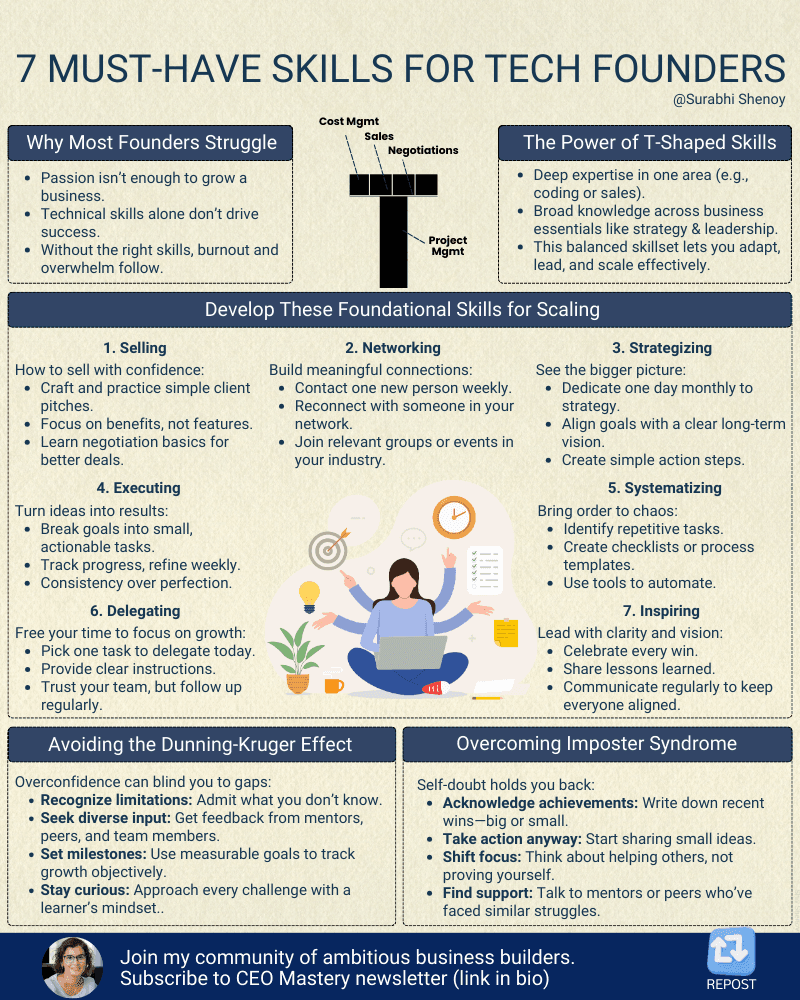
1. T-Shaped Skills: Your Entrepreneurial Superpower
What the heck is a T-shaped skill set?
The vertical line represents your deep expertise—maybe it’s coding, sales, or project management. The horizontal line represents a broad understanding of other important areas.
When I started my tech company, my expertise was in project management. But I was heading our business development effort from the front and needed to broaden my skills. I learned the basics of cost management, sales, and negotiations.

2. The Magnificent Seven: Skills Every Founder Needs
Over two decades in the tech world, I’ve seen what makes or breaks a founder.
These 7 skills kept popping up again and again. They make up 90% of your success. Master them.
1. Selling: Because great products don't sell themselves.
Action Tip: Create and practice elevator pitches for different client personas. Learn to sell the benefits (not features). Read about how I sold my company here.
2. Networking: Your network is your net worth.
Action Tip: Reach out to an old contact or make one new valuable connection each week. Quality trumps quantity.
3. Strategizing: See the forest, not just the trees.
Action Tip: Schedule a monthly “strategy day” to step back from day-to-day operations and focus on the big picture.
4. Executing: Ideas are worthless without action.
Action Tip: Break down your biggest goal into weekly actionable steps. Focus on completing one step each week.
5. Systematizing: Create order from chaos.
Action Tip: Choose one repetitive task and create a simple checklist or flowchart for it. Make space for creative thinking.
6. Delegating: You can't (and shouldn't) do it all.
Action Tip: Identify one task to delegate this week. Document the process and assess the results.
7. Inspiring: Rally the troops and maintain vision.
Action Tip: Start each week by sharing a win or lesson learned with your team or mentor. Celebrate progress, no matter how small.
To summarize, skills 1-2 help you start, 3-4 direct and drive, 5-6 help scale and manage, and 7 is the capstone that holds everything together.
Now, here’s where it gets interesting. Knowing this list is one thing, but developing and using them? That’s where the real challenge begins.
3. Overcoming Mental Roadblocks
As you begin to improve upon these skills, two invisible mental blocks can sabotage your growth. You want to be cautious about these:
The Dunning-Kruger Effect
This is when you’re overestimating your abilities.
For founders, this can be dangerous.
You might ignore good advice from a mentor.
- You will miss areas where you need to level up.
- This could lead to poor judgment and decision-making
Here’s how to overcome it:
- Regularly seek feedback from mentors, team members, or peers
- Embrace a beginner’s mindset (especially outside your core expertise)
- Set measurable goals for skill improvement, track your progress objectively
Imposter Syndrome
This is when you doubt your abilities and feel like a fake.
For months, I hesitated to share insights on LinkedIn, thinking, ‘Who am I to talk about this?’ But I pushed through and started small. Now, I receive messages from people saying that my suggestion helped them. This has made me realize that my experience, however ordinary to me, could be valuable to others. And the same is true for you.
To overcome Imposter Syndrome:
- Write down your achievements, big and small
- Remember that everyone starts as a beginner
- Focus on helping others with what you know
Irrespective of where you are in your entrepreneurial journey, develop these skills. You’ll immediately start noticing changes in your thought process and work efficiency.
Your task this week:
- Pick one skill from the “Magnificent Seven” to improve
- Take one action to develop it by blocking 30 minutes daily
- Notice and tackle if Dunning-Kruger or Imposter Syndrome shows up
So, which skill are you tackling first?
Keep pushing, keep growing, and remember: you’ve got this!
To your Mastery!
Surabhi Shenoy
CEO Coach
Ready to master your CEO game?
Here are 2 ways I can help
1) Elite CEO Coaching:
Strategic support to scale systematically
→ Book Your Free Clarity Call
2) 1:1 Strategy Session
One focused hour. Clear action plan. Immediate implementation.
→ Get a Power Hour With Me