
Is there anything left to say about delegation?
Honestly, I asked myself that before writing this.
Every leadership book covers it. Every podcast mentions it. The advice is everywhere.
And yet.
Week after week, I watch capable founders slow their own growth because they can’t bring themselves to delegate.
So no, this is not another “how to delegate” edition.
This one is about why you don’t — even when you know you should.
In my experience, founder delegation isn’t just a skill problem.
It’s an identity problem.
If delegation is already working well for you, keep reading anyway. The leaders on your team may be facing the same barrier. Share this with them. The growth bottleneck might not be you anymore. It might be the next layer down.
Your Role Evolves, So Should You
As a business grows, founder delegation becomes difficult because the founder’s role keeps evolving.
What made you successful in the early stages of the business is not what the company needs from you now.
I think of founder role evolution in four stages:
Builder → Operator → Multiplier → Allocator.
At the Builder stage, you do everything.
You are the product, the sales team, the support desk.
At the Operator stage, you start building a structure.
You hire people. You introduce processes. Growing revenue and getting ready for expansion is on your mind now. But every important decision still runs through you.
At the Multiplier stage, something harder is required.
You must delegate decisions — not just tasks. You must trust others to think, not just execute.
At the Allocator stage, you delegate entire domains of responsibility.
Capital. Strategy. Talent. You become the person who decides what the company focuses on — not the person who does the focusing.
Each stage demands a little more letting go.
This is where many founders struggle.
Over time, I’ve noticed a few psychological patterns that tend to appear along the way.
Five Psychological Barriers That Stop Founders From Delegating
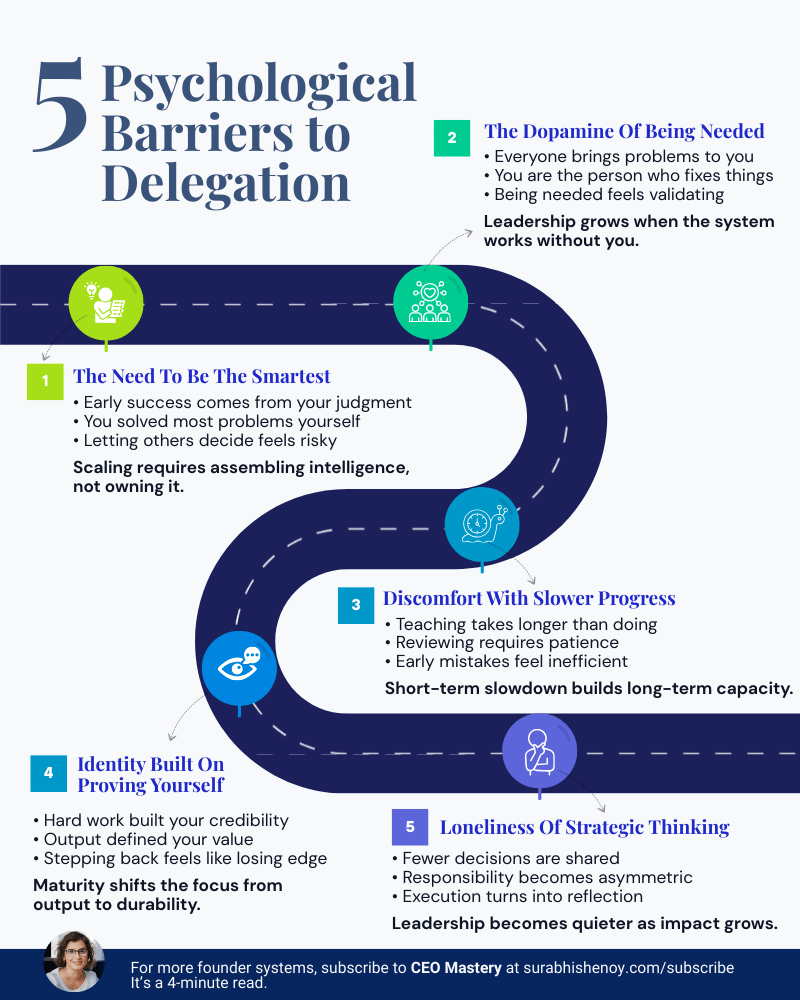
Barrier 1. The Need to Be the Smartest Person in the Room
Early-stage success reinforces intellectual dominance.
You made the calls. You spotted the patterns. You were right more often than not. That’s how the company survived.
But scaling requires hiring people who see things you don’t. People who challenge your assumptions. People who make decisions differently than you would.
That threatens identity.
Not logic.
Logic says: “Hire smart people and let them lead.”
Identity whispers: “But what if they don’t need me?”
I have seen this repeatedly — founders build capable teams and then override decisions, insert themselves into conversations, or hold back information. Not maliciously. Unconsciously.
The role of the founder has to expand.
At scale, being “smart” no longer means having the best answers.
It means building a room where others bring expertise, make collective decisions, and you are comfortable owning the consequences.
Barrier 2. The Dopamine of Being Needed
When every problem flows through you, you feel indispensable.
There’s a rush in being the person everyone turns to. The one who saves the deal. The one who fixes the crisis at midnight. The one who “just knows.”
Delegation removes that.
Silence replaces urgency. The inbox gets quieter. Meetings happen without you. And instead of relief, many founders feel something closer to emptiness.
Sound familiar?
The founder must learn to replace the need for validation with satisfaction from building something that works without them. That is a fundamentally different source of self-worth. And it takes time.
Barrier 3. Discomfort With Slower Visible Output
When you do something yourself, the result is immediate.
When you delegate, it slows down.
Teaching takes time. Reviewing takes patience. Watching someone take three attempts to reach a conclusion you could have reached in ten minutes — that feels inefficient.
In the short term, it is.
In the long term, it compounds.
I saw this clearly while building the operating model at Tejora.
I could have written every process document myself in half the time. Instead, I sat with my team, guided them through the thinking, let them struggle, let them get it wrong, and then let them own it.
It was painfully slow for about six weeks. And then — it was fast. Faster than I could ever have been alone.
The founder who delegates must accept a temporary dip in visible speed for a permanent gain in organizational capacity.
Barrier 4. Identity Built On Proving Yourself
Early in the journey, identity is often tied to proving competence.
You work the hardest. You know the most. You earn respect through sheer output. That is how many founders build credibility — with themselves and with the world.
But as the business matures, identity must shift from competence to durability.
The question changes from “Am I good enough?” to “Is this built to last?”
Durability requires patience. Patience requires ego control.
If your self-worth is still tied to being the most productive person in your company, delegation will always feel like a loss. You must redefine what winning looks like — from personal output to organizational strength.
Barrier 5. The Loneliness of Strategic Thinking
This one is rarely discussed.
As you move toward allocator-level thinking, the nature of your work changes.
You spend more time alone with long-term questions. You carry more asymmetric responsibility — decisions where the downside is large and the upside is uncertain. You cannot discuss everything internally because some decisions must be made before they can be shared.
That solitude is part of evolution.
It is not dysfunction. It is maturity.
But it often catches founders off guard. They move from a world of camaraderie and shared execution to a world of solitary reflection and strategic weight. Some retreat back into operations just to feel connected again — not because the business needs them there, but because they need the business to need them there.
If this feels familiar, it is part of the transition. You are evolving. And the discomfort you feel is the cost of the next stage.
What Replaces the Old Identity
Here is the thing I have learned — from my own journey and from working with dozens of founders through this transition.
This is not about “letting go”.
Your role is changing.
You stop trying to be the smartest person in the room. Your job is to assemble the right intelligence.
Speed becomes less visible, but leverage increases.
The focus shifts from proving yourself to building something durable.
And from ‘doing the work’ to ‘deciding what matters most’.
That change in role doesn’t happen in one workshop or after reading one newsletter.
It happens gradually — through practice, through discomfort, and through the discipline of choosing to stay in the new role even when the old one pulls you back.
One Question to Sit With This Week
Ask yourself:
Which of these five barriers is most active in my life right now?
Don’t judge it. Just name it.
Because the moment you see the pattern, it loses some of its control.
And if you lead a team — share this with them. The leaders you are developing are likely facing their own version of these same barriers.
Delegation is not just a founder problem. It is a leadership problem at every level.
The business can only grow as fast as the people inside it learn to let go of what’s not serving them anymore.
Thank you for being here. I will see you next Thursday.
Surabhi