
This is Part 4 of a 4-part series studying Sam Walton — focusing on how his thinking applies to pricing, distribution, incentives, and growth.
Part 1 : How Sam Walton Thinks
Part 2: How Founders Can Use His Thinking
Part 3: How Sam Walton Built a Team That Could Scale
Part 4: Where Sam Walton’s Thinking Lives Today (this edition)
In 1984, a sixteen-year-old boy in Bentonville, Arkansas, took a summer job at Walmart.
He picked orders and unloaded trucks.
It was hourly work.
No special access.
No family connections.
Just a teenager earning money over summer break.
His name was Doug McMillon.
Thirty years later, he became the fifth CEO of Walmart.
He held that role for twelve years, growing the company‘s annual revenue from $486 billion to $681 billion.
He retired in January 2026.
His successor is John Furner.
Furner started at Walmart in 1993.
Also, as an hourly associate.
Two consecutive CEOs.
Both entered the company at the bottom.
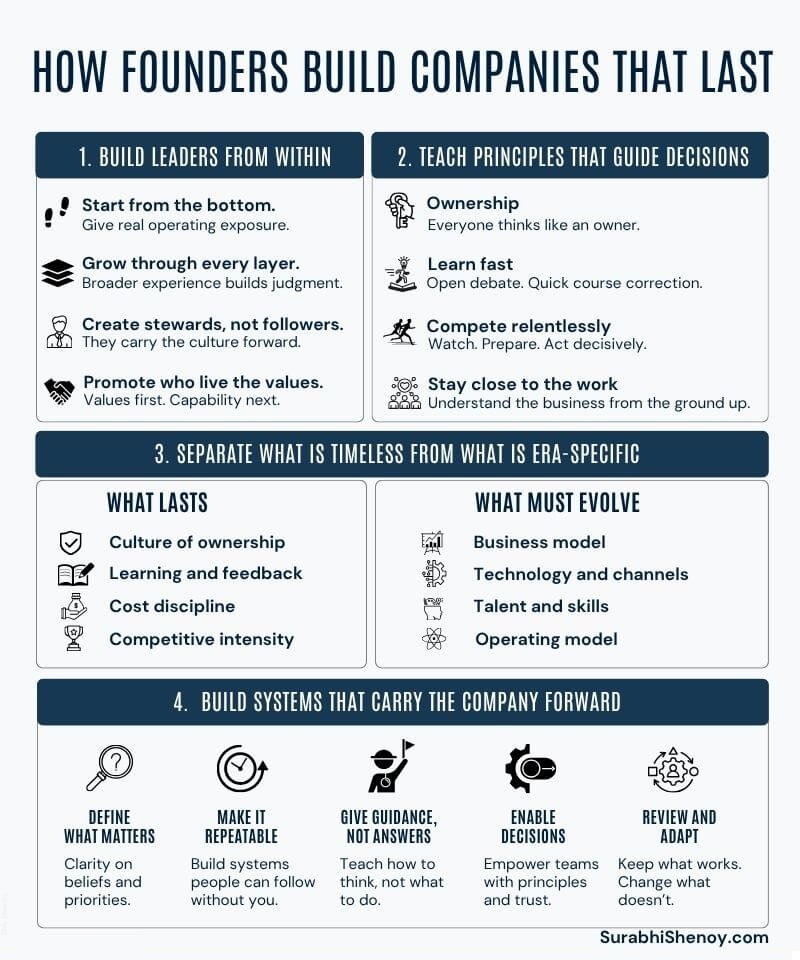
Both rose through every layer of the business before reaching the top. This is a testament of how leaders get developed inside a growing company.
Sam Walton died in 1992. He never saw McMillon become CEO. He never saw the e-commerce transformation. He never saw Walmart reach $681 billion. But the system he designed — the ownership culture, the internal leadership pipeline, the belief that ordinary people could become extraordinary operators — produced these outcomes decades after he was gone.
The real test of a founder’s thinking is not whether it works while you’re running the company, but whether it works when you’re not. This is what scaling a business actually tests.
Scaling a Business: What Survived Sam Walton
What Sam Walton built didn’t disappear with him. It still shows up inside Walmart today — not as slogans, but as operating behavior.
The ownership culture survived. Profit sharing, employee stock purchase plans, and associate investment programs continued to create wealth for people at every level of the organization. McMillon expanded this further — increasing wages, expanding parental leave, and paying for associates to earn certificates and degrees. The principle stayed. The implementation evolved.
The learning velocity survived. Saturday morning meetings. Open discussion of mistakes. Store-level accountability. The weekly rhythm Sam started with a handful of managers in a small town of Arkansas became institutional infrastructure that scaled across thousands of stores globally. It wasn’t a meeting anymore. It was how the company learned.
The “think small” discipline survived. McMillon, even as CEO of a company with 2.1 million employees, was known for visiting stores personally, talking to associates, and staying close to ground-level operations. His Facebook bio read: “Proud Walmart associate.” Not “CEO.” It was a small signal that he still saw the business from the store outward, not from the office downward.
Scale didn’t create distance, because the system prevented it.
The competitive identity survived. When Amazon began dominating e-commerce, Walmart didn’t retreat into its physical footprint and hope the threat would pass. It fought. Aggressively. That instinct — prepare structurally, meet competition head-on, then execute — is pure Sam Walton.
These didn’t survive by accident. They were built into how the business operated.
What Didn't Survive — And What Had to Change
Not everything Sam built aged well.
Some of his strongest principles created challenges for his successors to overcome.
Sam Walton built Walmart around physical retail — stores, distribution centers, trucks, regional density. Everything in his system was optimized for moving physical goods to physical locations at the lowest possible cost. That system was brilliant for forty years.
Then the internet changed how people buy things.
By the time McMillon became CEO in 2014, Walmart had fallen behind online retailers badly. Amazon was growing at a pace that made Walmart’s traditional model look slow. The company’s deep commitment to “everyday low prices” in physical stores had led to underinvestment in digital infrastructure. The very identity that made Walmart dominant — a low-cost physical retailer — became the constraint that resisted transformation.
McMillon had to break through this.
He approved the $3.3 billion acquisition of Jet.com to bring in e-commerce talent and capability. Wall Street questioned whether Walmart had overpaid. In 2015, he announced wage increases for half a million hourly workers — a move that triggered a stock sell-off and wiped more than $20 billion in market value in a single day.
Both decisions faced sharp criticism in the short term. Both proved correct in the long term.
The lesson for founders is uncomfortable but important.
Your best principles have an expiry date.
The operating beliefs that make you successful in one era can become the constraint that makes you vulnerable in the next.
Sam’s cost discipline, competitive intensity, and learning culture all transferred beautifully across decades. His physical retail orthodoxy did not.
McMillon didn’t reject Sam Walton’s thinking. He separated what was timeless from what was era-specific. He kept the ownership culture. He kept the competitive intensity. He kept the obsession with cost. But he rewired the delivery mechanism underneath all of it.
This is the work every founder must do periodically — while they’re still leading it.
The Question This Series Leaves You With
Here’s what I keep thinking about after spending months inside Sam Walton’s story.
He didn’t start with a forty-year plan. He started with a paper route, a small-town store, and a deep reluctance to waste a single dollar. The system that eventually produced two CEOs from the warehouse floor wasn’t designed on day one.
It emerged from early decisions, compounded over time. When Walmart was still small enough for the team to fit in one room, Sam Walton built cost discipline, ownership thinking, open discussion of mistakes, and constant competitive awareness into how the company operated.
You don’t need to know what your company will look like in 40 years. You need to know what you believe today — about cost, people, competition, and learning — clearly enough that it shows up in how your team operates without being told.
- What do you believe about how your business should run as you scale?
- Which of your principles are genuinely timeless?
- Which principles are you holding onto because they worked before, not because they’ll work next? (HINT: AI may not change your values, but it could change your workflows, hiring, and decision-making much sooner than you think.)
- Can your team articulate them without you in the room?
Your answers will tell you if you’re building something that compounds.
If not, that’s not failure. That’s your next project. Define your principles to be made structural.
Sam Walton spent forty years on that project. You can start today.
Closing the Series
Four editions. One operator. Here is what I hope stayed with you.
Part 1 was about seeing the mind — cost as worldview, learning velocity, thinking small at scale, competitive identity. Not tactics. Operating patterns.
Part 2 was about making it useful — designing cost structure before pricing, building distribution before you need it, shifting from operations-driven to merchandise-driven, and recognizing your constraints as potential moats.
Part 3 was about people — the shift from cheap wages to ownership culture, the structural systems that turned ordinary workers into partners.
Part 4 — this edition — was about what survives. The principles that outlasted Sam Walton, the assumptions that didn’t, and questions every founder should contemplate.
Studying iconic founders like Sam is not about admiration; it’s about extraction. Take the patterns that transfer. Leave the instincts that don’t. And build something that doesn’t need you to keep running.
That’s the work.
Thank you for reading this series. I’ll see you next Thursday.
Surabhi
PS: I spent over a month researching Sam, taking notes, applying my own founder lens, extracting lessons, thinking about which ones apply to today’s founders, then designing the series and finally writing it. This is over 80 hours of work, presented to you as a 30-minute, 4-part read. This is the kind of work CEO Mastery is designed for.
If you enjoyed this series, please write a testimonial here. It helps me reach more founders.