
📌 Note: This is Part 3 of our Operating Model series. For best results, read Part 1 and Part 2 first. They lay the foundation for this implementation guide.
Over the last two weeks, we explored:
- Why org charts can’t keep work flowing (Part 1)
- The 4 elements that make up an Operating Model (Part 2)
Now comes the part most companies get wrong: Implementation.
I’ve seen this play out many times:
- “Let’s roll this out company-wide!”
- “We’ll document all our processes this quarter!”
- “Everyone needs to follow the new system starting Monday!”
Three months later: Everyone’s back to their old ways.
Why? Because changing how work flows through your company isn’t about grand announcements. It’s about careful, deliberate shifts in how people work together.
Here’s how to get your Operating Model right.
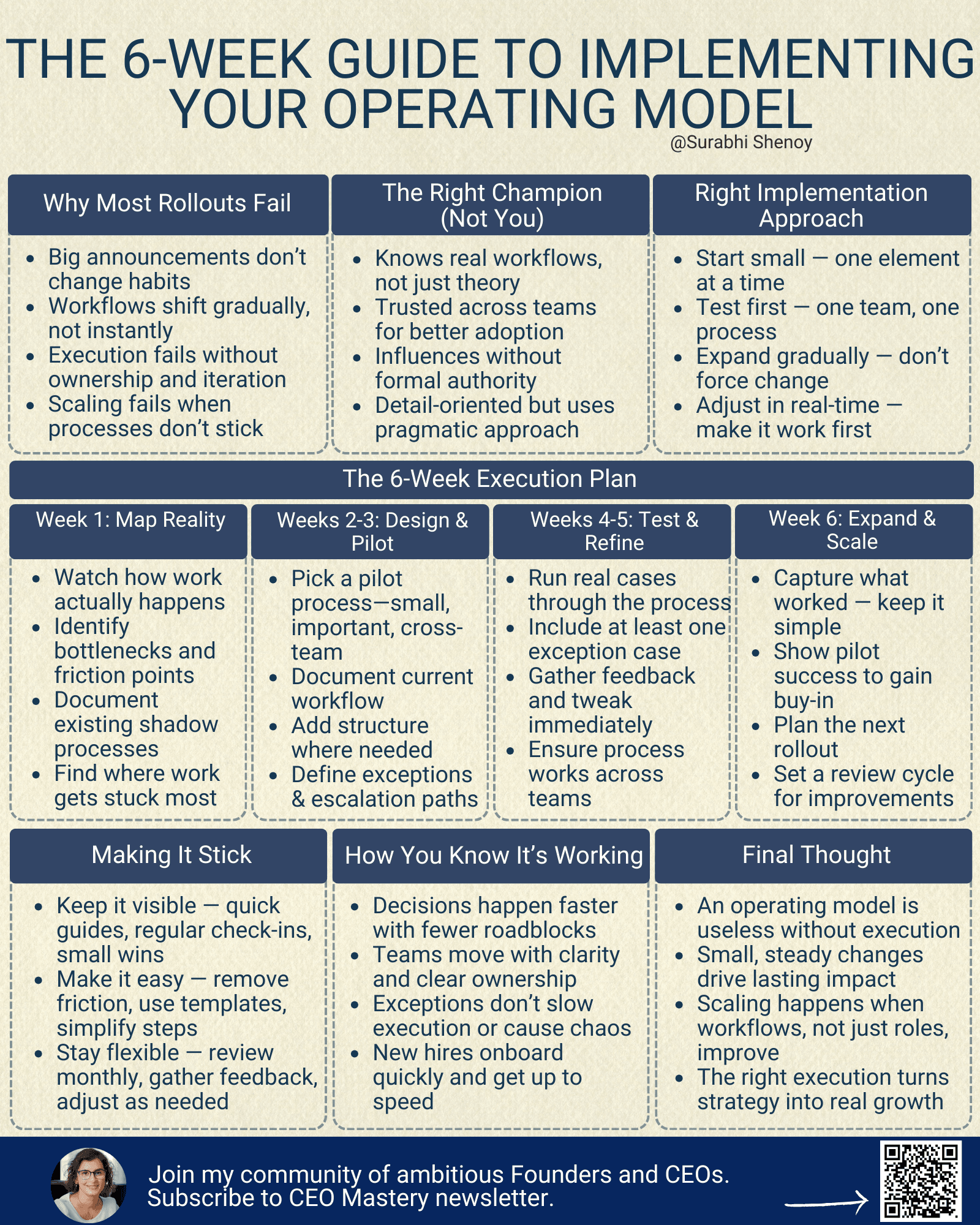
Step 1: Choose Your Champion
This isn’t a founder-led initiative. You guide it, but don’t run it.
The ideal owner is someone who:
- Understands how work actually flows (not just how it should flow)
- Has earned trust across teams (so people listen)
- Can influence without authority (gets buy-in naturally)
- Is detail-oriented but practical (not a process-for-process’ sake person)
Often this is an experienced Product Manager, Operations Lead, or your most seasoned Team Lead.
Step 2: Draw an Implementation Timeline
Here’s the approach that works:
- Start with one workflow
- Get it working in one area
- Test and refine
- Move to the next workflow
For a 20-person company, this might take about 3-4 months total.
For a 100-person company, plan for about 6-8 months.
The exact timeline isn’t what matters. What matters is:
- Starting small enough to succeed
- Moving fast enough to maintain momentum
- Going slow enough to make it stick
Let’s break down how to implement your first workflow in the next 6 weeks. (You and your Champion can adjust this timeline based on your context.)
Start With What Works
Here’s a story I love:
A major university was designing their campus walkways, they faced endless debates about the “right” path to build around a big lawn. Finally, someone suggested: “Don’t build any path for some time. Let students walk where they naturally would. Then build the path where the grass is worn away.”
The same principle applies here.
Your teams have already created informal paths to get work done. These “shadow processes” aren’t perfect, and maybe not known to everybody, especially the new joinees, but they exist and they have evolved for a reason. We will embrace them.
Step 3: Follow the 6-Week Plan
Week 1: Map Reality
This is your assessment phase:
- Watch how work moves through your company
- Note where work commonly gets stuck
- List the informal workarounds teams use
- Map which teams are involved in each process
Weeks 2-3: Design
Next, pick your “perfect pilot workflow”:
Choose ONE process that is either:
- Your biggest time-waster
- A common friction point between teams
- Something customer-facing where delays cost revenue
Your chosen workflow should be:
- Small enough to design initial solution in two weeks
- Involve 2-3 teams (not the whole company)
- Have clear before/after metrics
Then, for this workflow:
- Document the current process in detail
- Add structure for all four elements:
- Decision rights: Who can approve what
- Information flow: Who needs to know what
- Work flow: Standard steps and paths
- Team allocation: Who handles each part
- Define exception handling
- Share draft with the pilot team
Need help figuring out your workflow’s structure? I help founders implement Operating Models through 1:1 strategy session. Book a call here to get unstuck quickly.
Weeks 4-5: Test and Refine
- Run 2-3 real cases through the new process
- Include at least one exception scenario
- Get feedback after each case
- Adjust immediately when something doesn’t work
Week 6: Expand
- Write down what worked (be specific)
- Create simple guidelines
- Show the pilot’s wins to the team
- Start planning rollout for next workflow
Step 4: Make It Stick
1. Keep it visible
- Quick reference guides, not manuals
- Regular check-ins
- Celebrate wins
2. Make it easy
- Remove unnecessary steps
- Create templates
- Make the right way the easy way
3. Stay flexible
- Monthly reviews
- Clear feedback channels
- Regular updates based on input
What Success Looks Like
You’ll know it’s working when:
- Clear ownership exists
- Decisions happen quicker
- Teams move forward confidently
- Exceptions get handled smoothly
- New people understand quickly how things work
The real win?
Work flows naturally, like students taking the obvious path across campus.
Your Next Step
- Choose your Champion this week
- Pick your first workflow to implement.
Start small, move steadily, make it stick.
Thank you for joining me on this journey. If you implement this system, I’d love to hear how it goes – just hit reply and let me know.
Surabhi
PS: Building systems isn’t exciting work. It’s not the kind of thing that makes for great social media posts. But it’s exactly what makes the difference between a founder-dependent business and a truly valuable company.

What I am reading:
Finished Inspire Someone Today — and here’s the real takeaway:
Some books inspire. Some books equip.
This one does both.
It’s a mindset reset for professionals who want to lead with clarity, act with purpose, and stay resilient when things get tough.
What stood out most? The simplicity of its wisdom.
No fluff, no overcomplication — just clear, practical lessons you can apply immediately.
If you’re serious about long-term success without burnout, this book belongs on your shelf.
Ready to master your CEO game?
Here are 2 ways I can help
1) Elite CEO Coaching:
Strategic support to scale systematically
→ Book Your Free Clarity Call
2) 1:1 Strategy Session
One focused hour. Clear action plan. Immediate implementation.
→ Get a Power Hour With Me