

Revenue is the most visible sign of momentum in a business.
When revenue grows, everything changes. Strong candidates want to join. Vendors take you seriously. Customers trust you more easily. The internal mood moves from survival to ambition.
That’s why founders spend so much energy on one question: How do we grow revenue faster?
Most founders chase revenue growth through scattered tactics — a new marketing channel, a different pricing page, another sales hire.
But revenue growth rarely comes from tactics alone. It comes from understanding the system behind them.
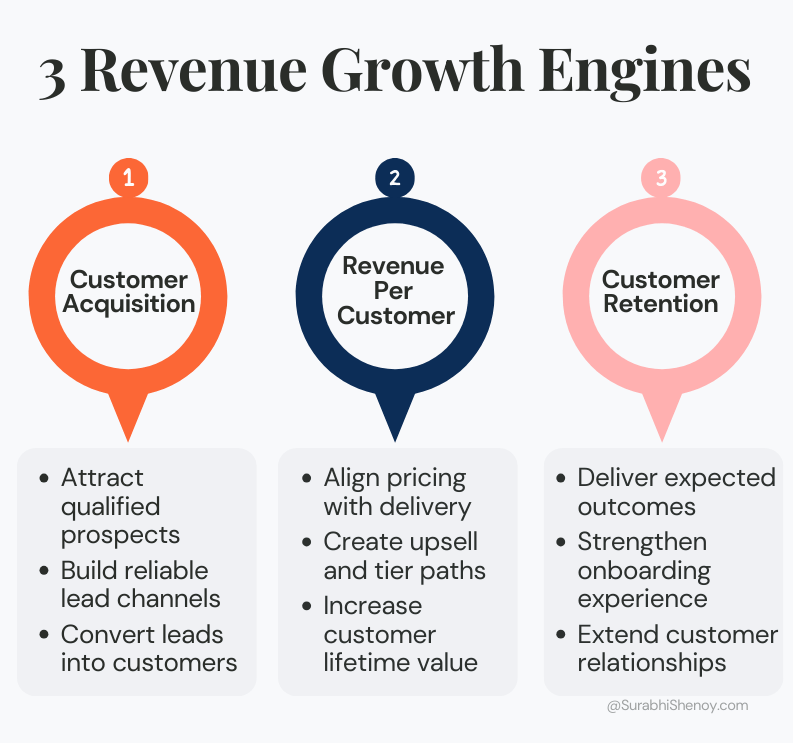
Revenue grows through a small number of engines. When those engines are clear and well-fed, growth becomes predictable.
In this article, we will look at:
- What Are Revenue Growth Strategies?
- Revenue Engine 1: How to Acquire More Customers
- Revenue Engine 2: How to Increase Revenue Per Customer
- Revenue Engine 3: Why Customer Retention Drives Revenue Growth
- Why Revenue Growth Stalls (And What Most Founders Miss)
- From Revenue to Profit: The Missing Piece Most Founders Ignore
- Cash Flow Management: Turning Profit Into Growth Capital
- How Revenue, Profit, and Cash Flow Work as a System
- Articles to Deepen Your Understanding
- Best Books on Revenue and Profit for Founders
What Are Revenue Growth Strategies?
Revenue growth strategies are the ways a business increases total sales over time.
Tactics vary across industries, but revenue ultimately grows through only three structural mechanisms:
- Acquiring more customers,
- Increasing how much each customer spends, and
- Improving how long customers stay.
That’s it. Three engines.
Every marketing campaign, pricing decision, product improvement, or customer success effort strengthens one of these engines.
The problem? Most founders don’t know which engine is weak. They throw effort at all three simultaneously and wonder why months of hustle produce marginal results.
The better question is not: Which tactic should we try next?
The better question is: Which revenue engine needs attention right now?
Revenue Engine 1: How to Acquire More Customers
Customer acquisition is the first lever founders usually reach for. More leads, more meetings, more customers. It’s visible, it’s tangible, and it feels like progress.
But acquisition only works well when the three foundations are strong.
Clarity on who you serve.
When a business tries to serve everyone, the message gets weak and sales cycles get longer. I’ve seen this pattern in many founders I’ve coached — they resist narrowing their audience because it feels like leaving money on the table. In reality, the narrower the focus, the faster the growth.
Consistent lead sources.
Growth cannot depend on occasional referrals or one viral LinkedIn post. It needs channels that bring in qualified leads week after week. Without that consistency, revenue becomes uneven and hard to plan.
A structured sales process.
Even strong lead flow breaks down without a clear way to qualify, present value, and close. At Tejora, we didn’t start growing predictably until we stopped relying on my personal relationships and built a repeatable sales process the team could run without me.
Here’s the insight most founders miss: acquisition problems are rarely solved by spending more on marketing. They’re solved by improving clarity, consistency, and conversion.
Revenue Engine 2: How to Increase Revenue Per Customer
Many founders assume the only way to grow is to add more customers.
In my experience, improving revenue per customer is often faster, cheaper, and more sustainable.
This happens through three mechanisms.
Pricing strategy.
The generic advice is ‘charge more’. But pricing is rarely that simple.
Premium pricing and discounted pricing both work. What matters is that your pricing matches your operating model.
High-ticket, low-volume works if your delivery supports deep, high-touch engagements. Low-ticket, high-volume works if your costs, automation, and processes can serve scale without burning cash and team. When pricing and delivery are aligned, customer acquisition gets easier and every customer becomes more profitable.
Expansion revenue.
Upsells, cross-sells, and structured service tiers give existing customers a natural path to spend more.
Strong businesses do not stop at closing a deal. They design a journey for the customer.
In B2B companies this often takes the form of a land-and-expand model supported by an account manager who grows the relationship over time.
Customer lifetime value.
The total revenue from each client relationship grows when you intentionally deepen it over time.
Not through aggressive selling. But by consistently finding new ways to solve problems they already trust you with.
Small improvements here produce disproportionate results. A 10% improvement in pricing (or cost optimization) and a modest upsell path can transform a business’s economics without adding a single new customer.
One story stays with me.
A founder I coached believed he needed more leads. When we reviewed the numbers, the real issue was different.
His average deal size had not changed in three years. But his costs had increased.
We adjusted pricing and introduced a second tier.
Revenue grew 30% within two quarters. The number of clients stayed the same.
Clients Ghosted Jay Until He Changed These 5 Words tells a similar story about how offer clarity unlocks revenue.
Revenue Engine 3: Why Customer Retention Drives Revenue Growth
Retention is the quietest growth lever. It rarely makes headlines.
But over time, it becomes one of the most powerful drivers of revenue growth.
When customers stay longer, several things happen at once.
- Customer lifetime value increases.
- Customer acquisition costs become easier to justify.
- Revenue becomes more predictable.
And the business builds a compounding base that makes every new sale additive rather than essential for survival.
Retention depends on one thing above all: consistently delivering the outcome customers expected when they bought.
Strong onboarding matters. When customers experience value quickly, they stay engaged. Ongoing communication and support reinforce the relationship. But none of that compensates for a gap between what was promised and what was delivered.
Founders who track retention carefully often see warning signs early.
Customers rarely leave without signals first.
Patterns appear in feedback, support requests, and usage long before revenue starts to decline.
Why Revenue Growth Stalls (And What Most Founders Miss)
If growth depends on just three engines, why do so many businesses struggle to scale?
Because every engine requires fuel.
Money.
Customer acquisition requires marketing investment and sales capacity. Growing revenue per customer requires strong delivery and differentiated value. Retention requires operational consistency and customer success capabilities.
For bootstrapped founders especially — and I was one for twenty years — that fuel has to come from within the business itself.
Growth is expensive — it needs cash.
This is where profit enters the picture.
From Revenue to Profit: The Missing Piece Most Founders Ignore
Revenue represents activity.
Profit represents capacity.
Profit is what allows you to reinvest in marketing, hire stronger people, improve systems, and expand the business. Without sufficient profit, revenue growth slows.The company may be busy, but progress becomes difficult.
The trap is gradual.
Margins don’t disappear in one dramatic event. They shrink through small operational issues that compound
Pricing decisions made years ago no longer reflect current value.
Certain clients consume far more resources than expected.
Delivery processes contain hidden inefficiencies.
At Tejora, I didn’t fully understand this until I began preparing for exit.
When I finally audited where margins were leaking, I found opportunities I’d been walking past for years. Most founders I coach have a similar experience — 10-15% in margin improvement hiding in plain sight, no new strategy needed.
I built a free tool to help founders run this audit systematically — the Profit Leak Detector.
It walks you through pricing, delivery, client mix, and operational systems to find where margins are being lost.
The strong founders don’t treat profit as whatever’s left after expenses. They design for it from the beginning.
Cash Flow Management: Turning Profit Into Growth Capital
One more piece completes the picture.
A business can show profit on paper while still struggling to pay bills. Profit is an accounting measure. Cash flow reflects operational reality.
Cash flow problems typically arise from delayed invoicing, long payment terms, or projects requiring significant upfront work before revenue is collected.
A few simple practices can make a meaningful difference.
- Invoice immediately after delivery.
- Use milestone billing or deposits for larger projects.
- Shorten payment terms where possible.
- Track receivables consistently.
At Tejora, switching from net-60 to net-30 with milestone billing freed up enough cash to fund a full quarter of growth without borrowing. We also built a simple collections SOP — pre-date reminders, same-day follow-ups, 3-day escalations — that kept receivables tight without damaging client relationships.
When cash moves efficiently through the business, you gain the flexibility to reinvest in growth without external funding.
That’s the kind of freedom most founders started their companies to create.
How Revenue, Profit, and Cash Flow Work as a System
Let me bring this together.
Acquisition, pricing, and retention are the three engines of revenue growth.
Profit determines how much fuel the business generates.
Cash flow determines how quickly and predictably that fuel becomes available.
These aren’t independent. They operate as one system.
Your operating model shapes pricing.
Pricing affects retention.
Retention strengthens profitability.
Profit and cash flow determine how fast you can reinvest.
And reinvestment fuels acquisition.
When you start thinking about revenue this way — as a system, not a set of tactics — growth becomes something you can engineer. Not through heroics but through clarity, discipline, and patience.
The result is a business capable of sustainable, self-funded, growth.
The kind that compounds easily and becomes worth far more than the sum of its parts.
Key Takeaways
- Revenue grows through three engines: customer acquisition, revenue per customer, and customer retention. Diagnose which one needs attention before chasing new tactics.
- Profit is the fuel that supports revenue growth. Without healthy margins, your revenue engines can’t sustain growth. Design for profit — don’t treat it as a leftover.
- Cash flow determines speed of growth. Profit on paper means nothing if cash is trapped in slow invoicing and long payment cycles.
- Think in systems. The founders who grow sustainably manage revenue engines, profit margins, and cash flow as one interconnected system — not three separate problems.
Articles to Deepen Your Understanding
On revenue and business model design:
On diagnosing growth constraints:
On profit and financial discipline:
On sales and client relationships:
Best Books on Revenue and Profit for Founders
Profit First: The Money System That Actually Works for Entrepreneurs The book that changed how I think about profit. Stop treating it as a leftover — design for it first.
The One-Liner That Sells: How ‘Story Brand’ Helped Me Clarify My Offer and Close Faster If customers hesitate, delay, or ghost — your messaging is the problem. This book fixes that.
Speed of Trust: The Founder’s Hidden Growth Engine Trust isn’t a soft skill — it’s an economic driver. When trust goes up, speed goes up and costs come down.
Zero to One: A Founder’s Guide to Building and Scaling with Clarity Stop competing. Start building the only business that matters — one where you set the rules.
Small Giants: How to Win Without VC A manifesto for self-funded founders who refuse to trade autonomy for speed. Control beats capital.