
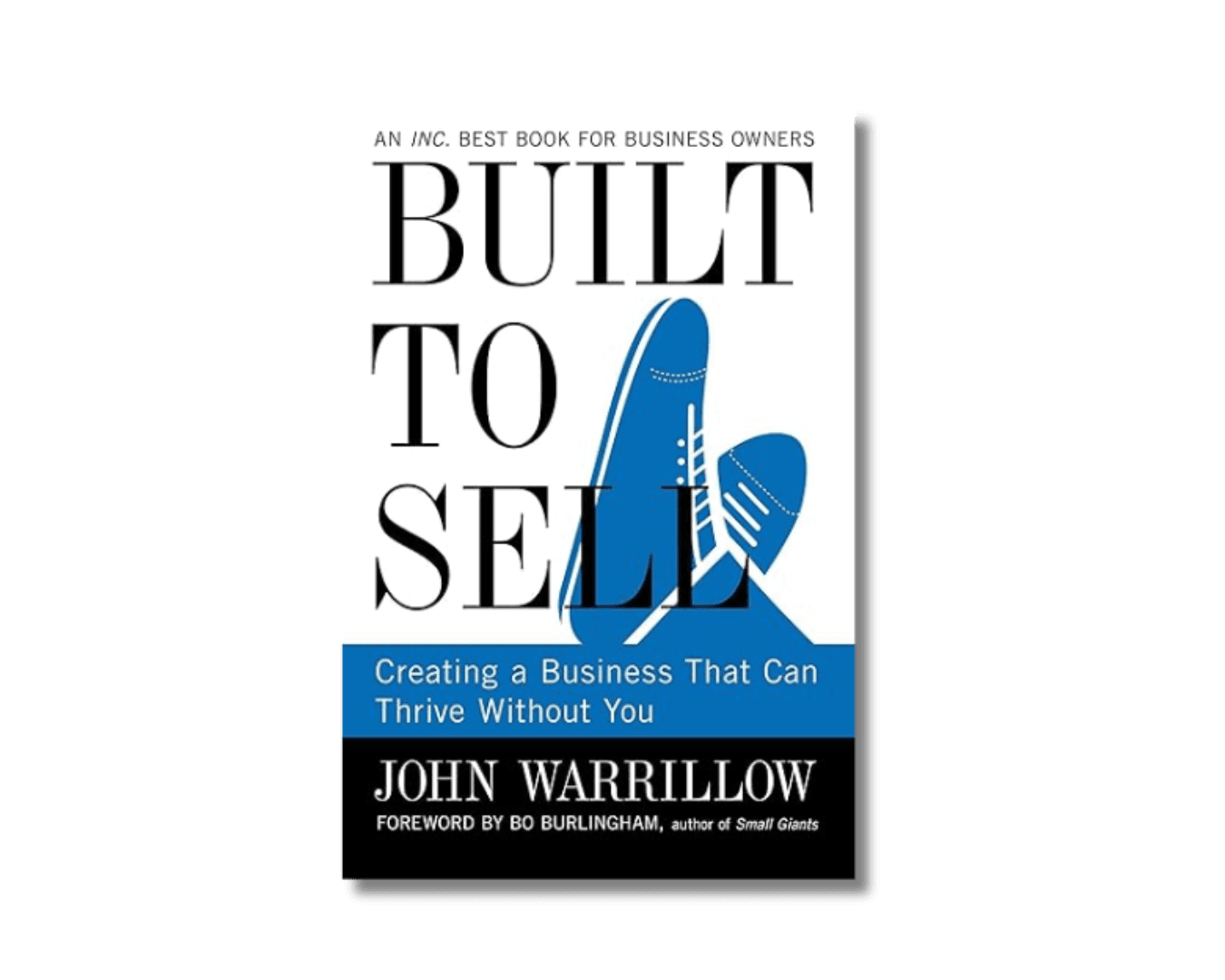
I have exited two businesses.
The first exit was luck. The second was strategy.
This is why Built to Sell stayed with me.
John Warrillow’s book shares a simple but powerful idea. A business becomes far more valuable when it can run without its founder.
This matters if you want to sell one day. But it matters even more if you do not. Because the traits that make a business sellable are the same traits that make it stronger to run now — Better systems. Cleaner numbers. Less founder dependence. More freedom. More value.
Businesses are not sold. They are bought. Smart founders build a buyable one from the beginning.
I learned this through experience.
Before my first exit, I was focused on execution. The company was good. It was growing. But I was not thinking about valuation. I was not thinking like a buyer. So when an offer came, I sold. But I left money on the table.
The second time, I approached things very differently. I gave myself time. I reduced founder dependence. I built the business with an exit lens. That changed the quality of the business and the quality of the outcome.
Every founder should read Built to Sell — even if you are not planning to sell in the near future.
What Makes a Business Buyable
A buyable business does not rely on the founder for every sale, every decision, or every client outcome.
It has revenue that is more predictable. An offer that is easier to understand and deliver. Systems that protect quality. Numbers that create confidence. A team that can carry real responsibility.
In other words, it is a business with value beyond the founder.
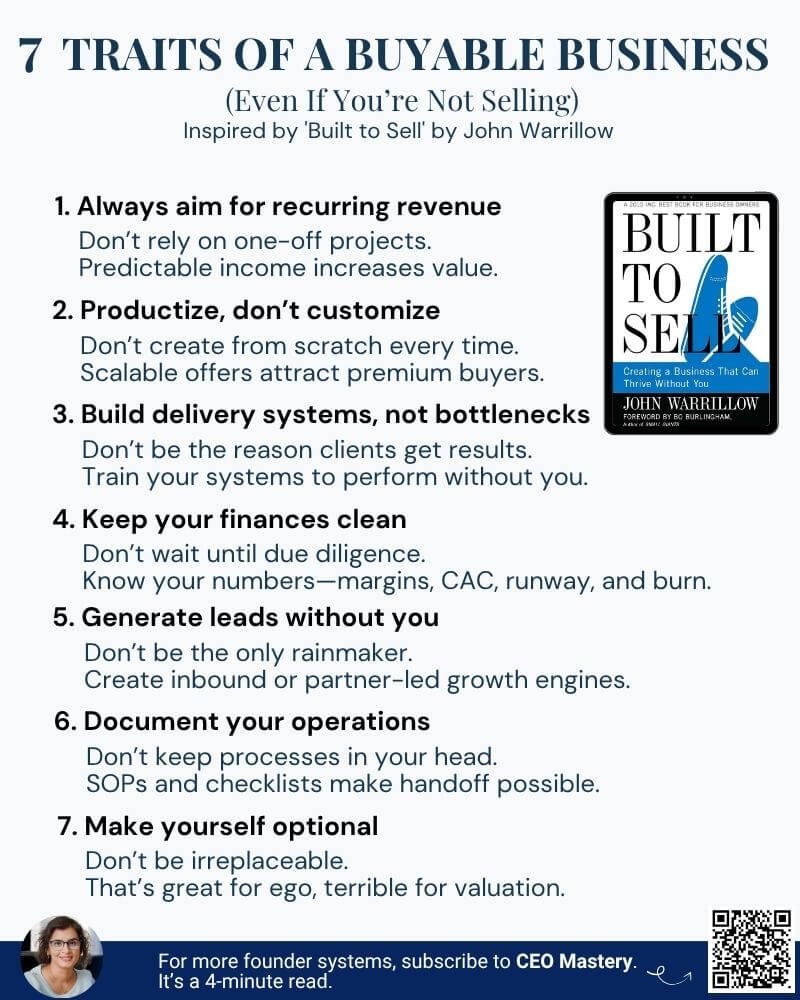
7 Traits of a Buyable Business
I identified seven traits from Built to Sell — through the lens of what I’ve seen work in my own exits and in coaching founders through theirs.
1. Recurring revenue increases business valuation
One-off sales create revenue.
Recurring revenue creates stability.
That difference matters to both founders and buyers.
When part of next quarter’s or next year’s revenue is already committed, the business becomes easier to plan, easier to manage, and easier to value. Retainers, subscriptions, maintenance contracts, and long-term service agreements all do this.
They reduce uncertainty. They also reduce stress.
If you want to build a buyable business, start by asking a simple question: How much of my future revenue is already locked in?
The stronger that answer, the stronger the asset.
2. Productise your offer to build a sellable business
Too many service businesses sell custom work every single time.
It feels premium. It feels flexible. It may even feel client-friendly.
But custom work is hard to scale. Hard to delegate. Hard to price well. Hard to train for. Hard to protect.
A productised offer is different. It has a clear promise, a clear scope, and a repeatable process. That makes it easier to deliver, easier to teach, and easier to grow.
This is one of the strongest ideas in the book.
Many founders think saying yes brings growth. Often, it brings complexity.
Standardisation does the opposite. It sharpens the offer. It improves margins. It makes the business clear to understand — and clear to refer.
A sellable business is rarely built on endless customisation.
It is built on focus.
3. Build systems that make the business scalable
Growth without systems creates chaos.
The founder sees it first. Clients feel it next. Then the team feels it too.
When delivery depends on memory, effort, or one or two strong employees, quality becomes uneven. New hires take too long to ramp up. Mistakes repeat. The business gets heavier as it grows.
Systems fix this.
You need documented steps. Clear handoffs. Checklists. Quality controls. Defined ways of doing the work.
This does not make the business rigid.
It makes the business reliable.
And reliability is valuable.
Founders often underestimate how much confidence systems create. A business with strong systems feels more mature. It feels less risky. It feels more transferable.
That is exactly what buyers want.
4. Clean financials and management information systems matter
A business should not become financially clear only when a buyer shows up. It should always be clear.
That means clean books. Simple reporting. Good visibility into margins, client concentration, cash flow, and the real drivers of profit.
Messy numbers create doubt. And doubt lowers valuation.
This is also where a strong management information system matters more than most founders realise.
In my own experience, a strong MIS did more than help us manage the business. It signalled maturity. It showed prospective buyers that we knew what we were doing. It showed how decisions were made, what metrics mattered, and how early we could spot problems.
That creates trust.
A buyer may not use the phrase “management information systems” in a meeting. But they absolutely respond to what it creates: clarity, discipline, and confidence.
This matters even if you never sell. Financial clarity helps you run the business better right now. It shows where profit leaks are hiding. It improves strategic thinking. It helps you make better decisions with less emotion and more evidence.
Clean numbers are not just exit preparation.
They are good management.
5. Generate leads without founder dependence
If the founder is the brand, the network, the marketer, and the closer, then growth has a ceiling.
That ceiling is the founder.
A stronger business has more than one way to win new business. It has referrals that do not depend on constant founder effort. It has content, partnerships, lead systems, and a sales process that can work independently.
The type of salesperson matters too.
A product-led sales mindset protects your positioning. A service-led sales mindset often weakens it.
When every prospect gets a custom promise, the business becomes harder to scale and harder to deliver well. But when sales supports a clear productised offer, the business becomes more consistent and easier to grow.
The goal is to make growth less fragile.
6. Document operations to accelerate growth
Many founders keep too much in their heads. That feels fast in the early days. Later, it becomes expensive.
When no one knows how things work unless you explain them, every hire is slower, every handoff is rougher, and every problem finds its way back to you.
Documentation solves this.
Write down key processes. Build playbooks. Create standard operating procedures. Show people what good looks like. Make it easy for others to act without waiting.
This is not admin work. It is growth infrastructure.
The companies that scale fastest have one thing in common. Operational knowledge lives in systems, not in people’s heads. That is what makes a business transferable. But long before any transfer, it removes roadblocks to growth.
7. Make yourself optional as the founder
This is the hardest lesson in the book.
It is also the most important.
Founders often take pride in being needed. It feels earned. It feels safe. It feels like control.
But being essential is not the same as being valuable.
A founder-dependent business is harder to scale, harder to lead, and harder to live with.
The real goal is to build a company that does not break when you step away.
That means hiring well. Delegating real ownership. Creating systems. Letting other people lead.
It also means building a management team — and rewarding them with incentives tied to their performance and loyalty.
That is how founder dependence starts to fall.
By structure. By incentives. By leadership that extends beyond one person.
My Favourite Quotes from Built to Sell
- Nobody wants to buy a business where 40 percent of the revcenue comes from one company. It is too risky. You should have diverse group of clients where no one company makes up more than 15 percent of your revenue.
- Ignore your profit and loss statement in the year you make the switch to a standardized offering. As long as your cash flow remains consistent and strong, you will be back in black in no time
Built to Sell and the Entrepreneurial Mindset Shift
The book is practical. But it goes beyond business mechanics. It pushes a different entrepreneurial mindset.
Many founders build for revenue.
Fewer build for value.
A founder who builds only for revenue may create a busy company that depends heavily on them. A founder who builds for value thinks differently. They think about systems. Margins. Repeatability. Optionality.
You do not build to sell.
And wealth comes from owning something valuable — whether you ever sell or not.
This is the mindset change I wish more founders understood earlier. Revenue matters. Growth matters. But value is what gives you options. Value is what creates freedom. Value is what turns hard work into an asset instead of a treadmill.
That is a far more satisfying way to build.
Which Exit Path Are You On?
Warrillow focuses on one type of exit: selling to a strategic buyer.
There are 12 distinct exit paths. Each has a different buyer profile, different valuation levers, and different preparation.
I created a free guide to help you identify yours — and the specific blind spots that quietly kill deals on each path.
Inside this guide, you will learn:
- How to spot which exit path you are on
- Hidden blocks to a smooth exit
- How to increase business value for your specific exit strategy
- What buyers care about (and what they ignore)
- The first step to becoming exit-ready
If you are serious about building a buyable business — or just want to understand where your current path leads — this is where to start.
Who Should Read Built to Sell
This book is for any founder who has built something that works — and suspects it still works mainly because they are holding it together.
It is especially useful if:
- You run a service business
- Clients expect too much customisation
- Sales depend heavily on you
- The team still comes to you for too many decisions
- Growth feels like it needs more of you, not less
It is also for founders who want to improve their business valuation or are considering an exit in the next one to five years.
Even if you have no plan to exit, this book is still worth reading. It gives you a practical framework for building a business that is easier to run, easier to grow, and less dependent on founder energy.
It is short, clear, and useful.
Build a Buyable Business
Work with me 1:1
This high-touch partnership helps founders grow revenue, increase profit, boost valuation, and build a business that runs without them.