
A few years ago, I had someone on my team who was brilliant.
Clients loved working with her.
She could run projects independently.
She was fast, strategic, and composed under pressure.
She made delivery look easy.
But deep down, I knew:
If she left, we’d be in trouble.
And when she did, everything slowed down.
Projects stalled. Clients escalated.
I had to step back into firefighting.
That memory came rushing back last week when a founder told me:
“My delivery head is amazing. But I’m constantly bending the company around him. His mood shifts everything. If he quits…I don’t even want to think about it.”
I knew that fear—of being one resignation away from collapse. And he’s not alone.
The Fix Starts With a Better Definition
Most founders don’t know how to replicate their best people — because they’ve never defined why they’re exceptional.
They’ll say:
“She’s just really solid.”
“He thinks like me.”
“They just get it done.”
But that’s not a hiring spec.
Here’s what actually makes them different:
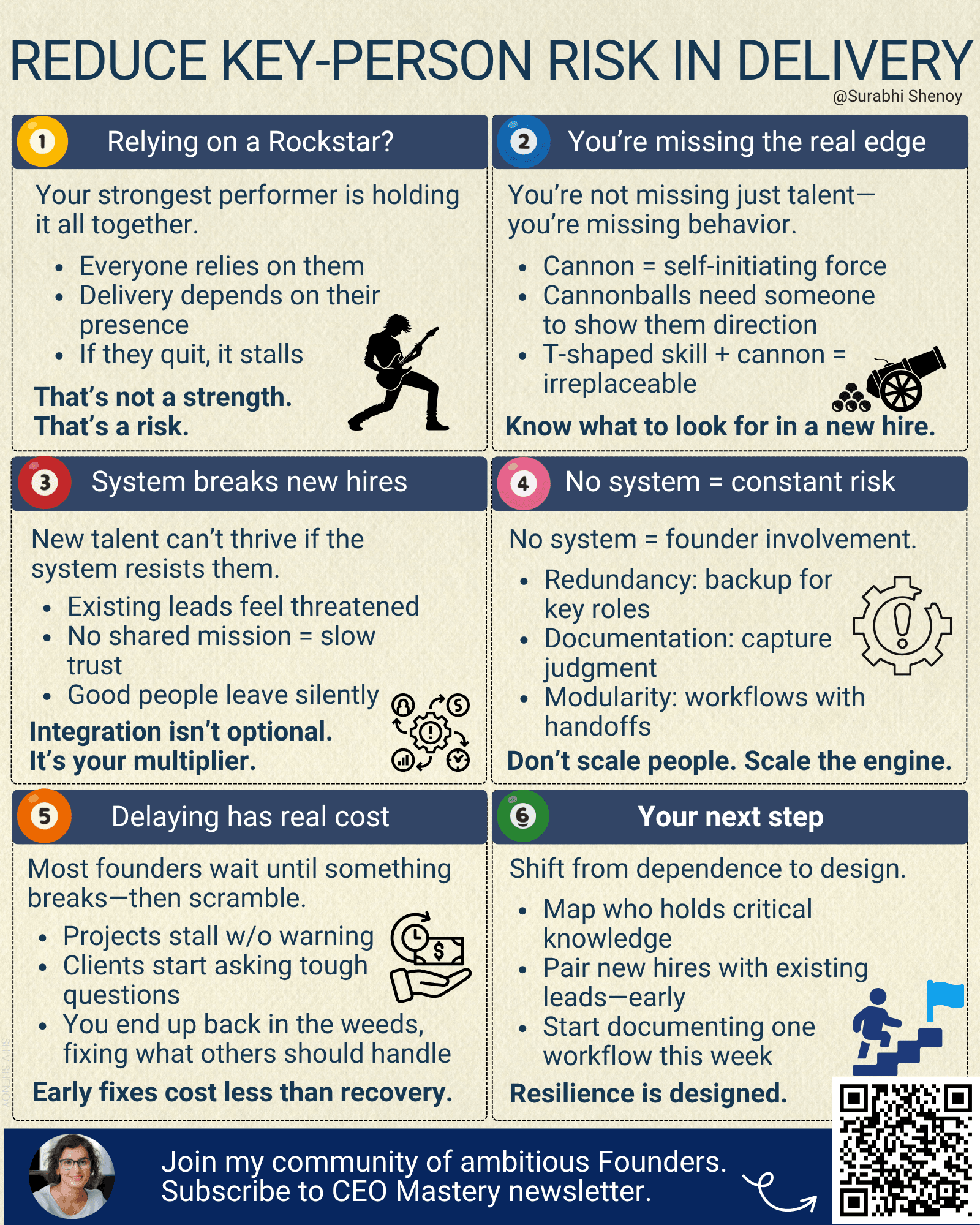
They’re the only ones with T-shaped skills.
They have depth in one function (tech, ops, client service) and enough breadth to connect across departments, manage expectations, and solve upstream problems.
And more importantly, they’re a cannon.
The cannon is the launcher—the driving force.
They bring energy, direction, and initiative. A cannon doesn’t wait to be told what to do. They look at the goal, take the shot, and adjust as they go. But when everything depends on that one cannon—you’re this close to being exposed.
Most people in delivery are cannonballs— They can do great work, but only if someone gives direction. They need instructions, check-ins, and push.
When you combine T-shape + Cannon, that’s the high-performance DNA.
You don’t have to rely on luck. You can build more of them—by design.
I go deeper into these ideas inside Founder’s Freedom Blueprint—where we work on building a core team that can lead, move, and deliver without needing you at the center.
But Hiring Isn’t Enough—Integration Matters
Great hires fail most of the time, because the system rejects them.
Especially when your current delivery head feels threatened. Their identity is tied to being the one who holds it together. And suddenly, they’re no longer the only one.
So here’s what I tell founders:
- Frame the hire correctly.
“We’re not replacing you. We’re growing and building a team that can scale delivery without burning anyone out.” - Acknowledge the contribution.
Publicly credit the existing person. Make them a bridge, not a blocker. - Engineer the overlap.
Assign both people to one shared mission—so trust is built before the handoff happens.
Pro-tip: Ideally, hire someone slightly junior with high potential, reporting into your delivery head, but on your watch (and support). This will help build trust, expand capacity, and strengthen the team without increasing cost.
This approach protects the culture and the continuity.
Then—De-Risk Delivery at the System Level
Hiring cannons (strong players) helps. But no matter who you hire, your systems will decide whether they succeed.
I break this down in two detailed guides:
- One shows you how to build management capacity that actually scales delivery.
- The other gives you a 6-week roadmap to implement your Operating Model.
Together, they’ll help you move from people-dependent delivery to system-backed performance.
Start small. Execute simply. Scale without chaos.
A Fragile Business May Look Impressive—Until It Breaks
If delivery only works when that one person shows up…
You’re not building a business. You’re taking a bet. You’re gambling on loyalty (and it’s very fickle).
Real scale, real margin, and real optionality come from a business that runs even when your best people take a break.
And as a founder, that’s your highest leverage move—
Not doing more. Not hiring faster.
But designing a business that doesn’t depend on you… or any one person.
📚 From My Bookshelf:
Actionable insights from books that transformed me and how I built.
Book: Good to Great
In this article, I share how Jim Collins’ Good to Great principles helped our self-funded company grow from 20 to 200+ employees.
You will get a practical checklist showing: how to build a leadership team of A-players, lead with humility, build a culture of discipline, and focus on cash first.
The book is written after studying billion dollars companies but it helped me build and scale over 20 years and finally get a successful exit. Read this and let me know what you think.
Thank you for being here, see you next Thursday.
Surabhi
P.S. If you’re tired of delivery depending on you—or on just one person—
Module 4 of Founder’s Freedom Blueprint walks you through how to:
- Define your ideal “T-shape + Cannon” hire
- Build a core team of ownership-driven managers
- Delegate without chaos or ego clashes
🎓 [Join here]