
Here’s the truth: You’re probably running your meetings wrong.
It’s not your fault. Most founders make the same mistake. They try to be both visionary and operator in the same meeting. I know because I did this, too.
Your brain operates like an athlete: It can either sprint or meditate. Try both simultaneously, and you’ll fail at each. This isn’t about skill—it’s pure biology.
Learning it the hard way, I’m sharing everything I’ve learned about fixing it:
- Why your brain needs two different meeting modes
- How to lead each meeting type (they need opposite approaches)
- A rescue plan for when meetings go wrong
- Your day-one implementation playbook
But first, let’s understand the core difference.
Strategic meetings
are like slow cooking. They need space, time, and the right environment.
These are sessions where big ideas take shape:
- Your quarterly planning sessions
- Big product decisions
- Market expansion talks
- Long-term vision work
Operational meetings
are like short-order cooking. They’re fast, focused, and results-driven.
These are the sessions that keep things moving:
- Weekly team updates
- Sprint planning
- Resource decisions
- Status checks
These meetings demand different mental muscles.
Mix them, and you create friction. Confusion. Missed opportunities.
Whether you are just two founders in a strategy meeting or a team of ten, this matters. Actually, it matters more when you’re small. Why? Small teams switch contexts more often, paying a higher price for each transition.
The Strategic Meeting: A Counterintuitive Approach
Most founders think strategic meetings need more of their voices.
The opposite is true.
Strategic meetings need more of your silence.
Here’s the counterintuitive approach that works:
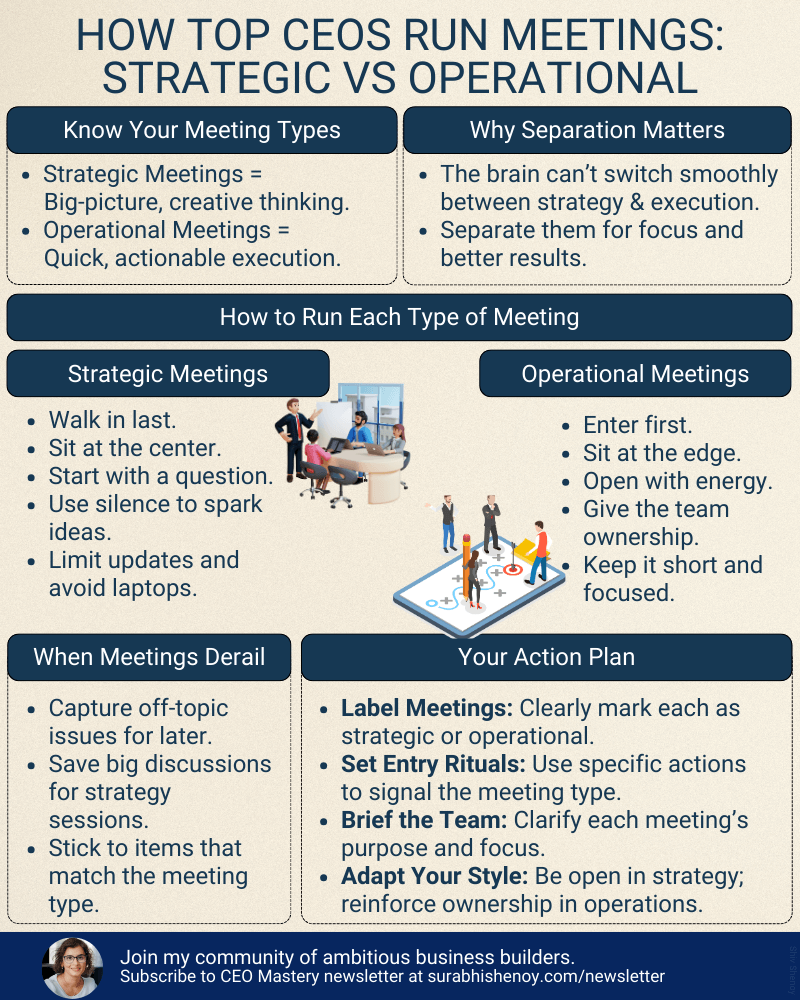
- Walk in last. This isn’t about making an “entry”. It’s about psychology. When you enter last, your team has already shifted from day-to-day thinking. They’re primed for big ideas.
- Take the center position (in-person or on Zoom). Own the space, but not the conversation.
- Ask one provocative question.
- Then stay quiet for 60 seconds.
That silence? It’s not dead air. It’s the sound of minds shifting gears.
The Operational Meeting: Where Most Founders Self-Sabotage
Plot twist: Everything you do in strategic meetings? Do the opposite here.
- Enter first
- Sit at the edge
- Open with energy
- Speak last
“But Surabhi, won’t I lose control of the meeting?”
That’s exactly the point.
Your operational leaders need to own this space. Your early arrival and corner position send a clear message: “This is your show. I’m here to support, not direct.”
Guidelines for Differentiating the Meeting Types
Small changes in Your behavior create big shifts in team dynamics:
For strategic sessions:
- Keep laptops closed
- Ban “quick updates”
- Use silence as a tool
- Count till 7 before breaking silence
For operational meetings:
- Let your authority take a backseat
- Speaking last becomes your strength
- Your position matters more than your words
- Guide, don’t govern
The best leaders don’t just run different types of meetings. They become different types of leaders for each one.
When Meetings Go Off-Track
Every meeting will derail. It’s not a question of ‘if’, but ‘when’.
Smart leaders prepare for them.
Here’s your rescue playbook:
Strategic Meeting Hijackers
The Urgent Problem
- Trigger: “We need to discuss this client issue…”
- Prevention: Have a parking lot for operational issues
- Recovery: “Let’s schedule a separate operational review for this”
The Status Update Spiral
- Trigger: “While we’re here, let me update everyone on…”
- Prevention: Send updates in writing before the meeting
- Recovery: “Let’s return to our core question about next year’s market”
The Technical Deep Dive
- Trigger: “Let me show you how this feature works…”
- Prevention: Pre-meeting briefs on technical context
- Recovery: “Is this technical detail crucial for our strategic decision?”
Operational Meeting Hijackers
The Vision Discussion
- Trigger: “But should we even be building this?”
- Prevention: Clear scope of current sprint/quarter
- Recovery: “Let’s park this for our next strategic session”
The Process Redesign
- Trigger: “We should completely change how we…”
- Prevention: Focus on execution within current process
- Recovery: “For now, what’s blocking us in the current system?”
The Team Evolution
- Trigger: “Maybe we need to restructure the team…”
- Prevention: Separate org planning sessions
- Recovery: “Let’s focus on delivering with our current structure”
The fact is that meeting success isn’t about better agendas.
It’s about protecting mental modes:
- Strategic thinking needs a safe space to share ideas
- Operational work needs clear ownership
Don’t let them mix. Guard the cognitive spaces.
Your Next Steps:
Make the switch today!
Here’s your simple action plan:
- Label your meetings: Look at next week’s calendar. Mark each meeting:
- Strategic (blue)
- Operational (red)
- Create separate “entry rituals”:
- Strategic: Walk in last, center stage, one question
- Operational: First in, edge seat, high energy
- Brief your team: Tell them what you’re changing. Tell them why it matters. Show them through action.
- Create your parking lot: Wrong-mode discussions will emerge. Have a clear place to park them. Return to them in the right setting.
The Bottom Line
The best CEOs aren’t static figures.
They shape-shift:
- Visionaries in strategic rooms
- Guards of execution in operational spaces
Here's the final insight:
Your team CAN think big and execute well.
Just not at the same time. Not in the same room. Not even on the same day.
Accept this limitation. Design around it. Watch your impact multiply.
What’s your experience been with this? Let me know – I’m always learning too.
Wishing you light and clarity this Diwali,
Surabhi
Ready to master your CEO game?
Here are 2 ways I can help
1) Elite CEO Coaching:
Strategic support to scale systematically
→ Book Your Free Clarity Call
2) 1:1 Strategy Session
One focused hour. Clear action plan. Immediate implementation.
→ Get a Power Hour With Me