
This is Part 2 of a 2-part series studying Phil Knight and the early growth of Nike.
The series explores what early-stage founders often understand too late about growth, risk, customers, hiring, and cashflow.
Part 1 : What Shoe Dog Reveals About Growth and Risk
Part 2: 5 Early-Stage Growth Moves I’d Make If I Built My Tech Company Again (this edition)
After my 2nd exit, I often find myself asking:
If I were to build my tech company again today, what would I do differently?
Not that I regret the journey, it’s been great, but distance always reveals things we cannot see while inside the business.
When you are building, most days are spent reacting, solving, and keeping momentum alive. Only later do you see the missed opportunities of growth.
Reading Shoe Dog a second time brought this back for me.
Most people know the famous early Nike story: Phil Knight sold shoes from the trunk of his car.
That story is true, but it is incomplete.
Blue Ribbon Sports, which later became Nike, did not grow only because Phil hustled hard. It grew because of a few smart early-stage choices.
Early-stage growth is scrappy.
Money, talent, reach, experience, and founder maturity are all limited. Ambition is usually the only thing in surplus.
And while ambition gets you moving, it does not guarantee growth.
So this edition is a reflection on a question I keep returning to:
If I built my tech company all over again, how would I handle early growth differently?
These moves will apply whether you are building a B2B business, SaaS company, consulting firm, or any expertise-led business.
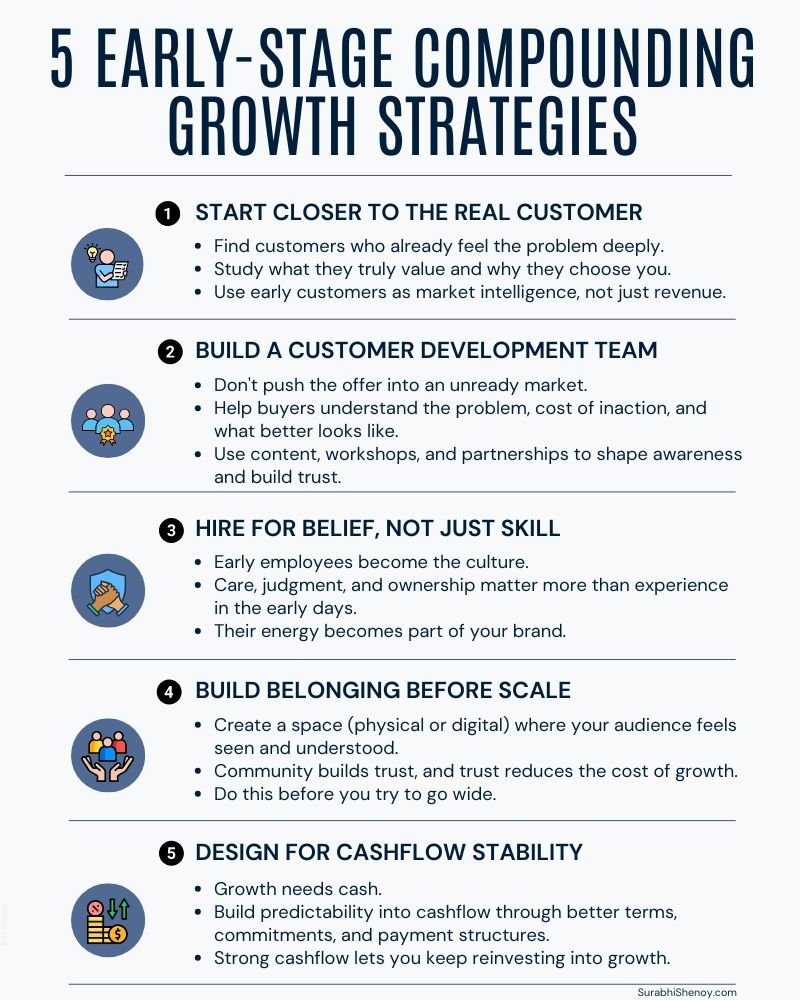
1. I Would Start Closer to the Real Customer
Phil Knight first tried selling shoes through sporting goods stores.
They rejected him. He was too small and unknown.
Then he went directly to track meets and spoke to coaches, runners, and fans.
That changed everything.
Between races, he showed them the shoes.
They understood the value.
They cared about performance.
They were already living inside the problem.
That is such an important early-stage lesson.
When you are small, broad reach is tempting. You want more visibility, more leads, more markets, and more channels. But early growth often comes from the opposite. It comes from going narrower. That is one of the most counterintuitive parts of early-stage growth.
The question is not: “How do I reach everyone?”
It is: “Where are the people who already feel this problem deeply?”
If I were building again, I would spend much more time close to the highest-intent customer.
Not the easiest customer to find or sell to, but the one whose problem is intense enough to teach me what the business should become.
Then I would study them carefully:
Why did they trust us?
What problem were they really buying us for?
Where did we create the most value?
Which customers brought out our best work?
Early customers are not just revenue; they are market intelligence.
That is what strong customer development creates early.
2. I Would Build a Customer Development Team
Bill Bowerman, Phil’s coach and co-founder, was not only improving shoes, he was also helping expand the idea of running itself.
At the time, jogging was not mainstream.
People laughed at it.
Then Bowerman co-authored a book called Jogging, it sold over a million copies, and helped popularize running as a fitness movement.
Before people need better running shoes, they have to believe that running is worth doing.
This is a growth lesson many founders miss.
Sometimes the market is not ready to buy because it does not yet see the problem clearly enough.
You may have a good solution, but the customer may not yet understand:
- why the problem matters
- what inaction is costing them
- what better looks like
- how to evaluate options
- why now matters
If I were building my tech company again, I would start with market education, through content, workshops, and partnerships with credible voices in the industry.
I would also build a Customer Development function, not just a business development team — making the approach more outside-in instead of building a product first and then hunting for customers.
This is especially true for B2B, SaaS, and consulting.
Your buyer may not wake up looking for your exact offer. But they may be feeling the pain. Your job is to help them connect their symptoms to the real problem.
Say, you are building an AI product, market education is not optional. Your buyers need to understand what AI means in their industry, what inaction may cost them, and what advantage early movers may create.
That is where demand starts. Not by shouting louder, but by helping the market think better.
3. I Would Hire Early Employees for Belief, Not Just Skill
One of the most interesting people in Shoe Dog is Jeff Johnson.
He was Blue Ribbon’s first full-time employee, even before Phil was full-time in the company. Phil was still working elsewhere to earn a salary and fund Blue Ribbon.
Jeff Johnson was not just doing a job.
He loved running.
He understood runners.
He wrote to customers.
He remembered them.
He created relationships with them.
He wanted the company to mean something to them.
That kind of early employee is priceless.
In a mature company, systems can carry average people for some time. In a startup, people are the system.
Their judgment becomes the process.
Their care becomes the customer experience.
Their standards become the culture.
Their energy becomes part of the brand.
If I were building again, I would pay more attention to belief in the early team.
Not blind loyalty. Real belief in the work.
Do they care about the customer?
Do they understand why this work matters?
Do they bring energy to the mission, or only skills to the task?
This is even more critical to services and consulting businesses because your team is not hidden behind the product.
They are the product experience.
The way they speak to clients, solve problems, respond under pressure, and take ownership becomes the business in the customer’s mind.
4. I Would Build Community Before Scale
Jeff Johnson built Blue Ribbon’s first store.
It wasn’t just a store. He made it a place for runners.
A sanctuary.
A mecca.
A place where they could hang out, talk, learn, and feel understood.
There were books on the shelves that every runner should read. Many of them came from Johnson’s own private library.
It was not just a retail outlet but a place of belonging.
That is why this story matters so much for founders today.
Community is the feeling that: “These people understand me.”
For a B2B business, the community may look different:
- a sharp educational newsletter (like the one you are reading)
- a small founder roundtable
- a customer advisory group
- a private workshop
- a set of ideas that makes your prospects feel seen
If I were building again, I would build a sense of belonging with potential buyers much earlier.
Because belonging creates trust, and trust reduces the cost of growth.
5. I Would Design for Cashflow, Not Just Revenue
This is one of the least glamorous and most important lessons.
Nike’s Futures Program was born out of cash pressure. The idea was simple: Retailers would commit to large, non-refundable orders months in advance and in return, Nike would offer a discount.
This way, the company would get better visibility into income, longer lead times, fewer surprises, and more credibility with lenders.
It was a smart strategy to stabilize the business.
Many founders learn this too late.
Revenue alone does not bring stability. This is one of the hardest realities of early-stage growth. You can have clients and still feel financially tight because payment terms, hiring demands, delivery costs, and working capital are all pulling in different directions.
If I were building again, I would design a cash rhythm much earlier.
In my tech company, I did this partially. We would offer a discount if a client gave us a three-year purchase order instead of a one-year.
That one change brought a lot of stability to the business.
It gave us better visibility.
It helped us plan hiring.
It reduced the stress of constant renewal.
And when my time came to exit, it also helped increase the valuation because the revenue looked more predictable.
That is the deeper lesson.
Sometimes, certainty is worth more than a higher margin hiding operational chaos.
For a B2B or consulting business, that could mean:
- upfront payments
- more retainers
- annual commitments
- discounts for longer commitments
- fewer custom projects with unpredictable scope
The point is not to copy Nike’s model, but to understand the principle underneath it.
Fast and steady growth becomes possible when cashflow and delivery can support aggressive demand generation without strain.
A Closing Reflection
In the beginning, founders often misunderstand their role.
They think their job is to drive sales.
But their real job is to design a growth engine.
Sales matter, of course. Without sales, there is no business. But early growth becomes exhausting when everything depends on the founder’s push: more outreach, more follow-ups, more convincing, more personal energy.
If I were building my tech company again, I would design early growth with three outcomes in mind:
- Sharper demand.
So we are not chasing everyone, but speaking to the customers who already feel the problem deeply. - Faster trust.
So prospects do not need endless convincing before they believe we understand their world. - More fundable growth.
So revenue growth does not create cash stress, delivery strain, or operational panic.
This is a big part of the work I do with founders: helping them move from default to design, and from load to leverage.
Early-stage growth will always be messy. But it does not have to depend on the founder’s effort forever.
So here is my invitation for this week:
Look at your current growth efforts and ask:
Where am I still relying on push?
Where can I create more pull, trust, or cash stability by design?
You may not be able to fix all of it this quarter. But one honest answer may show you the next growth move. And sometimes, that is all early growth needs. One clearer move.
Thank you for being here.
I will see you next Thursday.
Surabhi