
Every founder’s team looks to them for answers.
But no founder has all the answers.
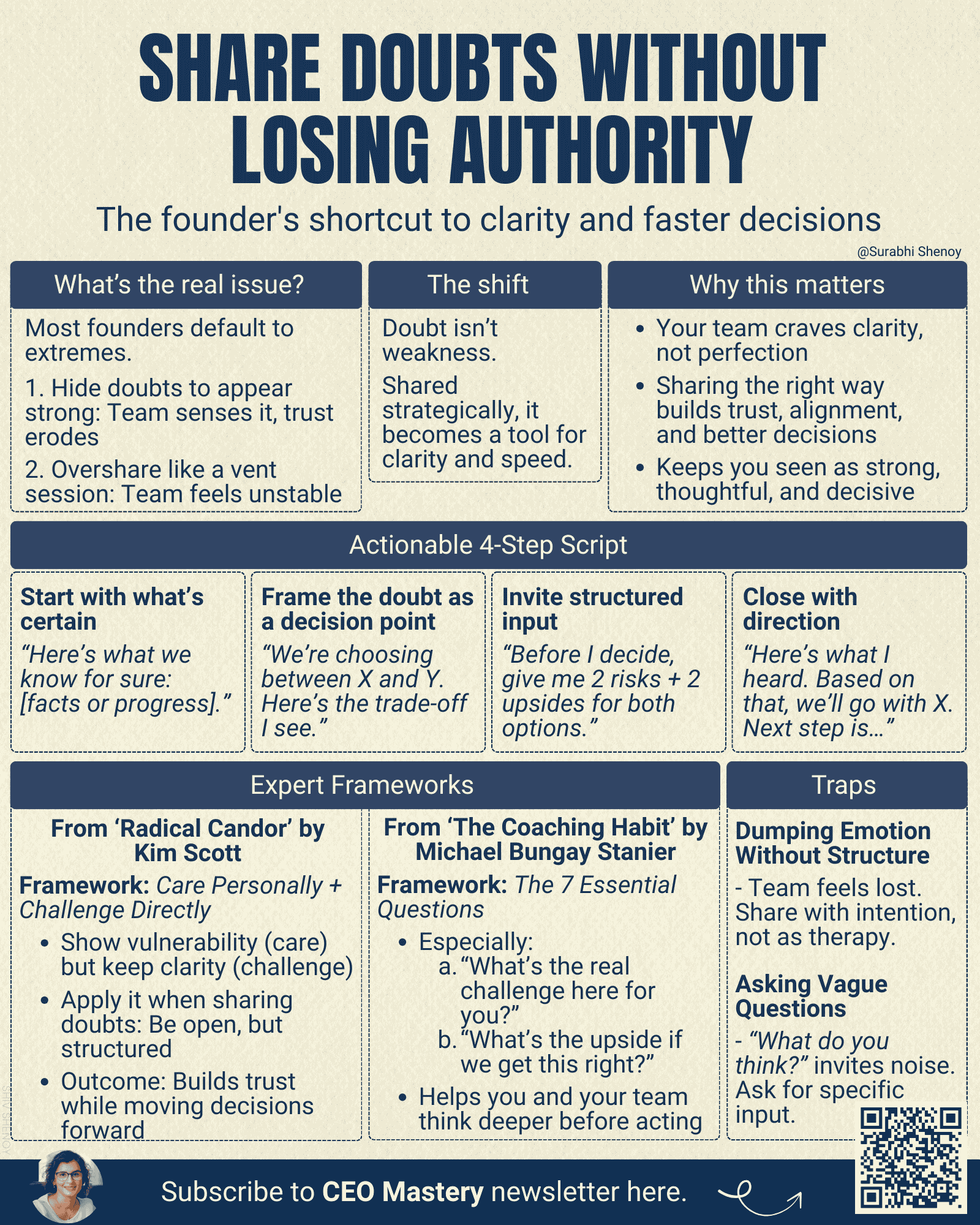
Most founders default to one of two extremes:
- Hide their doubts to look confident.
→ The team senses it anyway. Trust drops. - Overshare their doubts as a venting session.
→ The team feels unsettled or directionless.
Both approaches backfire.
The skill is sharing doubts strategically. Done right, you:
- Keep authority and stability.
- Use the team’s collective wisdom.
- Make faster, better decisions.
That’s the shift. Your doubt stops being a weakness. It becomes a tool for clarity and speed.
Here’s the tactical playbook I teach my clients:
4-Step Script to Share Doubts Without Losing Authority
1. Start with what’s certain
Anchor before you open the uncertainty.
“Here’s what we know for sure: [facts, progress, or commitments].”
2. Frame the doubt as a decision point
“We’re choosing between X and Y. Here’s the trade-off I see.”
3. Invite structured input
“Before I decide, I’d like each of you to share 2 risks and 2 upsides you see for both options.”
This way, you use their wisdom while keeping ownership of the final call.
4. Close with direction
Summarize → Decide → Next steps.
“Here’s what I heard. Based on that, here’s the path we’ll take. Next step is X.”
The team feels heard and aligned, not left in limbo.
The structure in practice:
Certainty → Doubt → Input → Decision
Pro tip: If the issue is complex, you can split this into two steps: first, share the context (Certainty → Doubt → Input), then meet again to decide. My preferred approach is to send a short note or email (writing helps) with those three steps, so the team has time to think, and then use the meeting to finalize the decision.
Demo: The Wrong Way vs The Right Way
Context (based on true story):
The client contract is up for renewal. They are not willing to increase rates for the coming year. They exhaust your team, and margins are thin. But they give sizable work, pay on time, which helps with revenue and cash flow.

Notice how the structure of – certainty → doubt → input → decision is integrated naturally.
Tactical Phrases You Can Use
- “Here’s what’s locked in. Here’s what’s open.”
- “I want to pressure-test this before finalizing.”
- “What blind spots might we be missing here?”
- “Your input helps me make a sharper call.”
How to Build a Team You Can Trust
Learning how to share doubts without losing authority is one step.
The bigger win is building a core team that can take ownership, so you don’t carry every decision yourself.
That’s exactly what I walk you through in Module 4 of Founder’s Freedom Blueprint. You’ll learn how to:
- Identify who to hire for your core team.
- Delegate outcomes (not just tasks).
- Build a management layer that frees you from daily decisions.
This is the same system I used to build, and successfully exit, two companies.
Action Step
Here’s how to put the script into action.
This week, test it on one live decision:
- Anchor with certainty.
- Frame the doubt as a decision point.
- Invite structured input.
- Close with direction.
You’ll notice the shift: less second-guessing, faster alignment, more trust.
And your team sees you as a decisive leader.
Pro tip: Encourage your managers to use this technique with their own teams. It multiplies wisdom across the company and builds alignment faster.
📚 From My Bookshelf
Actionable insights from books that transformed me and how I built.
Book: The Speed of Trust
Growth slows down when decisions drag.
And most decisions drag not because of data gaps, but because trust is thin.
Stephen M.R. Covey shows why trust isn’t “soft.”
It’s the single factor that makes communication faster, decisions clearer, and execution smoother.
I wrote an article breaking down how founders can build the kind of trust that makes speed a default, not a struggle.
Here’s a list of all books I have shared on this newsletter so far.
Thank you for being here. I will see you next Thursday.
To building together,
Surabhi