
“I don’t want to be known as a one-product company.”
That’s what a seasoned founder told me recently during our strategy call.
The seasoned founder wasn’t resisting. He was being honest. Underneath it, I heard the real fears:
- Will narrowing down cost me opportunities?
- What if I choose the wrong thing?
- Will I look… small?
These fears are real—especially for self-funded founders who’ve had to make every rupee, every dollar, count.
But here’s the hard truth:
Trying to be everything to everyone won’t make you look big.
It makes you forgettable.
The businesses that scale without chaos, that get acquired at premium multiples, that customers rave about and refer?
They’re known for doing one thing—exceptionally well.
What I Told My Client
“You don’t have to stay in one lane forever,” I told him.
“But you have to be known for one thing first.”
Because growth doesn’t come from doing more.
It comes from becoming the obvious choice for something specific.
Category ownership begins with focus.
Proof It Works: Raising Cane’s
If you haven’t heard of Raising Cane’s, it’s a US-based restaurant chain with a cult following.
Their entire menu is centered around one thing: chicken fingers.
That’s it.
No burgers. No wraps. No seasonal gimmicks.
Just: chicken fingers, crinkle fries, and Cane’s sauce.
And it’s working [Forbes].
- $5.1 billion in revenue (2024)
- 900+ stores and counting
- $6.6 million average sales per store (double than competitors who serves lot of menu items)
- Fiercely loyal customers who line up just for that one thing
They didn’t win because of marketing budget. They won because of:
Radical Simplicity
→ One core product = fewer decisions, better operations, higher margins.
Obsessive Execution
→ They focused every resource on doing one thing extremely well. No distractions.
Word-of-Mouth Driven Brand
→ They created repeatable, high-quality customer experiences that earned loyalty.
Culture + People
→ Their team rallied around one clear mission: quality chicken fingers.
→ Easier to train, replicate, and lead.
They weren’t trying to be McDonald’s.
They just said: “We’ll be the best at this one thing.”
Why Focus Feels Risky (But Isn’t)
Here’s the fear most founders won’t admit:
“Back then, I didn’t have the luxury to focus. I had to say yes to survive.”
And honestly? That made sense 10 or 15 years ago.
In 2005, 2010, even 2015—if you were bootstrapped, you:
- Sold whatever you could
- Took whoever would pay
- Offered broad solutions to a small local or referral-driven network
Back then, access to markets was the constraint.
But today, the landscape has changed.
- You can build online
- You can reach niche audiences directly
- You can become category-famous on LinkedIn, podcasts, YouTube—without funding
So the founder’s fear of narrow = small = risky is outdated logic.
Now, narrow = differentiated = profitable.
In today’s world, clarity is the real unfair advantage. Most founders won’t do this. That’s exactly why you should.
Tech Founders Do This Too
This principle isn’t just for food chains.
The most iconic tech companies started the same way.
Think of it—
- Amazon: Just books.
→ Before AWS, before marketplace, before Prime—it was the best place to buy books online. - Google: Just search.
→ One box. One button. That’s all they did. And they did it better than anyone. - Calendly: Just scheduling.
→ Not a productivity suite. Just the cleanest way to book meetings. - Dropbox: Just file syncing.
→ Before teams, paper, or integrations—they made “it just works” cloud storage. - Notion: Just docs + notes.
→ They didn’t start as an all-in-one. They earned the right to expand from being a clean alternative to Google Docs and Evernote.
They all started with one thing. Did it exceptionally well. Became famous for it. And then built empires on top of that clarity.
The lesson?
Start narrow.
Dominate your lane.
Expand from strength.
Why Focus Wins
Here’s what happens when you focus:
- Operational Simplicity: You build repeatable systems faster
- Brand Clarity: People know exactly when to refer you
- Team Alignment: Everyone understands how to win
- Customer Trust: People trust specialists. They bargain with generalists.
You don’t need more offers. You need one that compounds.
Your Focus Formula (Do This Now)
- Identify your profit center Which offer (service or product) delivers the most margin with the least effort?
- Find your word-of-mouth engine Which offer do clients spontaneously refer?
- Cut the bottom 20% Which offerings drain energy but deliver little profit?
- Double down for 90 days Put 80% of resources behind your winner. Track the results.
Not sure what your ‘one thing’ is yet?
Here’s a quick prompt I use with clients:
“If your favorite client had to describe your work in one sentence… what would you want them to say?”
Write it down. Sharpen it. Build from there.
Being famous for one thing fixes two R3C stages at once
Sharp positioning directly improves Relevance (you attract the right people) and Resonance (your message lands faster). If your sales feel slow despite having visibility, this diagnostic will show you which of the four stages is the real constraint.
The Millionaire Mindset Shift
Narrowing isn’t limiting – it’s leverage.
The founders who exit at premium multiples don’t chase complexity.
They own one thing. They make it exceptional.
Then—only then—they expand from a position of strength.
Because no one refers a generalist.
And no one pays a premium for confusion.
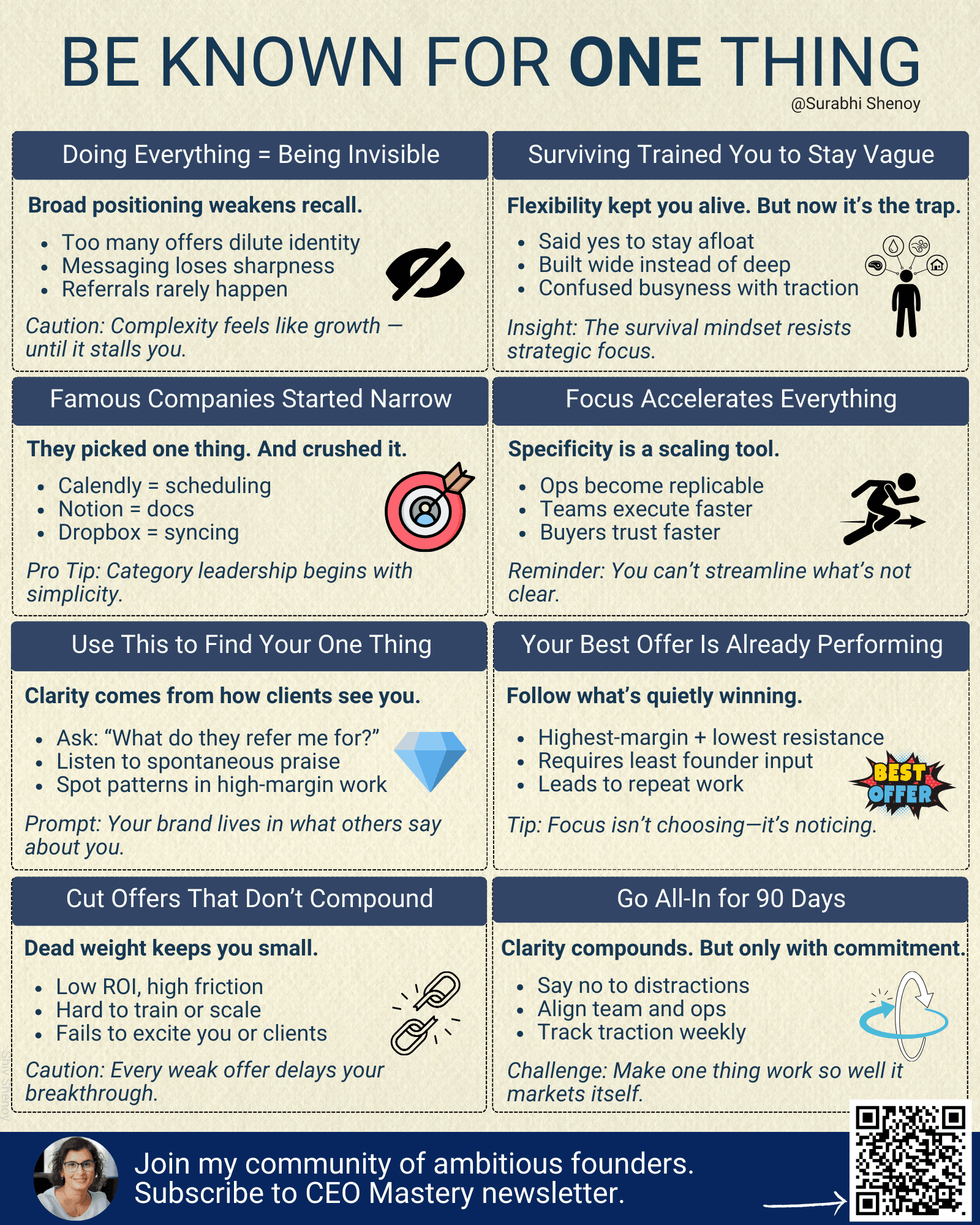
So here’s your challenge:
Pick the one thing you want your company to be known for.
Take the next 90 days to go all-in. Simplify. Sharpen. Systematize.
And if you want a partner in this process—someone who’s done it with dozens of founders…
I’ve designed a coaching sprint called Revenue Accelerator.
It’s a 90-day, founder-to-founder immersion where we:
- Clarify your core offer and positioning
- Build a focused growth engine
- Cut what’s not working
- And drive revenue—with simplicity, not stress
No endless planning.
No 12-month guesswork.
Just 90 days of focused execution.
You and me. One thing. Full intensity.
→ Book a Clarity Call and let’s build your breakout move.
📚 From My Bookshelf:
Actionable insights from books that transformed me and how I built.
Most people apply ‘Atomic Habits’ to morning routines – wake up early, exercise daily, eat healthy.
But there’s something bigger here: a blueprint for company transformation.
I applied the teachings of this book to develop and shape the identity of the company.
Most founders try to scale strategy.
This book taught me to scale behavior.
In my founder’s guide, I share:
- 4 principles of Atomic Habit for identity based scaling
- 3 practical ways to apply these principles
Thank you for being here. I will see you next Thursday,
Surabhi