
In 2025, SpaceX launched 165 rockets. One every 2.2 days.
The rest of the world combined launched 164.
More launches than every space agency, every government, every competitor on Earth put together.
In 2020, they launched 26 rockets. Five years later, that number had increased sixfold.
They are now the most valuable private company.
What they changed was simple: standardization over customization.
How did SpaceX do it?
Before SpaceX, every rocket launch was custom built, mission-specific. One-off engineering for each client. That’s how the aerospace industry had always worked.
Clients had detailed specifications. They expected custom rockets.
SpaceX refused.
They built one rocket — Falcon 9.
Same engine, same structure, same systems across every mission.
Customers had to design to SpaceX’s spec.
Why Did Customers Accept This?
The customers wanted custom solutions. Of course they did.
But they wanted lower prices even more.
SpaceX forced a choice. And when the economics were clear, every buyer adapted.
Your clients say they want custom, and they mean it.
But if you can deliver 90% of the value at half the cost with 3x reliability, most of them will take that trade. The ones who won’t are often the ones killing your margins anyway.
The Real Reason Customization Is Expensive
Before starting SpaceX, Elon Musk studied what rockets were made of. Aluminum alloys, titanium, copper, carbon fiber. The raw materials cost about 2% of the final price.
Two percent.
98 cents of every dollar went to process, overhead, and supplier markups.
He called this the “idiot index,” the ratio of a part’s actual cost to its raw material cost. If the ratio is high, you are paying for the process, not the product.
This is true in most service and product businesses too.
The cost of delivering your offering is not in the materials or expertise. It is in the process:
the scoping calls,
the custom proposals,
the unique project plans,
the one-off delivery workflows,
the rework cycles,
the handoffs that don’t transfer cleanly.
Every custom project carries a hidden process tax.
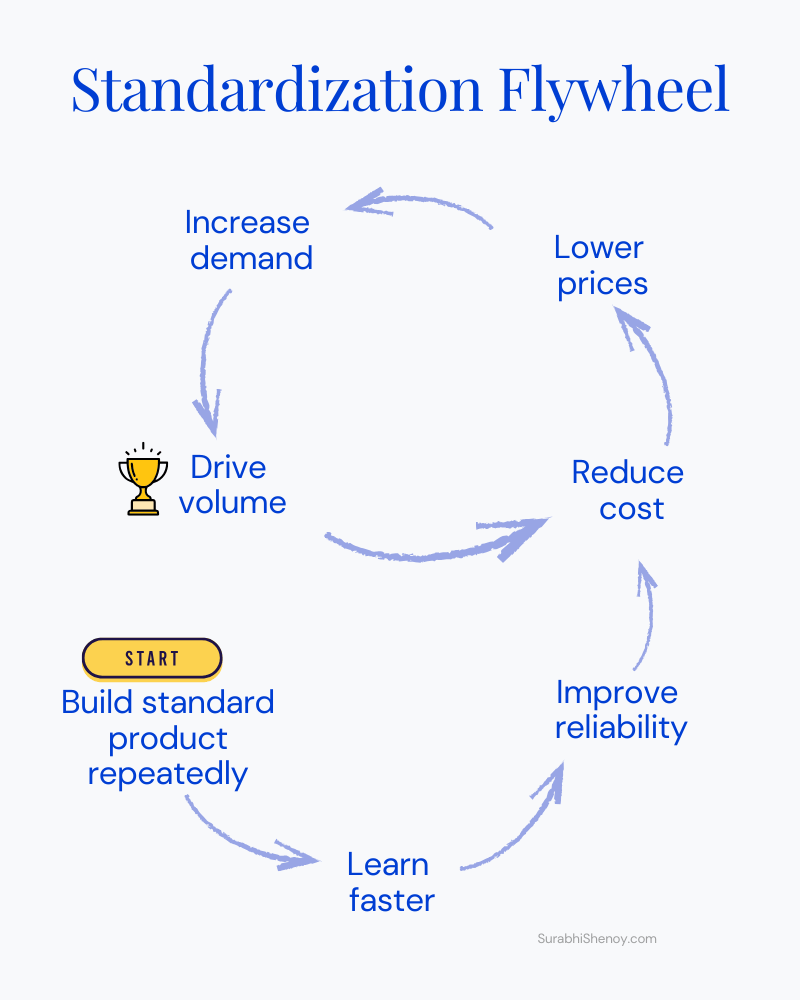
How Standardization Creates a Flywheel
SpaceX’s cost control was not about cutting corners. It was about building a standardized system that improves with each repetition.
When you build the same Falcon 9 forty times a year, every flight teaches you something. Every defect improves the next build. Every anomaly sharpens the design. Repetition improves the system. Standardization makes that repetition possible.
Lower costs enabled lower prices.
Lower prices captured market share.
More market share means increased volume.
More volume drove costs lower still.
The competitors understood this too late. They optimized components — better engines, lighter materials, incremental gains.
But SpaceX had optimized the system — for cost. They accepted component-level compromises for system-level dominance.
This is the key shift.
Stop optimizing individual projects. Start optimizing the system.
How to Apply Standardization in Your Business
I meet founders every week who believe customization is their moat. “Our clients want custom. That’s why they pay us.”
I get it. But if the rocket industry could standardize, I am pretty sure whatever you are building is not rocket science. (Pun intended.)
The question is how to think about it.
Here are five questions to consider.
1. Where is your “idiot index”?
Look at what you deliver and ask: what does this actually cost in terms of core expertise and materials, versus what it ends up costing you? If the gap is large, most of it is due to the process. Custom scoping, custom proposals, custom delivery plans, custom reporting. Each “custom” step is a cost multiplier hiding in plain sight.
Map it. You will be surprised by how much process tax you are carrying, and how much of it can be removed.
2. What would your “Falcon 9” look like?
SpaceX did not build a different rocket for every mission. They built one rocket that handled most missions well enough, then let the market adapt.
What is the one core offering that covers 70 to 80% of your client’s needs?
If you had to serve every client with essentially the same structure, process, and deliverables, what would that look like?
The answer does not need to be perfect. It needs to be good enough at a dramatically lower cost and complexity.
3. Are you optimizing components or the system?
Don’t tinker at the edges — a better proposal template, a smoother onboarding, a new tool for project management.
These are component-level improvements. They feel productive. They rarely move the needle.
The SpaceX insight: accept component-level compromises for system-level gains. Your individual project might be 5% less “perfect” in a standardized model. But your margins improve, your team delivers faster, quality becomes predictable, and you can actually scale without chaos.
4. What would volume unlock for you?
SpaceX’s competitors could not even imagine that there would be a market demand for so many rockets.
Most founders think the same way. “My market doesn’t have that kind of volume; there is no point in standardizing.”
But volume often does not exist because you have not created the conditions for it.
Lower your price through standardization, simplify the buying process, reduce delivery timelines, and you may discover demand that was invisible at your old price point and complexity level.
5. What are you afraid to delete?
Elon Musk has a rule: if you are not adding back at least 10% of the requirements you deleted, you are not deleting enough.
Every constraint, every “must-have” feature, every client-specific request should be treated as a hypothesis, not a fact.
Ask: Who requires this? Can they defend why it still matters? If the original reason no longer applies, delete it.
The best part is no part. The best process is no process.
Three Mistakes to Avoid
Mistake 1: Treating standardization as a one-time project. SpaceX did not standardize once and stop. Standardization is a discipline, not something you do once.
Build feedback loops into your standard offering so it improves with each delivery.
Mistake 2: Trying to standardize everything at once. Start with one offering. Your highest-volume, most repeatable service. Prove the model there. Let the results speak. Then expand. SpaceX started with Falcon 1 before building Falcon 9. They learned to walk before they tried to scale.
Mistake 3: Apologizing for it. When SpaceX published their user’s guide and told satellite companies to design to their spec, they did not apologize. They led with value. Do the same.
Frame standardization as what it is: faster delivery, lower cost, higher reliability.
Clients who see the value will stay. Those who insist on full customization at standard prices are usually not your best clients.
The Question That Matters
If the team that builds rockets for a living decided that customization was the enemy of scale, what makes your business different?
The answer, almost always, is nothing. Except for the belief that your clients will not accept it.
SpaceX proved they will. When the value is clear, the market adapts.
Your move.
Thank you for being here. I will see you next Thursday.
Surabhi
PS: This edition was inspired by Max Olsen’s essay, “Atoms Are Cheap, Process Is Pricey: What SpaceX Teaches Us About Building Hard Things.” If you are a space nerd or a systems thinker (or both), it is worth reading in full.