
For over 13 years, I’ve built myself through meditation, journaling, weightlifting, and yoga. When life threw a curveball, and I had to work relentlessly for three years straight, I survived because I was built strong.
That experience — combined with building and exiting two businesses and coaching founders for the last 3 years — kept bringing me back to the same question: what actually determines whether a founder scales or breaks under pressure?
The answer isn’t strategy. It’s fundamentals.
The 10 fundamentals: Courage. Decisions. Cash. Leaders. Fire. Presence. Scale. Adapt. Numbers. Fitness. A practical framework for each.
Why these 10 fundamentals?
I didn’t include: vision, strategy, product-market fit. Not because they don’t matter, but because if you’re a founder trying to scale, you likely already have them in some shape or form.
These 10 fundamentals are specifically for the scaling phase. The messy middle between “we have something that works” and “we’ve built something that lasts” — the stretch where founder development matters more than founding skill.
I chose fundamentals that get ignored because they seem soft, like courage, presence, fitness; some are obvious but misunderstood, like cash, numbers; and some sound simple but break companies when executed wrong, such as hire, fire, scale.
Most importantly, these are the gaps I see repeatedly in my coaching.
– Brilliant founders who can’t make decisions.
– Technical geniuses who lack business-building skills.
– Visionaries burning out because they can’t manage stress.
You can’t outsource these fundamentals.
You can hire a CFO to manage cash, but you need to understand cashflow yourself to make strategic calls. You can hire an HR head, but you still need to master hiring and firing yourself, because those decisions shape everything. You can build a great product, but without presence and fitness, you’ll break before the company succeeds.
Let’s dive in.
1. Courage
You needed courage to start your business — to quit your job, bet on an idea, and invest your savings. But the real courage gets tested as the business grows.
When your best customer wants to pay 50% less, do you save the relationship or protect your margins? When your star employee asks for equity, do you dilute yourself or risk losing them? When investors push you to pivot, do you follow their advice or trust your vision?
Early-stage courage is about taking risks.
Scale-stage courage is about making tough choices, disappointing people, and sticking to your principles under pressure — for the long haul.
The Courage Framework to Make Hard Decisions
- Name it — What exactly are you avoiding?
- Diagnose — What fear or discomfort is driving the delay?
- Decide — What would you do if you weren’t afraid of the consequences?
- Act — What is the smallest first step, and when will you take it?
Without courage, you drift. With it, you define your destiny.
2. Decisions
Courage gets you to act. But how do you decide what action to take?
Founders tend to think that more data leads to better decisions. Unfortunately, perfect information doesn’t exist, and waiting for it kills momentum.
The best founders move at 70% certainty — enough to be directionally right. The remaining 30% you learn by doing.
But different decisions need different approaches.
Hiring someone is reversible.
Firing a co-founder is not.
Launching a feature is reversible.
Pivoting your business model is not.
For reversible decisions: move fast. For irreversible ones: think deeply.
The Decision Framework to Avoid Analysis-Paralysis
- Reversible? — Can this be undone if you’re wrong?
- 70% ready? — Do you know enough information to be directionally right?
- Cost of delay? — What does waiting another week cost?
- Gut check — What would you do if you had to decide right this minute?
Your gut already knows. Your brain just needs permission to trust it.
3. Cash
Cash is oxygen for your business.
You can survive a bad quarter. You can survive losing a big client. You cannot survive running out of cash.
Cash isn’t just money in the bank. It’s the quality of decisions you make.
With 3 months of reserves, you’re chasing every payment, saying yes to low-margin clients, and stressed about delayed invoices. With 12 months of reserves, you can walk away from bad customers, invest in better systems, and negotiate from strength.
Your reserves determine if you can handle tight months without compromising too much.
The Cashflow Framework to Scale Fast
- Weekly — Track your cash position (not monthly)
- Cycle — Know your cash conversion cycle (most crucial)
- Seasons — Plan for seasonal variations (income and expenses, both)
- Reserve — Build reserves for opportunities, not just survival
Manage cash strategically. It enables your future growth.
4. Leaders
Your company scales only as far as your leadership team can take it.
At an early stage, founders hire for immediate needs and single-skill specialists. They mostly hire assistants for themselves rather than experts who can help with building. This starts breaking as the business scales.
What you need are people with T-shaped skills; that is, people with deep expertise in their function and broad knowledge across other areas.
Your head of sales should master sales but also understand product, marketing, and finance. Your CTO should be a technical expert who also grasps strategy and operations.
T-shaped people collaborate better, adapt as the company evolves, and see connections others miss.
I-shaped hires bring one deep skill. T-shaped hires are what scaleups actually need.
The Leaders Framework to Build a Team That Scales
- Depth — Test their core expertise ruthlessly
- Breadth — Explore their understanding of the wider business
- Thinking — Ask how they’d solve problems outside their function
- Curiosity — Assess their learning speed
The leaders you build around you determine how far you can step back.
5. Fire
Founders delay firing decisions for months.
They think, “Maybe they’ll improve.” “I don’t want to hurt them and their family.” “What will the team think?”
But delay has a cost: your A-players get frustrated, standards drop, culture erodes
Firing is not a punishment. It’s about fit. Some people are great humans, but wrong for the role. Some are skilled but wrong for the culture. Some worked before, but can’t scale with you. None of this makes them bad (or even incompetent) people.
Separate the decision from the consequences. Decide based on business needs, then minimize the consequences through execution.
The Firing Framework to Build a High-Performance Team
- Clarity — Be specific about what isn’t working
- Speed — Don’t drag it out once you’ve decided
- Grace — Protect their dignity and reputation
- Learn — What does this teach you about who you hire and how?
The team is watching how you handle this. Your courage — or lack of it — sets the standard.
6. Presence
You can’t fake your way to influence.
Your team feels what you feel — anxiety, confidence, clarity, confusion.
People read you subconsciously. They feel your anxiety before you speak. They sense your uncertainty in meetings. They mirror your emotional state.
You could fake it when the company was small. At scale, your internal state becomes the company’s emotional weather system.
If you’re calm, people feel steady. If you’re scattered, they lose focus. If you’re reactive, they walk on eggshells.
Your presence is your influence. Your influence determines everything else.
The Presence Framework to Lead With Calm Confidence
- Self-awareness — Know your triggers and emotional patterns
- Regulation — Manage your state before you start the conversation
- Listening — Be fully present in conversations
- Energy — Consciously, bring the energy you want the room to have (not the energy you’re carrying)
Do the inner work. The outer results will follow.
7. Scale
Growth doesn’t fix what’s broken. It amplifies it.
A process designed for five people starts to break down at 50. The founder, who used to catch every mistake personally, can no longer be in every room, so the mistakes start reaching customers instead.
Founders feel frustrated. Why does scaling feel harder than starting?
Because the tactics that got you here — speed, instinct, doing it yourself — are the wrong tools for what comes next.
In the Startup phase, you move fast and figure it out as you go.
In the Scaleup phase, you build infrastructure and design for growth.
Scale requires a different way of operating. I call it CompanyOS — read more in From Founder’s Brain to Company OS: A Tactical Guide.
Of the ten founder fundamentals, this is the one that reduces daily dependence on the founder.
Without CompanyOS: every decision comes to you, knowledge lives in people’s heads, new hires take months to contribute.
With CompanyOS: decisions happen at the right level, knowledge is institutionalized, new hires contribute quickly.
The Scale Framework to Build a Business That Runs Without You
- Diagnose — Identify what’s broken before you scale it
- Document — Turn individual knowledge into CompanyOS
- Design — Build workflows that work without you
- Debug — Continuously improve your CompanyOS
Don’t just grow your revenue. Build your CompanyOS to enable future growth.
8. Adapt
Most successful companies die from success, not failure.
They build something that works. They scale it beautifully. Then they stop adapting. We all know the Kodak, Nokia, and Blockbuster stories. Smaller companies experience the same pattern much earlier.
Every market shift creates winners and losers. The difference is whether you adapt early or late.
There are two types of adaptation.
- Catch-up — Watch customer behavior, new technologies, and regulatory shifts. Don’t let the market leave you behind.
- Riding the wave — Spot trends before they’re obvious, test new opportunities with small bets. Be an early mover.
The Adapt Framework to Stay Relevant as the Market Shifts
- Scan — Monitor market signals. When you want to dismiss something new, investigate deeper instead.
- Test — Make small bets on emerging trends. By the time something’s obvious, it’s too late.
- Measure — Track what’s working versus declining. Don’t explain away the decline.
- Scale — Double down on what’s working. Let go of what isn’t.
Your CompanyOS should be stable enough to handle today and flexible enough to capture tomorrow.
9. Numbers
How do you know if your numbers are telling you the whole story?
When I exited my second company, buyers asked detailed questions about our past performance and future projections. My Monthly MIS report addressed all of them. The MIS showed 18 months of a consistent track record of meeting targets. This stopped them from doubting future projections.
You need leading and lagging indicators.
Lagging numbers tell you what happened, like revenue, profit, customer count.
Leading numbers tell you what’s coming, such as sales projections, conversion rates, and delivery delays.
Smart founders stay ahead of the curve. They monitor leading indicators to spot problems and opportunities months in advance.
The Numbers Framework to Track What Actually Matters
- Identify — What numbers actually drive your business?
- Track — Both leading indicators and lagging results
- Compare — Past versus present versus projected, consistently
- Adjust — When numbers diverge, investigate why
Know your numbers cold.
10. Fitness
I built and scaled Elixir Fitness from 2007 to 2012. I’ve trained for years, be it lifting weights or yoga. For the last 13 years, I’ve journaled daily.
Then life threw a curveball of personal loss. Extreme grief and pressure to perform collided at once. I survived only because of my years of training — mental and physical.
I have worked more on myself than on my business.
I have seen founders lose their temper in meetings, make bad decisions from exhaustion, and burn out when their company needs them most. It doesn’t have to be this way.
Your body and mind are your primary business assets. Not your product, not your team, not even your cash flow. You.
When you’re depleted, your decisions get worse, your presence weakens, your courage fades.
When you’re fit — mentally and physically — you think more clearly, decide more courageously, and last longer in the game.
The Fitness Framework to Protect Your Most Important Asset
- Physical — Strength training, cardio, mobility work
- Mental — Meditation, journaling, mindfulness practice
- Recovery — Sleep, rest, boundaries
- Consistency — Daily practice, not occasional intensity
Fitness is not optional. Take care of the asset that builds everything else.
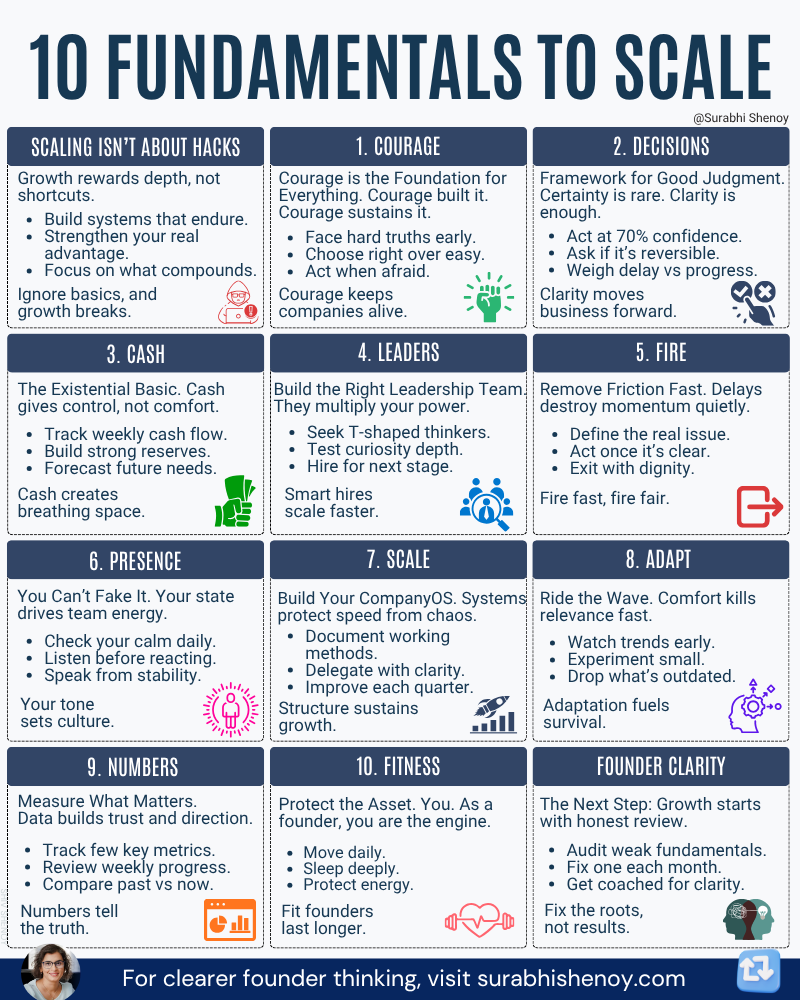
Looking Back at All 10
Three things became clear as I selected and worked through these 10 fundamentals.
- The fundamentals interact. Cash gives you decision-making power. Presence amplifies or undermines everything from courage to numbers. Fitness is the foundation under all nine of them. These fundamentals are a living system that works as a whole.
- Timing matters. You need different fundamentals at different stages. Early stage: courage, decisions, and cash dominate. Growth stage: hire, scale, adapt become critical. Mature stage: numbers and presence determine longevity. But fitness is foundational at every stage.
- ‘Presence’ surprises me most. Founders understand it intellectually but massively underestimate their own impact. I ask, “Do people feel calm or anxious around you?” Most say calm. But their teams see them as moody. Your internal state is your company’s cultural weather system. At scale, you can’t fake calm. You have to be calm.
Final Thoughts
The hardest part of all 10 isn’t understanding them. It’s doing them.
The gap between knowing and doing is where my coaching helps. Learn more about my 1:1 CEO coaching.
You don’t need to work on all 10 at once. Start with the one creating the most friction right now — the decision you keep avoiding, the number you don’t actually track, the hire or fire you’ve been putting off.
Use the suggested framework. Fix that one constraint, and the rest of the business gets easier to move.